Literatur ist das Papier, mit dem sich jedes Arschloch putzt
AuerhausThe expression Literatur ist das Papier, mit dem sich jedes Arschloch putzt is Frieder’s deliberately vulgar dismissal of literature as a kind of toilet paper. First heard in a classroom discussion of what students would need later in life, the line returns in the narrator’s German Abitur essay, where he quotes Frieder without naming him. Its movement from spoken provocation to borrowed argument gives the phrase a role beyond insult: it becomes a compact way for the narrator to challenge the school exercise from within it.
Classroom Origin
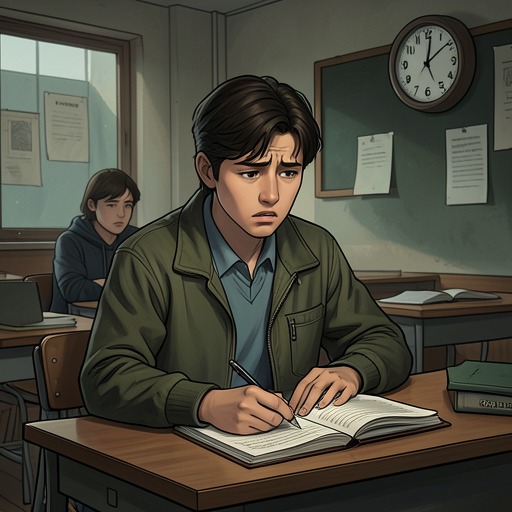
The remark follows a brief inventory of school subjects the narrator considers useful: circulation of the blood, the rule of law, and gross national product. Art and literature also appear on the curriculum, prompting Frieder’s blunt comparison. The narrator registers the line as extreme, while the classmates who carry on as usual form a contrast to the household’s and school’s altered attention around Frieder.
The phrase also exists in a variant recalled in the classroom account: Frieder calls literature the toilet paper every asshole wipes himself with. Both versions preserve the same abrasive metaphor, reducing literature from a cultivated subject to a disposable, bodily object. The shock comes partly from the mismatch between the school’s orderly list of useful knowledge and Frieder’s refusal to grant literature any elevated status.
Reuse in the Abitur Essay
Much later, near the end of his German Abitur essay, the narrator cites the line without identifying Frieder. The placement matters: this is the point at which students are expected to state their own opinion. The narrator borrows Frieder’s judgment as his own essay material, then needs to find a bridge from it to airplanes.
That bridge is not a new defense of literature. The narrator writes about airplane toilets once releasing waste directly into the air, where it froze and caused serious damage, punching holes in roofs and even in people’s heads. The grotesque practical consequence extends the earlier toilet-paper image into a literal argument about what gets expelled, where it lands, and whom it can hurt. The phrase’s crude register thus becomes part of the essay’s way of connecting literary criticism with a concrete, disturbing example.
Function and Significance
The expression’s force comes from its recurrence and change of setting. In the classroom it is Frieder’s abrupt counterstatement to the idea that literature belongs among the useful things students will need; in the exam essay it survives as an unattributed quotation inside the narrator’s effort to give an opinion. The narrator does not simply repeat the words: he turns them into a hinge for an argument that moves from literary contempt to the material consequences of waste.
The line also retains its roughness when carried into the formal setting of the Abitur. That friction makes the quotation more than a rebellious slogan: Frieder’s language enters an institutionally required exercise, while the narrator’s airplane example develops the image without smoothing away its offensiveness. The phrase’s afterlife therefore rests on two distinct acts—Frieder’s provocation and the narrator’s later reuse of it.