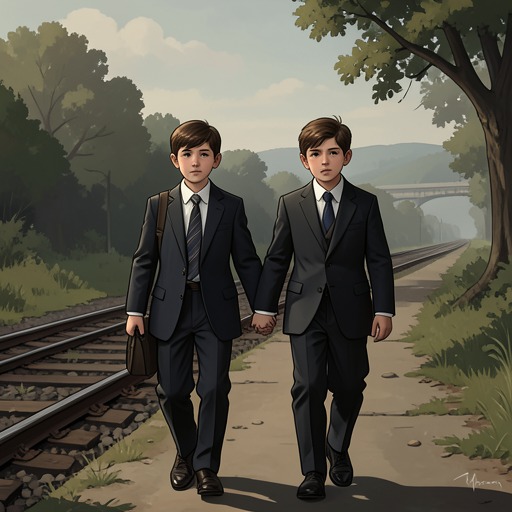
Frieder's first outing from the hospital and decision to move out
AuerhausFrieder’s first outing from the hospital and decision to move out begins as a supervised walk in the park and turns into a confrontation with the boundary between patient and ordinary town life. In the autumn scene, the narrator must decide whether to enforce the hospital’s limits or follow Frieder toward the city; at the railway bridge, Frieder stops and gives his reason for wanting to leave the park. The outing ends without a dramatic escape, but it points toward a more lasting change: Frieder proposes living in his deceased grandfather’s empty house, with his parents’ agreement on the condition that he not live alone. The episode makes his movement out of hospital inseparable from the narrator’s uncertainty about what safety, recovery, and freedom can mean.
Permission and Uneasy Responsibility
It is already autumn when Frieder is permitted to leave the ward for the first time. The permission is narrow: he may go only to the park, and only with an escort. The narrator is that escort, and the assignment feels less like a routine walk than an uncertain duty. The narrator assumes that Frieder must be considered well enough to go outside and notes that he is taking his medication, but neither fact provides confidence about what Frieder intends to do.
That uncertainty shapes the narrator’s sense of responsibility. He wonders whether he is expected to catch Frieder if he runs away. Before they set out, Frieder’s farewell to Pauline is unusually long and elaborate, not the sort of goodbye that suggests he will be back in an hour or two. Pauline asks the narrator to bring him back safely. Her request makes the escort’s role personal: the narrator is not simply accompanying Frieder, but is being asked to return him unharmed despite not knowing what he may choose.
The walk reaches the park exit, where Frieder says that he wants to go into town. The narrator’s panic is immediate and bodily, spreading through his body to his fingers, toes, and ears while he remains standing still. He warns Frieder that the hospital could take away the privilege of leaving if the staff found out. His fear is not only that Frieder will break a rule; it is that he will be held responsible for a choice he cannot control.
The Park Boundary and the Railway Bridge
The narrator tries to keep Frieder in the park, insisting that the hospital will probably allow him to go into town soon. Beyond the shrubs, the narrator can see the overhead railway wires; withered rose hips hang among the branches. A train approaches as Frieder quickens his pace toward an old pedestrian bridge. Because the railway line has already become a possible route to death in the narrator’s imagination, the scene makes an ordinary walk feel dangerously charged: he fears Frieder might jump in front of the train and believes that, if he did, the narrator would be to blame.
The bridge crosses both the tracks and a small river. On the far side lies the town centre and its pedestrian zone. Frieder puts a foot on the lowest step, then stops, gripping the handrail and breathing hard. He turns back and quietly explains that he wants to see something other than psychiatric patients. The reason is not framed as a declaration of recovery or a rejection of treatment; it is a wish for a different view of the world from the one defined by the ward and its patients.
Frieder sits on the steps as a freight train carrying brand-new Daimler cars on two levels rattles behind him. The train’s passage does not resolve the narrator’s fear by proving that Frieder is safe; rather, Frieder’s pause interrupts the movement toward the tracks. The two remain at the threshold between the park and town, while the narrator’s responsibility and Frieder’s desire for ordinary surroundings press against one another. In the later account of the outing, they return to the hospital rather than continue into the city.
A Life Beyond the Ward
The possibility of leaving the hospital takes a more concrete form when Frieder tells the narrator that his doctor thinks it would be good if he no longer lived with his parents. The plan is not to move permanently into the psychiatric hospital, as the narrator initially assumes. Frieder says that his grandfather’s house stands empty after his grandfather’s death the previous year, and that his parents have no objection to Frieder moving in there, provided he does not live alone.
The distinction matters. Frieder’s proposal is neither solitary independence nor a return to his parents’ home: it imagines a different living arrangement, in a house that belongs to his family history but is now empty. The narrator’s mistaken assumption that Frieder is moving into the hospital briefly collapses the alternatives into two choices—home with parents or continued confinement. Frieder’s explanation opens a third possibility, a life outside both settings with company still required.
The outing itself remains limited. The pair go back up the steps toward the hospital, and the narrator remembers turning to see sunlight fall through openings in the clouds onto yellow leaves. The bright, broken view accompanies no simple promise of cure; the move from ward to park, and the proposed move from parents’ house to the grandfather’s house, remain transitions rather than guarantees. What the episode establishes is a wish for a changed setting and a practical plan shaped by the condition that Frieder not be alone.
Trust, Risk, and the Limits of Knowing
The scene’s central tension is that the narrator has been given responsibility without access to certainty. Frieder is taking medication and has been allowed outside, yet the narrator does not know what he intends. A step toward the town can look like an attempt to escape, a search for ordinary life, or a danger near the railway; the narrator must react before he can know which meaning applies. His panic gives the outing its immediate stakes, while Frieder’s quiet explanation reveals a specific longing: not to be surrounded only by people identified as psychiatric patients.
Elsewhere, Frieder articulates the distinction between not wanting to die and not wanting to go on living. He also tells the narrator, after considering whether he would want to be rescued in a sudden life-threatening accident, that the narrator may save him because Frieder wants the choice to be his. These later statements do not supply a diagnosis of the earlier walk or settle what Frieder’s intentions were at the park exit. They instead clarify why the narrator cannot treat outward signs—permission to leave, medication, a quiet pause—as proof that the danger has passed. The outing’s small, consequential outcome is that Frieder stops at the bridge and returns, while the larger possibility it opens is a life arranged beyond the ward, but not without support.
Later Echoes
The proposed move gives the hospital outing a lasting place in Frieder’s story, but it does not become a neat account of recovery. The narrator later remembers moments when Frieder’s mood seemed impossible to read: sadness might be tiredness, while sudden happiness might mean that he had made a decision to die. The narrator also recalls Frieder riding his bicycle despite others hurrying ahead, and seeing him hanging from a rope in the barn when he is absent from school. Such later fears sit uneasily beside the earlier steps toward town and a new home; a desire for change does not make the narrator capable of predicting what Frieder will do.
After the narrator asks whether Frieder deliberately provoked the police officer into shooting him, Frieder says that he did. The narrator responds by striking him and demanding that Frieder not involve the others in a wish to die. That later confrontation makes explicit the burden already present in the first outing: care cannot give the narrator control over Frieder’s choices, and Frieder’s movements toward a life beyond the ward do not erase the possibility of self-destruction.
The narrator eventually says that the question of why Frieder first wanted to kill himself had grown faint through their conversations until it disappeared, even though no answer had been found. That unresolved account preserves the episode’s importance without turning it into a cure narrative. The first outing marks a real threshold—Frieder asks for more than the park, names what he wants to see, and later identifies a possible home—but its meaning remains bound to the uncertainty that made the narrator afraid to let him go.