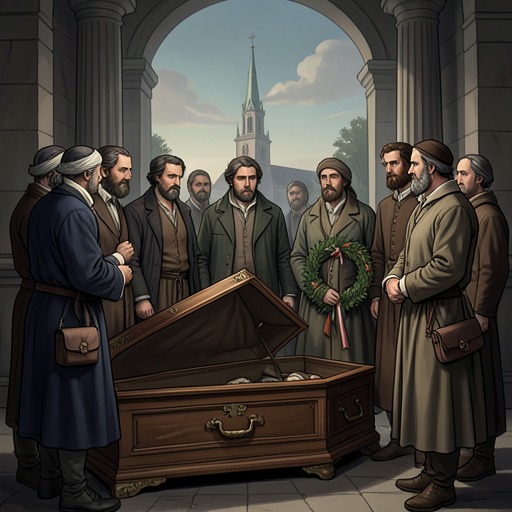
Frieder’s Funeral
AuerhausFrieder’s funeral is the friends’ final, hands-on encounter with his death: a ceremony in which the coffin must be carried, lowered, and faced, while ordinary objects are left behind as personal offerings. Its solemnity is repeatedly unsettled by the group’s awkward coordination and by the incongruous things placed on the coffin. The funeral gives physical form to the loss and to the vanished communal life at Auerhaus.
The Coffin Emerges
The gathering is silent as the narrator remembers how quiet chickens became on the truck taking them to the slaughterhouse. The comparison makes the crowd’s stillness uneasy rather than reverent. A loud clatter comes from the hall; someone unbolts the doors, and the priest and another man push out a wheeled stand. A collective sigh rises when the coffin appears.
The coffin is described as an enormous brown wooden box, its lid high enough that a corpse could sit upright inside. Bronze handles, compared to fat door knockers, give its sides a grotesquely domestic detail. The narrator’s blunt recognition that it is all true and finally decided follows the coffin’s arrival: what had been feared or resisted can no longer be held at a distance.
Frieder’s voice cuts through the silence with a request to open the lid because he cannot bear to see the mourners’ foolish faces. The remark makes his presence felt through the narrator’s account even as the coffin confirms his absence. The other man helping the priest is identified as Frieder’s father. Vera embraces him and speaks with him; when she returns, she tells the group that the pallbearers have not come.
Carrying and Lowering Frieder
With the expected bearers absent, Harry takes one of the coffin’s handles, and the friends and adults attempt to lift it onto their shoulders. Vera directs them to carry it that way. They are of different heights, so they keep changing places, circling one another like cyclists in a Belgian roundabout until the smaller people are at the foot end and the taller ones at the head: Vera and Frieder’s father in front, Harry and the narrator behind, with the priest and police chief Bogatzki between them.
The arrangement does not immediately solve the problem. Harry calls for a stop and crawls under the coffin to change sides with the narrator; the coffin tips backward, and the narrator has to lift it again as it wobbles. These practical failures do not dissolve the ritual. They show the mourners having to make the work of burial possible themselves, through repeated adjustment rather than ceremony’s imagined smoothness.
At the grave, planks laid across the opening support the coffin. The group raises it with thick ropes while the priest pulls the planks away, then lowers Frieder into the grave. The priest’s address is short, moving through Maundy Thursday, crucifixion, resurrection, and the taking away of sin. Vera and Harry have tear-swollen, exhausted faces; the narrator says they look like real adults. The funeral’s religious language and their visible grief meet in a scene where growing up is measured not by composure but by having to remain present.
Offerings at the Grave
After Frieder’s parents, Vera goes to the grave, takes a handful of sand, and throws it down. Harry follows, then the narrator. Looking into the exceptionally deep pit, the narrator sees the coffin become tiny. The widening distance makes the act of farewell feel less like a completed gesture than a separation that cannot be bridged.
A shuttlecock lies on the coffin, thrown there by Vera, beside a large, tightly rolled joint. Their placement brings the friends’ shared, unceremonious world into the burial space. The objects do not replace the formal service; they sit beside the priest’s religious words as recognizably personal traces of the living group.
The narrator does not want to throw sand onto Frieder. Instead, he lies on the earth and reaches as far down as he can, then lets his T-shirt fall onto the coffin. A white mark between the yellow cloth and the coffin startles him: for a moment he thinks he has failed to agree on a price, but it is only the laundry label. The small practical misunderstanding interrupts the solemnity without undoing it. Rather than a handful of earth, the narrator gives up something he is wearing, and the label makes the offering stubbornly ordinary.
The Funeral’s Aftermath and Meaning
The burial combines public forms—priest, parents, coffin, grave—with improvised acts by the young people who carry Frieder themselves. Its emotional movement is not from grief to resolution: the funeral makes the death undeniable, while the friends’ stumbling labor and personal offerings show how little ceremony can settle. The coffin is lowered, but the narrator’s reaching gesture registers the distance that remains.
The objects preserve different scales of memory. The towering coffin and deep grave make death monumental; the shuttlecock, joint, and T-shirt bring it back to the particulars of this group’s life. Even the narrator’s momentary fear about the price and the discovery of the laundry label keep the farewell bound to the material, unheroic world the friends inhabited. In that contrast, the funeral marks both Frieder’s absence and the end of the shared household: a final collective task carried out by people who must learn, in the act itself, how to bear what has happened.