Frieder’s Death
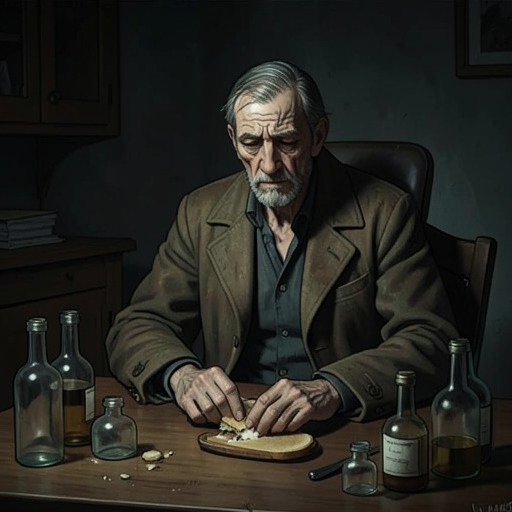
AuerhausFrieder’s death, revealed after the fact in a conversation among his friends, is the unresolved culmination of a story in which suicidal thoughts, apparent recovery, and the possibility of rescue never align into a reliable explanation. He had lain dead in his bed for several days before his landlady found him. His friends know that he died by suicide, but cannot establish the date or say with confidence whether the reasons were the same as those behind his earlier attempt; the uncertainty becomes part of how they remember him.
Discovery and the Public Account
The news reaches the group in the Ochsen, a dark-wood-paneled inn where afternoon sunlight falls in stripes across the walls. Harry responds, “That he still went through with it.” Vera allows another possibility about the manner of death: Frieder may simply have misjudged the dosage. Their comments register shock, but also the difficulty of distinguishing an intended outcome from a failed attempt or mistake after the person who could explain it is gone.
The account is stark in its few certainties. Frieder had been dead in his bed for a few days when the landlady discovered him. His parents’ death notice said, “After a long illness.” The narrator recognizes that this formulation was as true as it was false: it can name the long course of Frieder’s suffering, yet it also conceals the specific fact of his suicide. The doctor could no longer determine the date of death, leaving even that basic point beyond recovery.
Harry calls pills a bad method. Vera replies that when an attempt does not succeed, people assume it was only done to be rescued; the narrator counters that when it does succeed, it is called an accident. The exchange exposes a trap in interpreting suicidal behavior: survival can be taken as evidence that death was never intended, while death can erase the possibility of learning how certain or ambivalent the intention was. Neither explanation can now be tested against Frieder’s own account.
What the Friends Had Known
Before his death, Frieder had tried to distinguish not wanting to live from wanting to kill himself. He told the narrator, “I didn’t want to kill myself. I just didn’t want to live anymore. I think there’s a difference.” The distinction does not make his crisis simple or safe; rather, it gives language to a state that cannot be reduced to a settled decision or a single motive.
The group had learned how little outward mood could tell them. On one morning Frieder grinned tiredly as the others hurried to catch the bus, while the narrator went to school without him and could not stop picturing him hanging from a rope in the hayloft. The narrator had come to believe that Frieder would not use a gun or throw himself in front of a train, but such exclusions did not amount to knowing what he would do. They only gave fear particular images.
At another gathering, Frieder leaned against the refrigerator while the others watched him, Harry still lying on the kitchen floor and a kettle hissing on the stove. The narrator did not know whether Frieder was about to announce that he would never attempt suicide again or that he planned to kill himself that day. Even apparent cheerfulness had become difficult to read: sadness might be tiredness, while happiness might mean that Frieder had already decided. Frieder had once said that when someone who constantly thinks about suicide suddenly becomes cheerful for no reason, that person has made a decision. After his death, that observation makes cheerfulness feel ominous, but it does not establish what his own later good mood meant.
Rescue, Choice, and the Limits of Explanation
The friends had also talked explicitly about whether to intervene. The narrator asked whether Frieder would be angry if rescued from sudden danger, such as falling through ice. After thinking for a long time, Frieder said the narrator could rescue him, because he wanted to choose for himself. He then reasoned that someone who wonders what will happen without him must believe that he matters. His answer holds two positions together: a claim to decide for himself and an acceptance of rescue. It does not offer a rule that the others can confidently apply to every crisis.
After Frieder’s death, the narrator wonders whether the reasons for this suicide were the same as the reasons for the earlier, unsuccessful attempt. Repeated conversations had made the earlier question fade until it seemed almost to disappear; no answer had been found. The possibility that the same question remains unanswered after his death gives the friends’ recollections their shape. They can remember what Frieder said and how he appeared, but neither memory supplies a definitive motive.
A few days before he died, Frieder telephoned the narrator. The narrator felt that he was doing fairly well and remembers him as being in a genuinely good mood. In retrospect, that detail echoes Frieder’s earlier remark about unexplained cheerfulness, without proving that the call carried a warning or that the narrator could have understood it as one. The death therefore does not convert every earlier moment into a clear clue: it sharpens the friends’ attention to what they could not know at the time.
Narrative Significance
The revelation arrives through ordinary conversation—Harry’s blunt reaction, Vera’s qualification, the narrator’s reply—rather than through a recovered explanation from Frieder. Their words circle around the possible meanings of the method, the death notice, and the good mood before returning to the question of why he had wanted to die. That question, the narrator says, had already faded in the course of talking with Frieder; now the death gives it renewed weight without making it answerable.
The scene refuses to treat a successful suicide as proof of one simple intention, or an earlier attempt as proof that the person wanted to be saved. Frieder’s own statements leave room for both autonomy and rescue, while his friends’ interpretations remain fallible. Even the date is missing. What remains is not a final account of his reasons but a record of the limits of care and hindsight: the group had been close enough to ask, to listen, and to remember, yet not close enough to know what his final decision meant.