Oxford academic-dress regulations
BabelOxford academic-dress regulations govern the gowns, sleeves, caps, and related accessories through which Oxford students display their institutional and social position. In the student household at Number 4, Magpie Lane, Colin Thornhill presents the rules as a complete code of recognition: a man’s gown supposedly discloses what sort of man he is, making clothing an immediate social index rather than a private matter of taste.
The Code of Academic Dress
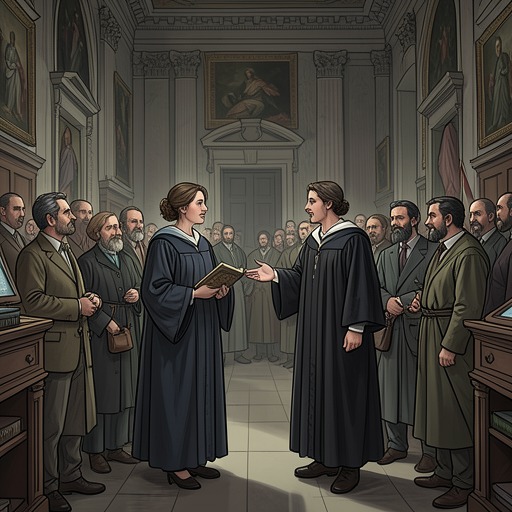
Colin distinguishes several forms of gown by their construction. A bachelor’s gown loops at the elbow and ends in a point; a gentleman-commoner’s gown is made of silk and has plaited sleeves; and a commoner’s gown has no sleeves but carries plaits at the shoulder. The difference between servitors and commoners is likewise marked by the absence of plaits on their gowns and the absence of tassels on their caps. These details make status readable through small, standardized differences in fabric, shape, and ornament.
The rules extend beyond the gown itself. Colin insists that proper academic dress is of the utmost importance because it displays the wearer’s status as an Oxford man. An ordinary tweed cap worn with a gown is treated as a serious breach, as is carrying a walking stick with a gown. His example of a supposed scholar being laughed out of hall after ordering the wrong gown shows the social danger of misclassification: the man had described himself as a scholar, but had won no scholarship and was merely a paying commoner. The regulations thus punish not only incorrect clothing but also a false claim to institutional standing.
Dress, Access, and Classification
The regulations have practical force as well as symbolic force. Colin states that students may not enter lectures without the proper attire, so the gown functions as a gatekeeping device. It identifies who belongs in an academic space before that person speaks, demonstrates knowledge, or participates in instruction. The clothing system converts an internal institutional category into an external inspection, allowing the university to sort bodies at the threshold of its buildings.
This sorting becomes visible when Ramiz Rafi Mirza asks what gowns he and Robin Swift should wear. He knows only that they have been given black ones and wants to confirm that they told their tailor the right thing. Colin responds by asking whether they are gentleman-commoners or servitors and what arrangement they have with the bursar. Ramiz’s uncertainty reveals that the newcomers have not yet mastered the social vocabulary encoded in their clothing, while Colin’s question reduces their identity to tuition, payment, and institutional classification. Bill Jameson cuts across the exchange by observing that Colin is very concerned with status, making explicit the hierarchy that Colin presents as neutral etiquette.
The exchange also marks a contrast between the two Babel students and the ordinary categories Colin knows. Edward Sharp says that they are neither gentleman-commoners nor servitors and identifies them as Babblers, adding that all Babblers are on scholarships. The word is new to Robin Swift. Their black gowns therefore place them within Oxford’s visible academic order without making their precise position intelligible to a conventional student. Their clothing signals belonging, but the category of belonging remains peculiar to Babel.
Assimilation and Institutional Control
The importance of dress is part of a broader process by which institutions remake Robin Swift for British civic life. Professor Richard Linton Lovell takes Robin to a physician, barber, hatter, bootmaker, and tailor, with each appointment altering or measuring the boy’s body for public incorporation. At the courthouse, a solicitor drafts papers intended to make Robin a legal citizen of the United Kingdom and a ward under Professor Richard Linton Lovell’s guardianship. Academic dress belongs to this same machinery of assimilation: it gives the transformed body a recognized appearance and places it within a hierarchy that claims to be orderly and civil.
The regulations also resemble Babel’s other systems of controlled access. Babel records scholars’ blood in labelled glass vials so that its wards can distinguish scholars from intruders, because the institution suffers repeated robbery attempts. Blood registration and academic dress operate differently, but both make membership legible through the body. One uses a hidden biological trace to open or secure doors; the other uses a public costume to determine who may enter lectures and what rank the wearer is presumed to possess. Together they show an institution that treats belonging as something to be verified, recorded, and displayed.
Meaning and Narrative Significance
The gown’s meaning is not inherent in cloth or color. It arises from a system of differences: sleeves versus no sleeves, plaits versus no plaits, tassels versus no tassels, scholarship versus payment. Colin’s intense attention to these distinctions demonstrates how cultural knowledge functions as social capital. Someone who knows the code can read and perform status; someone who does not may be exposed, ridiculed, or excluded even when dressed in the correct general form.
For Robin Swift and Ramiz Rafi Mirza, the regulations dramatize the distance between formal admission and genuine fluency in an institution’s habits. They possess the black gowns associated with Babel, but they initially lack the interpretive knowledge required to understand what other gowns mean. Their situation parallels Babel’s silver-working discipline, in which effective language requires more than recognizing words on a page: one must be able to think in and live through a language. Academic dress is a social language of its own. It does not merely cover the students; it demands that they learn how Oxford reads them, even as the institution reads their bodies before it hears their voices.
The rule system therefore exposes the tension between education as knowledge and education as controlled membership. Colin treats dress as etiquette, but the consequences attached to it make it administrative power. A wrong sleeve or cap can reveal a false position, prevent entry, and announce that the wearer has failed to inhabit the institution correctly. In this world, the gown is both uniform and credential: a visible promise that the body inside it has been classified, authorized, and made legible to Oxford.