Canton foreign-enclave confinement policy
BabelThe Canton foreign-enclave confinement policy is the Qing-controlled restriction that keeps foreign merchants, missionaries, officials, and soldiers inside the Thirteen Factories during the trading season. In the narrative, it is not merely a practical residence rule: it turns the foreign enclave into a bounded legal and social world, protects the commercial interests housed there, and dramatizes the unequal jurisdictions that will later make the opium dispute and the British mission to Canton so explosive.
Definition and Setting
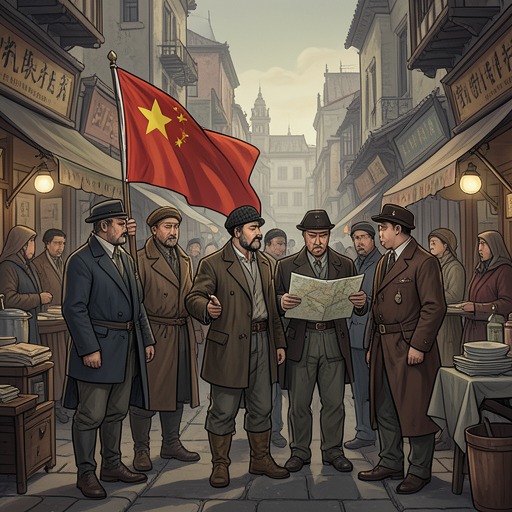
The policy operates through the Thirteen Factories, a row of thirteen Western-style buildings on the southwestern edge of Canton. Their recessed verandahs, neoclassical ornaments, and European flags make them appear like a transplanted strip of France or England rather than part of the surrounding city. Despite their name, the Factories are not manufacturing centres; they are residences and workplaces for the factors, or trade agents, along with merchants, missionaries, government officials, and soldiers during the trading season.
The New English Factory provides the delegation with a highly structured version of confinement. Robin Swift and his companions are led through a ground-floor warehouse, social room, and dining room to visiting chambers above, while the building also contains a library, rooftop terraces, and a riverside garden. The enclave therefore offers comfort, sociability, and commercial convenience, but those amenities exist inside a controlled perimeter rather than in unrestricted Canton. Its abundance helps conceal the coercive nature of the arrangement: the foreigners have nearly everything needed for life, provided they remain where they have been placed.
Rules and Enforcement
The restriction is stated directly by Mr Baylis, who warns the visitors that foreigners must remain within the foreign enclave and must not explore on their own. Even ordinary necessities are to be obtained inside the permitted zone: a corner of the Imperial Factory sells European goods, though its books are largely limited to nautical charts. The warning also distinguishes legitimate enclave commerce from prohibited movement, including the flower boats, which are expressly off limits. The policy thus regulates not only residence but access, circulation, commerce, and sexual contact.
The Factories are presented as the foreigners’ home from home, yet the phrase carries an unmistakable irony. Their European architecture, flags, warehouse systems, and social rooms create a miniature overseas environment within Canton, while the surrounding city remains legally and socially inaccessible. The enclave allows British interests to operate without granting them free movement. It is a compromise built on separation: foreign power is tolerated as trade, but contained as presence.
Robin Swift’s Breach of the Boundary
The rule becomes a personal and political challenge when Robin Swift, frustrated by Mr Baylis’s conduct during the day’s negotiations, announces that he wants to see the city. Baylis replies that foreigners are not allowed in Canton. Robin rejects the classification by insisting that he is not a foreigner because he was born there. Baylis has no answer, and Robin treats the silence as permission before taking his coat and leaving. Ramiz Rafi Mirza follows him, while Victoire Desgraves and Letitia Price watch from inside and Letitia briefly appears ready to rise before Victoire restrains her.
Robin and Ramiz Rafi Mirza walk the entire length of the Thirteen Factories and cross from the foreign enclave into the Cantonese suburbs. No official stops them or orders them back. Their passage reveals that the policy is neither an impenetrable physical wall nor a uniformly applied mechanism. It depends on recognition, compliance, and the presumption that those inside the enclave accept the identity assigned to them. Robin’s birth in Canton gives him a claim that unsettles the simple opposition between foreigner and local, while Ramiz’s presence demonstrates another racial distinction: Indian lascars are common in Canton and attract less attention than white foreigners.
The contrast with England is especially sharp. In Canton, Ramiz can move through the streets without peculiar comment, whereas his position in England has made him conspicuous. The same body is differently classified on either side of the boundary, showing that the policy belongs to a wider system of imperial and racial ordering rather than to geography alone. Robin’s walk is therefore both a search for the city of his childhood and an experiment in whether the rule’s categories can withstand lived experience.
Connection to Trade and Jurisdiction
The confinement policy forms part of the larger structure governing British trade with the Qing court. The delegation has been sent to negotiate for private companies, foremost Jardine, Matheson & Company, seeking open ports, wider market access, and the lifting of restrictions on imports such as opium. Qing authorities, wary of foreign influence, prefer to contain British and other foreign traders at Canton and Macau. The enclave is the spatial expression of that policy: trade may occur, but foreign presence is confined and conditional.
Earlier British attempts to obtain broader rights had failed through a combination of diplomatic insult, cultural misunderstanding, and force. The Macartney embassy of 1793 ended in failure after Lord George Macartney refused to kowtow to the Qianlong Emperor; the Amherst embassy of 1816 met a similar fate after Lord William Amherst refused to kowtow to the Jiaqing Emperor; and the 1834 Napier affair culminated in cannon fire and Lord William Napier’s death from fever in Macau. Professor Richard Linton Lovell presents the new delegation as different because Babel translators will lead the talks, but the enclave shows that translation cannot by itself remove the underlying conflict over who may enter, speak, trade, and exercise authority.
That conflict becomes explicit when Commissioner Lin questions the British delegation about opium. He points out that opium is prohibited with great severity in Britain itself and asks whether that domestic prohibition does not demonstrate that Britain knows how harmful the drug is. He then states that foreigners who bring opium into China intending to sell it will be decapitated and that the property aboard the ship will be confiscated. Mr Baylis answers by claiming that British citizens and British property cannot fall under Chinese authority, while Commissioner Lin insists that the delegation is standing on Chinese territory and that Chinese laws will be enforced there. The enclave’s restricted space thus becomes the setting for a direct collision between Qing jurisdiction and British claims of extraterritorial privilege.
Political Significance and Aftermath
The policy’s significance lies in its double function. It limits foreign movement, but it also concentrates foreign commercial power in a compact and privileged district where merchants can organise, entertain, store goods, and pursue trade. The thirteen buildings are both confinement and infrastructure: the same boundary that prevents foreigners from freely entering Canton enables an organised foreign presence to remain embedded at its edge.
Robin’s escape into the city exposes the instability beneath that arrangement. The rule presents identity as fixed—foreigner inside, Cantonese outside—but Robin’s birth, language, and personal history make the boundary difficult to enforce consistently. Ramiz’s unremarked passage adds a second contradiction, since racial visibility changes according to place and imperial hierarchy. The enclave therefore appears less as a neutral administrative solution than as a system that sorts people into legally meaningful categories and relies on those categories being accepted.
The later confrontation over Commissioner Lin’s authority gives the rule its broadest consequence. British negotiators demand commercial freedom while denying the Qing court the right to regulate British citizens and property; Qing officials permit trade while asserting control over Chinese territory and the conduct of foreigners within it. The foreign-enclave confinement policy is the everyday form of that unresolved contradiction. It turns architecture, residence, and movement into instruments of diplomacy, and it foreshadows the war that follows when the British insist that commercial interests should override Chinese law.