Babel blood-ward registration system
BabelThe Babel blood-ward registration system is the security and membership procedure through which Babel identifies its scholars by their blood. New students are required to provide samples that are stored in labelled glass vials, allowing the tower’s wards to recognise authorised bodies and exclude intruders. The procedure presents belonging as an administrative fact, yet its physical intimacy reveals a harsher truth: Babel does not merely enrol minds or record names; it claims material evidence from the bodies it admits.
Procedure and Registration
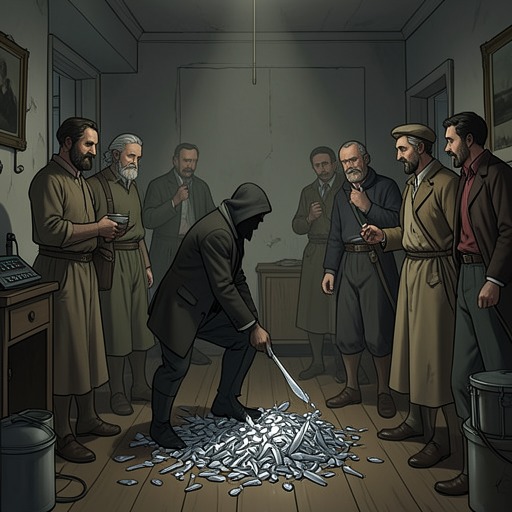
The system is introduced to Robin Swift, Ramiz Rafi Mirza, Victoire Desgraves, and Letitia Price after their initiation into Babel’s silver-working community. Professor Jerome Playfair leads them into a small, windowless room hidden behind the lobby shelves. The room contains a plain table, four chairs, and concealed drawers built into the stone wall. When Playfair opens the top drawer, the students see stacks of tiny glass vials, each marked with the name of the scholar whose blood it contains.
Playfair explains that the samples are needed for the tower’s wards. Babel experiences more attempted thefts than all the banks in London combined, and its doors must do more than keep ordinary trespassers outside. Hair and fingernails were tested as identifying materials but proved too easy to steal. Blood is harder for an intruder to obtain and therefore offers a more dependable means of distinguishing scholars from outsiders. The system converts a biological trace into an institutional password without requiring the students to carry a visible token.
The students are not given a meaningful opportunity to refuse. Playfair produces syringes from a lower drawer and instructs them to roll up their sleeves. Robin volunteers first because he does not want to endure the anticipation of watching the others. Ramiz follows, then Victoire, and finally Letitia, who becomes visibly green before the needle leaves her arm. The entire collection takes less than fifteen minutes, after which four new vials are added to the drawer in neat, tiny handwriting.
Blood as a Ward of Belonging
When Playfair locks the drawer, he tells the four students that they are now part of the tower and that the tower knows them. His language makes registration sound like a ceremonial admission, but the ceremony is also a surveillance act. The vials preserve their identities in a form that can be tested by the building itself, binding their access to Babel to a material sample held in its walls.
The procedure therefore joins two meanings of membership. On one level, it confirms that the students have entered the institution as scholars. On another, it places their bodies under institutional custody. A name on a vial is both a record and a condition of access: the student is recognised because Babel possesses something taken from the student. The system’s bureaucratic neatness, with its drawers, labels, and routine instructions, disguises the coercive force of that exchange.
The mechanism also reflects Babel’s wider belief that language and identity can be operationalised. Elsewhere, silver-working depends on deep fluency: words require someone who can think and live in a language, not merely recognise marks on a page. The blood wards apply a parallel logic to people. Just as a silver bar needs the right linguistic knowledge to function, the tower’s protective system needs a bodily sign that can distinguish an authorised scholar from a thief. Admission is consequently both intellectual and biological.
Defensive Power and Violence
The students later discover that the blood-based registration system is only one part of a much more aggressive security structure. A thief attempting to enter Babel is struck by the wards and dragged from the building by police with approximately five bullets in him. The incident shocks Robin, who had not understood that the wards themselves could inflict such damage. Anthony Ribben explains that Babel contains roughly half a million pounds’ worth of silver and is defended by scholars rather than soldiers, making its doors and wards essential to its protection.
The exact match-pairs powering the wards are kept secret. Professor Playfair updates them every few months, apparently in response to the frequency of attempted thefts. An earlier configuration tore deep wounds in a trespasser’s limbs with ancient knives reputedly from Alexandria, leaving blood on the interior carpet. The changing match-pairs demonstrate that Babel’s security is not a fixed charm but a maintained technical system, administered by specialists and withheld from ordinary members. Its violence is therefore both magical and bureaucratic: someone must choose the mechanism, install it, revise it, and preserve its secrecy.
The system’s limits are also implied by the principles of silver-working. Words cannot produce arbitrary transformations, and their effects depend on meaningful relationships between languages and on the presence of fluent speakers. The blood ward similarly depends on an institutional interpretation of legitimacy. It is not enough for a person simply to reach the door; the tower must classify the person and the purpose of the passage before permitting entry.
The Wards Learn Suspicion
The most consequential development occurs when Professor Playfair changes the wards. Ramiz Rafi Mirza and Victoire Desgraves attempt to leave Babel carrying six silver bars, two old books, and an engraving stylus, objects that scholars regularly take home at the end of the day. This time, however, the wards do not merely identify who and what is crossing the threshold. They detect whether the passage is legitimate.
A web of glistening silver string traps Ramiz and Victoire just outside the front door. New strands multiply before Robin Swift’s eyes, wrapping around wrists, waists, ankles, and throats. Ramiz’s neck and hands are tightened in the web, forcing Robin to pull him free before helping Victoire. Robin himself becomes entangled while assisting them, and the web appears to release one person only by taking hold of another. Its lashing stops only after whatever match-pair triggered the alarm has been satisfied or otherwise calmed.
This alteration transforms the registration system from a passive identity check into a judgment about intention. The tower now distinguishes not only recognised scholars from intruders, but permitted conduct from suspicious conduct. The change exposes the political danger concealed within the language of security: once an institution claims the power to determine whether a purpose is legitimate, membership no longer guarantees safety. Scholars can be recognised by the tower and still be treated as threats by it.
Institutional Meaning
The Babel blood-ward registration system embodies the institution’s method of converting vulnerability into administration. The students’ blood is collected through a short, orderly procedure, entered into a labelled archive, and used to protect an immense concentration of valuable knowledge and silver. Yet the same institutional logic that promises safety also makes bodies legible to an impersonal authority and gives that authority permission to punish misclassification or suspected disobedience.
Its significance extends beyond physical security. The blood vials create a record of who belongs, while the wards decide who may pass, what may be carried, and whether a movement is judged legitimate. In this sense, the system links identity, knowledge, property, and discipline. Babel’s claim to be a modern university coexists with a more ancient image of the tower as a place where transformation is made through hidden forces. The result is an institution whose doors know its scholars intimately, but whose knowledge of them can become a weapon.