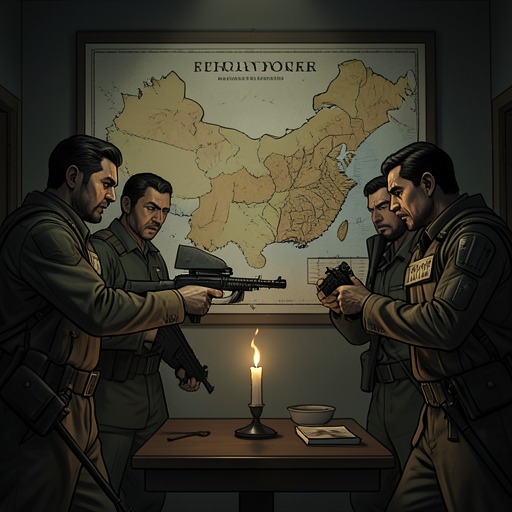
Qing opium prohibition
BabelThe Qing opium prohibition is the Qing government’s attempt to make the importation and sale of opium an enforceable capital crime rather than a nominal restriction. In the narrative, it becomes the decisive counterweight to the British demand for unrestricted trade: Commissioner Lin Zexu treats opium as a harmful foreign commodity and insists that foreign merchants must obey Chinese law, while British commercial interests recast enforcement as an assault on British property and national honour. The prohibition therefore exposes the legal asymmetry beneath the language of free trade and helps propel the Opium Crisis toward military confrontation.
Purpose and Legal Basis
The prohibition emerges within a long conflict over trade, jurisdiction, and foreign access to China. British merchants, particularly Jardine, Matheson & Company, seek open ports, broader market access, and the removal of restrictions on imports including opium. The Qing court, wary of foreign influence, has maintained restrictions that confine British and other foreign traders to designated commercial spaces at Canton and Macau. The new prohibition rejects the assumption that commercial preference can override those restrictions or that foreign traders possess an independent legal status beyond Qing authority.
Commissioner Lin Zexu states the principle directly during negotiations. Britain itself prohibits opium with great severity, and that domestic prohibition demonstrates that British officials understand the drug’s harm. His argument turns the British delegation’s economic language back upon itself: if opium is dangerous enough to forbid at home, its sale cannot plausibly be represented as a benefit to China. He also contrasts the imported drug with Chinese exports, asking whether China has sent Britain anything equally harmful or sold it anything other than goods for which British demand is high. The prohibition is thus presented not as arbitrary hostility to trade but as a response to a commodity whose social damage is known to the traders seeking to profit from it.
Enforcement and Jurisdiction
The measure is defined by its threatened penalty. Commissioner Lin explains that the new law is about to be put into force and provides that foreigners who bring opium into China intending to sell it will be decapitated, while every property aboard the offending ship will be confiscated. The severity of the sanction makes the prohibition more than a paper restriction: it claims the authority to punish foreign bodies and seize foreign commercial assets within Chinese territory.
That claim produces the central legal confrontation of the scene. Mr Baylis objects that the people involved are British citizens and that the cargo is British property. Lin rejects the distinction, treating foreigners who knowingly engage in prohibited trade as criminals rather than as protected merchants. When Baylis insists that British people do not fall under the Commissioner’s jurisdiction, Lin answers that the meeting is taking place on Chinese territory and that Qing authorities will enforce their laws as they see fit. The exchange establishes two incompatible legal orders: British commercial representatives invoke nationality and property, while the Qing commissioner invokes territorial sovereignty and the universal application of Chinese law.
Translation makes the conflict audible but does not resolve it. Robin Swift conveys Baylis’s demands, while William Botelho translates Lin’s replies into English, producing a conversation passed through four people rather than a direct exchange. The arrangement reveals translation as an instrument within the dispute: it allows each side to state its position, but the underlying disagreement concerns who has the right to define the terms under which those words become legally effective.
Confiscation and the Opium Burning
The prohibition’s most visible enforcement occurs when Commissioner Lin orders the collected opium destroyed. From the English Factory, Robin Swift and the others see what first appears to be a catastrophic fire across the water. The flames are controlled, however, concentrated around chests placed on deep-bellied boats pushed into the shallows. The sickly sweet smell carried through the windows identifies the cargo before the sight is fully understood: Commissioner Lin is burning the opium.
The destruction transforms the prohibition from a threatened rule into a public act of state power. The fire does not merely prevent future sales; it removes the stock already surrendered or confiscated and makes its destruction impossible to interpret as temporary detention. For the British merchants, the loss is enormous. Mr Baylis describes more than twenty thousand chests, valued at nearly two and a half million pounds, as British property unjustly seized. The same act that Qing officials understand as lawful suppression of contraband is therefore represented by British interests as the destruction of commercial wealth requiring compensation or retaliation.
The scene also marks a reversal in political visibility. Before the fire, the British delegation can present the dispute as a negotiation over market access, apology, and compensation. Once the opium burns in full view, enforcement becomes an undeniable spectacle. Letitia Price’s horrified reaction and the fury of Professor Richard Linton Lovell and Mr Baylis register the event’s immediate emotional force, while the controlled nature of the fire underscores that it is deliberate policy rather than accidental disorder.
From Prohibition to War
British commercial representatives respond to the prohibition and the burning by demanding that the British government defend its citizens and property. Commissioner Lin has issued a proclamation banning English trade from Canton entirely, and Jardine, Matheson & Company use the resulting hostilities as grounds for war. Their argument is framed in nationalist terms: Britain must defend its honour or accept humiliation in the East. The House of Lords begins debating a military expedition, even though Parliament remains uncertain about committing national resources to a distant and unprecedented conflict.
The narrative makes clear that the dispute is not only about legal principle or merchant losses. Victory over China would give the British Empire access to what is described as the world’s greatest reserve of silver, enabling faster warships and more powerful, accurate guns. The prohibition consequently stands at the intersection of drug control, commercial expansion, imperial finance, and military planning. What British advocates call the defence of trade becomes a possible route to extracting resources and expanding imperial power across Africa, Asia, and South America.
The later discovery of military documents confirms how rapidly enforcement has been translated into preparations for invasion. Letters contain detailed sketches of Canton’s docks, lists of Chinese naval vessels, descriptions of forts and coastal defences, and precise counts of ships and troops. Professor Richard Linton Lovell appears among the most hawkish voices, arguing for the benefits and ease of war and anticipating access to extensive linguistic resources after a British victory. The prohibition thus exposes the coercive structure behind the supposed commercial negotiation: when Qing law blocks the desired trade, British merchants and their allies begin treating military force as the next instrument of policy.
Narrative and Historical Significance
The Qing opium prohibition gives the Opium Crisis its clearest test of competing claims to legality. The British side presents free trade, nationality, and property as principles that should limit Qing action; Commissioner Lin insists that foreign merchants operating in China remain subject to Chinese law. Neither side is merely disputing a tariff or a shipment. They are contesting whether commerce creates rights that supersede territorial sovereignty, and whether a state may destroy a profitable commodity it considers socially destructive.
Its significance is sharpened by the contrast between administrative language and physical consequence. The rule is discussed through interpreters, proposals, and legal warnings, but its meaning becomes concrete in the fire, the confiscated chests, the severed trade at Canton, and the prospect of warships. The prohibition also links distant institutions: the Qing court and Commissioner Lin, the English Factory, Jardine, Matheson & Company, British Parliament, and the imperial military apparatus. By the time Professor Playfair is challenged over what happened to Richard Lovell, the prohibition has become part of a wider revelation that the war was being designed through intelligence, commercial pressure, and political lobbying. Its decisive function in the story is therefore to show how an attempt to enforce domestic law can be converted by an imperial power into a justification for conquest.