Resonance
BabelResonance is the power-distribution system that allows Babel to operate silver bars made with a higher proportion of alloys. Its rods form a centralized network in which the Institute acts as the centre and resonance-dependent bars across England act as the periphery. By reducing the need to reactivate every distant bar constantly, the system extends Babel's influence into transport, public utilities, communications, commerce, and imperial infrastructure; by making those systems dependent on a tightly controlled centre, it also creates a single point of catastrophic failure.
Definition and Construction
Resonance first appears through a failed resonance link in an older match-pair. Professor Chakravarti and Robin inspect the bar under a hand-held microscope, find no erosion in either its Chinese or English calligraphy, and still cannot activate it even after Chakravarti works over it with his smallest engraving stylus. The failure establishes that a bar may remain physically intact while its connection to the larger system has ceased to function. Resonance is therefore not simply an inscriptional property of an individual object; it is a relationship between bars, rods, trained maintenance, and the institutional network that sustains them.
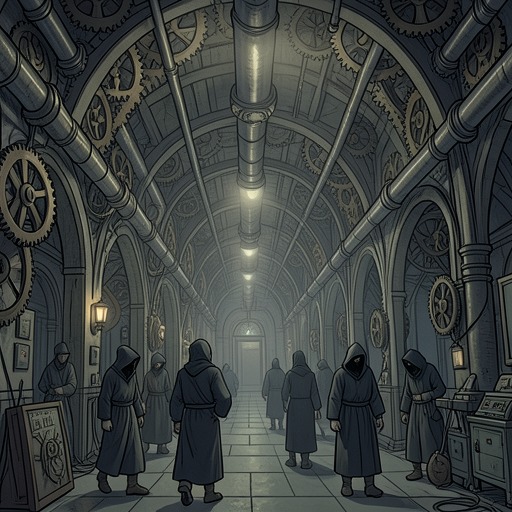
The system is housed in a chamber that resembles a fun-house exhibit or the interior of a giant piano. Massive silver rods of different lengths and heights stand throughout the floor, some reaching only to the waist and others extending almost from floor to ceiling, with narrow passages between them. They resemble church organs, although their apparent high-frequency vibration produces no audible sound. The rods are engraved with commonly used match-pairs and carry additional letters and symbols that Robin cannot initially decipher. Their material presence makes an otherwise invisible system visible: the quiet room contains the active centre of a network spread across the country.
Operation and Imperial Infrastructure
Professor Chakravarti describes Resonance as a means of cutting costs. Higher-carat silver must be reserved for bars requiring endurance, including those used by the Navy to protect merchant ships. Bars operating on English land can instead contain a higher percentage of alloys, provided that they remain fuelled through Resonance. The arrangement therefore depends on a distinction between durable bars for exceptional or maritime demands and cheaper, maintenance-dependent bars for everyday domestic infrastructure.
Babel is the centre, while the resonance-dependent bars in England form the periphery. The rods supply the manifesting power, allowing distant bars to function without such constant reactivation. The analogy to British outposts calling upon the home country for soldiers and supplies exposes the political shape of the technology: the network does not merely distribute energy but reproduces a centre-periphery relationship associated with empire. Smaller resonance centres exist in Edinburgh and Cambridge, and the effect weakens with distance, but Oxford contains the lion's share because maintaining multiple major centres would require more trained translators than the Royal Institute of Translation can provide.
Resonance gives London its mechanical heartbeat and underwrites a broad material system whose silver is visible in the wheels of cabs and carriages, horses' hooves, buildings, shopfronts, streets, and clock towers. The same logic reaches beyond the capital. Babel's first working telegraph line in England, established by July 1839 between Oxford and the British Foreign Office in London after Samuel Morse was brought to Oxford, demonstrates that the Institute's technical culture is capable of incorporating pure electricity even though the silver-working department is built around language-based match-pairs. Resonance thus belongs to a wider history of infrastructure in which translation, metal, communications, and imperial administration reinforce one another.
Withdrawal and Cascade Failure
The political danger of Resonance becomes concrete when Robin explains the system to Victoire and proposes removing its centre. At first, the plan appears limited: he pulls the nearest rod from its fixture and proposes beginning with two dozen rods. The rod slides out with surprising ease, without resistance, noise, or any visible transformation. Victoire removes a second and then a third. The apparent simplicity of the act contrasts with the scale of the network it interrupts.
The consequences begin with Magdalen Tower. It falls the morning after the strike. The tower, Oxford's second-tallest building, had depended since the eighteenth century on silver-facilitated engineering techniques that compensated for centuries of soil erosion at its foundations. Babel scholars were supposed to reinforce its supports every six months, in January and June, but the maintenance could not be completed after the faculty's displacement. Professor Playfair had overseen those reinforcements for fifteen years, and his notes were locked in his office, inaccessible to the exiled faculty; the city council had expected him at the appointment, unaware that he was in hospital and unconscious under laudanum. The collapse reveals that Resonance's danger lies not only in deliberate removal but also in the administrative fragility of its maintenance regime.
The wider breakdown is rapid. On the following day, all the bell-tower clocks stop at exactly 6.37 in the morning. Silver-facilitated sewage systems cease to move, leaving an immobilized mass of sludge and sending a great stink over Oxford. That evening, the city's lamp-posts fail one after another until every light on High Street goes out, plunging Oxford into its first completely dark night since gas lamps were installed two decades earlier. These failures make the invisible network legible through absence: time, sanitation, and public illumination had all been quietly delegated to silver-working.
By the third morning, transport begins to fail. Speed-based match-pairs, drawing on Latin and occasionally Old Slavic meanings associated not only with rapidity but also with hope, fortune, and reaching a destination, had allowed carriages to travel quickly without accidents. Once the bars stop working, drivers who have grown accustomed to letting the technology manage difficult turns cannot compensate. Oxford's roads fill with overturned wagons and cabs, while a family of eight in the Cotswolds falls into a ravine after a driver fails to negotiate a turn. The postal system collapses as well: bars engraved with the French-English match-pair parcelle-parcel had made heavy postal loads seem a fraction of their real weight, but without that assistance postal carriages must carry loads three times heavier than expected and collapse mid-route.
Manufactured Dependence and Political Meaning
Professor Chakravarti explains that the failures are not accidental consequences of an otherwise neutral design. Babel deliberately made Oxford dependent on the Institute. Bars were designed to last only several weeks rather than months because maintenance appointments generated revenue. The system therefore combines technological sophistication with artificially produced scarcity: it shortens durability, creates recurring demand, and makes the population dependent on the institution that controls the expertise and records required for repair.
That dependence extends to London and the national economy. Silver powers the ice-making machines of wealthy kitchens, brewery engines, flour mills, and locomotives; without it, railway construction stops, water becomes foul, and air thickens with grime. The mechanized processes of spinning, weaving, carding, and roving would bring the British textile industry to a complete halt, while silver-dependent plough-frames, seed drills, threshing machines, and drainage pipes threaten food production in the countryside. Regional centres in London, Liverpool, Edinburgh, and Birmingham can temporarily soften the effects, but they cannot replace Oxford's capacity, particularly because they lack the same maintenance ledgers.
Resonance consequently exposes the contradiction at the heart of silver-working modernity. The system makes cities faster, brighter, cleaner, and more interconnected, but its convenience conceals a political arrangement in which a central institution controls the knowledge, materials, maintenance schedules, and points of access on which the periphery depends. The same centre-periphery model that Robin associates with British colonial administration is reproduced inside the infrastructure itself. A network built to save silver and lower operating costs becomes a mechanism for concentrating power.
Global Context and Significance
The vulnerability of Resonance is inseparable from the global circulation of silver. Griffin explains that silver became an international currency after the Hapsburgs discovered extensive deposits in the Andes and extracted them through the labour of Indigenous miners who were not fairly paid. Spanish wealth purchased printed cotton from India and supported the purchase and exploitation of enslaved Africans on colonial plantations. In the present crisis, silver flows toward China, where British demand for porcelain, lacquered cabinets, silks, and tea is not balanced by Chinese demand for British manufactured goods. The thirty million pounds' worth of tea exported from China to England each year is paid for in silver, while British imperial power depends on the reserves it is steadily sending away.
Ramy makes the connection between this monetary system and lived colonial violence explicit through his memory of an opium plantation in West Bengal owned in part by his guardian, Sir Horace Wilson. The scarlet fields of Bengal, Bihar, and Patna supply opium that is packed in Calcutta and sold under the brands Patna and Malwa before being shipped onward. Robin then sees a web linking Indian cotton to Britain, Indian opium to China, Chinese silver and tea to Britain, and the profits of trade to colonial labour and pain. Resonance is the local technological form of that larger web: it converts extracted materials and specialized language into systems that appear autonomous until their dependencies are interrupted.
The destruction of the rods therefore does more than disable equipment. It turns infrastructure into an instrument of resistance and reveals the empire's material foundations as contingent rather than natural. Two dozen removed rods can expose the scale of a network that normally disappears into ordinary life, while a fallen tower, stopped clock, blocked sewer, dark street, overturned carriage, and collapsed postal wagon show how technical dependence transfers risk from its designers and owners to an entire city. Resonance is both Babel's achievement and its structural weakness: the device that keeps the periphery alive also makes the centre indispensable, and makes the centre's withdrawal capable of bringing the surrounding world down with it.