Translation as betrayal
BabelTranslation as betrayal is the book’s central account of why no act of translation can carry a text across languages without changing it. Translation is necessary for communication, yet it is never neutral: the translator selects meanings, adjusts tone, negotiates incompatible legal and cultural assumptions, and may be compelled to make one party intelligible on another party’s terms. The concept therefore links the technical difficulties of language to the political consequences of empire, especially when Robin Swift serves as an interpreter between British merchants and Commissioner Lin in Canton.
The Linguistic Problem
Professor Jerome Playfair develops the concept through the ordinary vocabulary of translation. German words such as schlecht and schlimm may both mean “bad,” but their different uses cannot be recovered by translating each word in isolation; similarly, French fleuve and rivière do not map neatly onto a single English equivalent, and the French esprit cannot be transferred without deciding which aspect of its meaning matters in context. Translation must therefore evoke how words fit into an entire passage rather than simply replace them one by one. The problem is not a minor imperfection in technique. It arises because words acquire meaning through relationships within particular languages and cultural histories.
Playfair extends this argument from vocabulary to the structure of language itself. Syntax, grammar, morphology, and orthography form what he calls the bones of a language, and these bones do not survive unchanged when a text is moved elsewhere. His example is Heinrich Heine’s “Ein Fichtenbaum,” in which a pine tree longing for a palm tree represents a man’s desire for a woman. German gender makes the masculine and feminine contrast part of the poem’s mechanism, while English lacks grammatical genders capable of reproducing that opposition. Even when the general image and theme are understood, an essential formal relation has already been lost. The translator must distort; the only remaining question is whether the distortion will be deliberate and critically understood or unconscious and politically convenient.
Fidelity, Visibility, and Betrayal
In Professor Playfair’s class, the technical question becomes an explicit debate about fidelity. Translators are accused of faithlessness, but the object of fidelity is unstable: a translator may claim loyalty to the text, the author, the audience, style, or beauty, and these loyalties can conflict. Playfair invokes John Dryden’s aspiration to make Virgil speak the English he would have spoken had he been born in England in the present age. Ramiz Rafi Mirza rejects that as an adequate model because it strips Virgil of the particular time and place that made him Virgil. Making an ancient author sound immediately familiar may be fluent, but familiarity can itself be a form of unfaithfulness.
The alternatives become clearer through the distinction between domestication and foreignization. Playfair recalls Johann Gottfried Herder’s attack on French neoclassicists for making Homer a captive dressed in French clothes and customs. He also notes that Persian translators often privileged the spirit of a work over literal accuracy, changing European names and replacing aphorisms with Persian verse and proverbs. These practices do not yield a single universal rule. A translation that preserves foreignness may force readers to acknowledge historical and cultural distance; one that naturalizes the text may make it accessible while concealing the work of adaptation. Friedrich Schleiermacher’s model leaves the author in peace and moves the reader toward the author, whereas dominant English practice moves the author toward the reader and attempts to make the translation disappear as a translation.
Playfair’s conclusion is not that one method is simply correct. He presses the class toward the recognition that every choice sacrifices something. Either the translator situates a text in its original time and place or brings it into the present world of the audience. When he asks whether faithful translation is impossible, Victoire Desgraves reluctantly accepts that communication across time and space cannot occur with complete integrity. Playfair then gives the dilemma its sharpest formulation: if the opposite of fidelity is betrayal, and translation necessarily warps and distorts an original for foreign, unintended eyes, translation is necessarily an act of betrayal. Robin’s meeting of Playfair’s gaze produces a physical sense of guilt, turning an abstract classroom proposition into an accusation that implicates his own work.
Translation as Imperial Labor
The book tests the concept outside the classroom by placing translation inside the commercial and legal machinery of the British Empire. Professor Richard Linton Lovell prepares Robin and his companions for a mission in Canton, where they are to negotiate on behalf of private trading companies, foremost Jardine, Matheson & Company. The negotiations concern free trade, access to ports and markets, restrictions on imports, and above all the opium trade. Earlier British delegations had failed through political and cultural misunderstanding: the Macartney embassy of 1793 and the Amherst embassy of 1816 were damaged by refusals to kowtow, while the Napier affair of 1834 ended in cannon fire and the death of Lord William Napier from fever in Macau. Babel translators are presented as the solution to these “fiascoes of cultural miscommunication,” but their linguistic expertise is recruited to advance commercial and imperial aims.
Robin’s value is inseparable from this institutional demand. Mr Baylis chooses him to interpret at an audience with the Commissioner because the available translators are scarce, while Professor Lovell explains that white men such as Baylis and Lovell are regarded as barbarians. Translation becomes a form of social and economic dependency: Western traders distrust government-licensed Chinese linguists as insufficiently skilled or insufficiently loyal, while foreign Chinese-speakers are rare because teaching Chinese to foreigners was officially punishable by death. Skilled translators such as Robin and Lovell are consequently “worth their weight in gold,” their schedules filled with meetings while Ramiz Rafi Mirza, Letitia Price, and Victoire Desgraves are sent from factory to factory to perform silver-work maintenance. The translator is not an invisible conduit but a valuable, monitored laborer whose access and usefulness serve institutions larger than himself.
The asymmetry becomes explicit when Anthony Ribben instructs Robin how to turn Professor Lovell’s letters into inflammatory pamphlets. Robin is told to avoid language about anticolonialism and national sovereignty, and instead to use terms such as scandal, collusion, corruption, and lack of transparency that will provoke an English readership without making the issue one of race. The political message is therefore translated not only between languages but between audiences and ideological vocabularies. Robin understands the assignment as translating material for white people, and Anthony confirms it. The episode shows betrayal operating at the level of framing: even accurate evidence can be redirected by choosing which moral vocabulary the audience is permitted to hear.
The Canton Audience
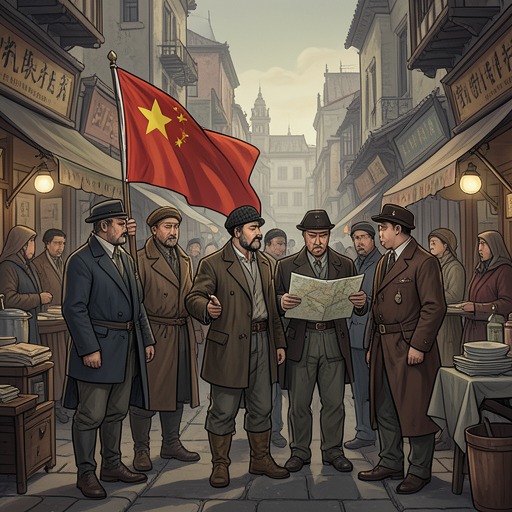
At Commissioner Lin’s audience, translation mediates a confrontation in which every party claims authority over the meaning of law, trade, and harm. Mr Baylis demands that agents of Jardine, Matheson & Company be allowed to sell opium legally, that the company receive an apology for earlier treatment, and that the twenty thousand chests of opium seized months earlier be returned or compensated. Robin reproduces the demands while trying not to reproduce Baylis’s loud, patronizing tone. He delivers them flatly, yet his reddening ears register the moral violence that neutrality cannot erase: the meeting feels less like dialogue than a lecture delivered to a supposedly inferior child.
Commissioner Lin answers by exposing the contradiction within the merchants’ argument. Britain prohibits opium for its own civilians, so its representatives know that the substance is harmful; China, by contrast, has not sent a noxious article into Britain but has sold goods for which Britain has great demand. Lin’s question forces the issue away from the merchants’ abstract language of free trade and toward the bodily and social consequences of the commodity. Because the exchange passes through William Botelho, Robin, and Baylis, none of the speakers directly addresses the person whose words are being heard. The layered circuit makes translation visible as an active structure rather than a transparent window.
Lin then states the new Qing law: foreigners bringing opium into China for sale will be decapitated, and the property aboard their ships confiscated. Baylis responds that British citizens and British property cannot fall under Chinese authority. Lin rejects that claim by insisting that criminals cannot invoke foreign ownership to escape the laws of the territory in which they act. The dispute demonstrates how translation can expose incompatible legal orders rather than reconcile them. A phrase such as British property carries one meaning within the merchants’ imperial assumptions and another within Qing jurisdiction; rendering the words accurately does not remove the conflict over who has the right to define the terms.
When Lin requests a private conversation with Robin, Baylis immediately objects that Robin has no company authority and is “just the interpreter.” Lin answers that he seeks only a casual conversation, but the request reveals the unstable position created by translation. Robin is officially secondary, yet his linguistic capacity makes him the person through whom the conflict may become intelligible. He is both treated as an instrument by the British delegation and recognized by Lin as someone whose presence might permit a less controlled exchange.
Ethical and Narrative Significance
Translation as betrayal gives the novel a vocabulary for the gap between apparent neutrality and actual participation. A translator may try to suppress a speaker’s tone, preserve a foreign text’s strangeness, or make a message persuasive to a chosen audience, but each decision redistributes meaning and power. The concept does not reduce translation to deliberate lying. Its force lies in showing that even conscientious work alters the relation among author, speaker, reader, and institution, while unequal political conditions determine whose alterations become law, commerce, or public truth.
The idea also explains why the book treats language as a companion of empire rather than a merely cultural accomplishment. British merchants need translators to make their demands legible in Canton; Qing officials use legal language to deny the merchants’ claim to exceptional jurisdiction; Babel’s translators are valued because their fluency can facilitate trade, negotiation, and intelligence; and Robin later helps reshape evidence for an English public by adopting the vocabulary that audience is prepared to recognize. Translation can carry meaning across conquered territory, but it can also carry the assumptions of the conquering power with it.
By the time Professor Playfair asks what happened to Richard Lovell, the theory has acquired an ominous narrative charge. Robin’s claim that Lovell helped engineer the war, gathered military intelligence in Canton, and maintained contact with Lord Palmerston is dismissed in the room as absurd. The scene recalls Playfair’s earlier warning that translators rewrite what they carry across, but it also shows the danger of being unable to control how one’s account is received. Translation as betrayal finally names a double bind: the translator may betray the source by changing it, yet may also betray the truth by making it acceptable to the audience, institution, or empire that controls the exchange.