Match-pair
BabelMatch-pair is the foundational unit of silver-working, pairing expressions in different languages so that the meanings lost, narrowed, or distorted in translation can be captured and made materially effective. It is the principle that allows Babel’s scholars to turn linguistic difference into power, while also binding that power to the histories and limits of the languages themselves.
Definition and Operation
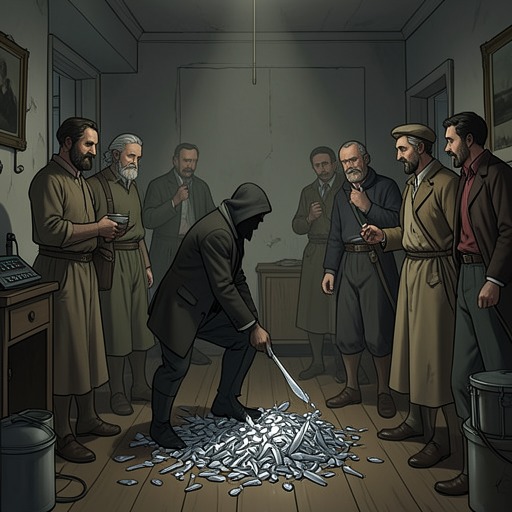
Professor Playfair explains Match-pair through a silver bar engraved with a word or phrase in one language on one side and a corresponding word or phrase in another language on the other. Translation can never carry meaning across perfectly; the residue of that imperfect transfer is caught by the silver and manifested into the world. The bar therefore does not create arbitrary miracles. It gives physical force to a relationship already present between the paired expressions, making the gap between them the source of its effect.
The principle depends on a fluent speaker. A translator must be able to invoke the languages without hesitation, which is why Babel’s students, described as the equivalent of Psammetichus’s boys, are valuable: their foreign birth and multilingual fluency allow them to activate forms of silver-working unavailable to ordinary people. The effect can endure after the translator leaves, but its duration depends on the bar’s concentration and quantity of silver, as well as the frequency and intensity of use. Bars containing more than ninety per cent silver last longer; cheaper versions often contain only a thin silver coating over wood or another inferior metal and need to be “touched up” after weeks.
Examples of Linguistic Distortion
The Greek kárabos demonstrates how a Match-pair preserves associations that disappear in a later language. Kárabos can mean “boat,” “crab,” or “beetle,” while the related word caravel means a quick, lightweight ship but retains only the nautical sense. When the bar is attached to a fishing ship, the surviving sea-creature associations give it a better catch than its sister vessels. The effect is powerful but bounded: prolonged use eventually reduces the fishing yield to its former level, because the bar can warp reality but cannot materialize new fish.
Another widely replicated bar pairs triacle and treacle. Playfair presents it as an example of how older meanings and etymological connections can stabilize the distortion captured by a bar. This process, called Daisy-chaining, follows older linguistic forms across centuries and distances, functioning as additional support for the Match-pair and helping identify the precise alteration being manifested.
A commissioned bar for the Duke of Wellington pairs the Greek idiótes with idiot. Idiótes can signify both a fool and a private person disengaged from worldly affairs, whereas idiot carries the diminished sense of lacking intelligence. The translation removes knowledge, and the bar can consequently make someone abruptly forget what they believed they had learned. Its military use is explicit: it can cause enemy spies to forget what they have seen. In this example, a semantic narrowing becomes an instrument of coercion.
Limits, Power, and Imperial Infrastructure
Match-pair cannot restore the dead because no suitable linguistic relationship has been found in which life and death are not opposed. The natural evolution of languages restricts the scale of transformation: even when meanings diverge, the paired words must remain sufficiently related. This limitation prevents silver-working from becoming unrestricted divine power, but it does not make the technique harmless. Match-pairs can improve harvests, erase knowledge, sustain engineering, and operate across national territory.
Babel extends their reach through Resonance. In a chamber resembling the inside of a giant piano, massive silver rods engraved with commonly used Match-pairs stand at different heights, vibrating silently. Babel functions as the centre and resonance-dependent bars across England as the periphery; the rods supply power so that distant bars require less constant reactivation. The arrangement resembles the imperial structure of British outposts calling on the home country for soldiers and supplies, turning a linguistic mechanism into a model of political and material dependency.
The same network makes local disruption capable of producing national consequences. When Babel’s systems fail, Magdalen Tower collapses because its weight had depended on silver-facilitated engineering supports maintained every six months. The failure then spreads through Oxford: clocks stop at 6.37 in the morning, sewage ceases to flow, and the gas lamps along High Street go dark. In London, silver-powered ice-making machines, breweries, flour mills, locomotives, textile machinery, plough-frames, seed drills, threshing machines, and drainage pipes all become vulnerable. Match-pair is thus not merely a magical object but part of a tightly coupled infrastructure whose maintenance records, expertise, and institutional access determine whether society continues to function.
Language, Silver, and Empire
The historical power of Match-pair is inseparable from the history of silver. Silver moved from ancient mining and Roman imperial expansion into the global currency system after the Spanish discovery of vast deposits in the Andes, extracted through the labour of Indigenous miners. That silver helped purchase Indian cotton, which helped finance the purchase of enslaved Africans for colonial plantations. Later, British demand for Chinese porcelain, lacquer, silk, and tea sent enormous quantities of silver toward China; at least thirty million pounds’ worth of tea was exported from China to England each year, while British manufactured goods found little reciprocal market there.
This circulation makes linguistic power part of a larger imperial system. Silver and languages accumulate in London, where the city becomes heavier, faster, brighter, and increasingly dependent on the resources it absorbs. The movement of goods forms a web: cotton travels from India to Britain, opium travels from India to China, silver becomes tea and porcelain in China, and value flows back toward Britain. Match-pair gives that web a linguistic infrastructure, allowing differences between languages to be converted into productive force while concealing the labour, slavery, colonial extraction, and poverty that sustain it.
The technique also exposes the instability of imperial power. British silver drains toward China because China does not require British goods, and the empire cannot solve that imbalance through translation alone. Once the silver reserves disappear, the system that gives Babel and British industry their reach will fail; resources may accumulate in places previously exploited, and silver-workers will follow the work. Match-pair therefore embodies both the empire’s domination and its dependence: Britain governs through linguistic and material networks that can ultimately turn against the centre.