Imperial extraction through language
BabelImperial extraction through language is the process by which Babel gathers the world’s languages and linguistic talent, transforms them into silver-working power, and directs the resulting wealth and force toward Britain. Its decisive significance is that it makes language neither an abstract medium nor a neutral form of knowledge: language becomes a resource, an industrial input, and a mechanism through which empire concentrates value at the centre while leaving the societies that supplied the knowledge with little or nothing in return.
Definition and Institutional Form
Babel presents itself as a centre of translation and learning, but its institutional history reveals a more political function. Anthony explains that translation agencies have served great civilizations as instruments of government: the Royal Institute of Translation was founded in London in the early seventeenth century and moved to Oxford in 1715, after Britain acquired territories formerly held by Spain and decided to train speakers of the languages of its new colonies. The tower therefore grew alongside imperial administration. Its scholarship is organized around the practical needs of rule, commerce, and expansion rather than knowledge detached from power. The Grammaticas make this hierarchy visible. The volumes are arranged by the Romanized names of languages and by publication date, with European languages occupying entire display cases while Chinese appears in only three volumes and Japanese and Korean in one volume each. Tagalog, by contrast, fills five volumes. The collection is not a balanced archive of world languages but a record of what Babel has chosen to translate, preserve, and exploit. Robin notices that the first authors of the Oriental-language Grammaticas are generally white British men rather than native speakers, so the languages that supply imperial power are also represented through British scholarly authority.
Language as Imperial Resource
Griffin gives the clearest political account of the system. Babel collects foreign languages and foreign talent as it hoards silver, then produces translation magic that benefits England alone. The most powerful bars depend on Chinese, Sanskrit, and Arabic, yet fewer than a thousand such bars exist in the countries where those languages are widely spoken, and even those are concentrated in the homes of the wealthy and powerful. Linguistic knowledge is thus extracted from one part of the world and converted into technological advantage in another. The unequal distribution is not an accidental shortage but evidence of a political economy in which Britain monopolizes both the finished instruments and the benefits they generate. The extraction is reinforced by trade and violence. Babel’s silver helps Britain pressure other countries into commercial agreements that keep wealth flowing toward London; the same bars then make British ships faster, soldiers hardier, and guns more deadly. Profit and coercion form a closed circuit: imperial agreements produce silver, silver strengthens the instruments of empire, and those instruments enforce further agreements. Griffin describes Babel not as an observer of colonialism but as its business, pointing to the Literature Department’s one-way translation into English and to interpreters sent abroad to serve imperial purposes. The example of Sir Horace Wilson, whose Sanskrit tutorials support Christian missionaries, shows how academic expertise can become an arm of religious and political expansion.
Unequal Circulation and Linguistic Scarcity
Anthony explains that the system also consumes the resource on which it depends. Languages affect one another, and as linguistic barriers become more porous, the semantic force required by silver-working weakens. Many of London’s bars rely on Latin, French, and German, but those languages have been translated so extensively that their returns are declining. Romance Languages is described as the most threatened branch of the faculty; Latin and Greek retain some power because elite fluency keeps them socially restricted, while attempted revivals of Manx, Cornish, and Gaelic appear unlikely to succeed. This logic makes colonial and semi-colonial languages especially valuable to Babel. Robin’s Chinese and Ramy’s Indian languages are called uncharted territory, languages that Britain has not yet exhausted and that everyone is fighting over. Anthony speaks of language in the same terms as gold and silver, noting that people have fought and died over the Grammaticas. The metaphor is literalized by institutional demand: Babel recruits students from other countries to work in its translation centre, yet their homelands receive no comparable share of the wealth. Robin eventually repeats this criticism directly, condemning the way Babel hoards materials and directs silver toward luxury and military production while people die from conditions the bars could remedy.
Infrastructure and Dependence
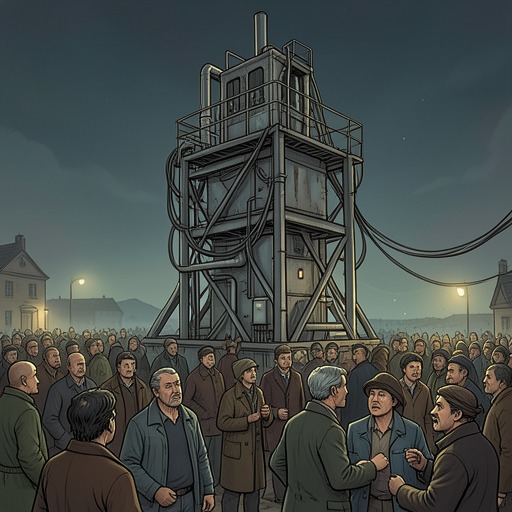
The imperial logic of language is embedded in an extensive material network. Professor Chakravarti explains that Babel is the centre and the silver-working bars throughout England are its periphery. Vibrating rods engraved with commonly used match-pairs sustain linked bars across the country, allowing distant installations to draw on the tower’s power. Robin compares this arrangement to British outposts in the colonies calling on the imperial centre for soldiers and supplies. The metaphor identifies the technical network as a miniature empire: authority and energy flow outward from Babel, while the outlying system remains dependent on the central institution. London’s mechanical heartbeat makes the dependence visible. Silver hums through cabs, carriages, buildings, clock towers, and commercial goods, producing an artificial metallic sound unlike the bamboo-based systems of Canton. The city is larger, faster, brighter, and more technologically powerful because it has accumulated the world’s silver and languages. Yet its wealth is inseparable from deprivation: London is at once unimaginably rich and wretchedly poor, a city growing fat on imperial spoils while still starved for more labour, capital, and culture. The telegraph demonstrates how linguistic extraction merges with modern infrastructure. After Samuel Morse’s device reaches Oxford, Babel scholars bring him to the Royal Institute of Translation, where the silver-working department is struck by a system operating without match-pairs and instead using pure electricity. By July 1839 Babel has established the first working telegraph line in England, connecting Oxford to the British Foreign Office in London. Professors De Vreese and Playfair develop an alphanumeric code capable of transmitting messages of any kind, and the resulting service draws businessmen, officials, and clergymen into a queue around the tower. A technology that initially escapes Babel’s linguistic system is quickly absorbed into the institution’s commercial and governmental machinery.
Diplomacy, Commerce, and Colonial Speech
The concept is enacted in the delegation to Canton. Robin, Professor Lovell, and their companions are sent to negotiate on behalf of private trading companies, foremost Jardine, Matheson & Company, because Babel translators are expected to prevent the cultural misunderstandings that damaged earlier British missions. Their assignment concerns free trade, wider market access, and the removal of restrictions on imports including opium. Translation is presented as a solution to diplomatic failure, but the demands being translated already belong to an unequal commercial project. At the New English Factory, the geography of power is made architectural. Thirteen Western-style buildings stand apart from Canton, containing merchants, missionaries, officials, and soldiers during the trading season. The Factories are not production centres but residences for agents of trade, a foreign enclave embedded at the edge of the city. Mr Baylis describes the opium bond as an intolerable burden and calls the confiscation of more than twenty thousand chests, valued at nearly two and a half million pounds, an unjust seizure of British property. Robin is required to translate demands that opium be sold legally, that an apology be issued, and that compensation be paid, converting commercial interest into the language of negotiation. Before Commissioner Lin, Robin tries to flatten Baylis’s loud and patronizing presentation into an emotionless translation, but the encounter exposes the limits of translation under imperial conditions. The meeting does not function as dialogue: Baylis continues speaking through the silence, insisting that Qing trade restrictions harm the Chinese and invoking free trade as the secret of national prosperity. Translation gives Robin technical power to carry words across languages, yet it does not equalize the parties. It can transmit demands while leaving the underlying distribution of force untouched.
Resistance and Consequences
Imperial extraction through language generates its own opposition. Griffin explains that Hermes exists to break the cycle by diverting silver to communities and movements that deserve it, aiding slave revolts and resistance movements and melting down bars designed for domestic luxury into instruments for curing disease. Hermes therefore contests not only Britain’s wealth but the assumption that Babel’s ownership of linguistic resources is legitimate. Its intervention treats silver-working as something that can be redistributed once the imperial institution’s claim to exclusive control is challenged. The vulnerability of the system becomes unmistakable when the supply of working bars is disrupted. Babel has deliberately designed bars to last only several weeks rather than months, making maintenance appointments a source of income and creating artificial demand. When that dependence is interrupted, transportation begins to fail: speed-based bars no longer assist carriages, accidents multiply on Oxford’s roads, and a family of eight falls into a ravine after a driver relies on horses and technology that no longer function as expected. Postal carriages collapse because parcels once made artificially lighter now weigh three times as much. Silver’s apparent convenience has concealed a manufactured fragility. The consequences extend beyond roads and mail. Silver powers London’s ice-making machines, breweries, flour mills, locomotives, textile machinery, plough-frames, seed drills, threshing machines, and drainage pipes. A prolonged interruption threatens rail transport, clean water, breathable air, industrial production, and even food supply. Regional centres in London, Liverpool, Edinburgh, and Birmingham can provide only a temporary substitute, especially because they lack Babel’s maintenance ledgers. The system’s failure thus reveals the political structure that ordinary prosperity hides: a local struggle over the control of linguistic labour can become a national crisis because the empire has centralized knowledge, maintenance, and material power in one institution.