Violence shocks the system
Babel“Violence shocks the system” is the central formulation of Griffin Lovell’s theory of anti-imperial action. It does not mean that a small insurgent force can defeat the British Empire in a conventional battle. It means that an empire built on extraction is vulnerable to disruption: if resistance interrupts a supply line, denies a necessary resource, or disables an essential institution, the resulting shock can travel through the entire system. The expression therefore turns violence from a measure of military strength into a method of exposing structural dependence.
Origin and Immediate Context
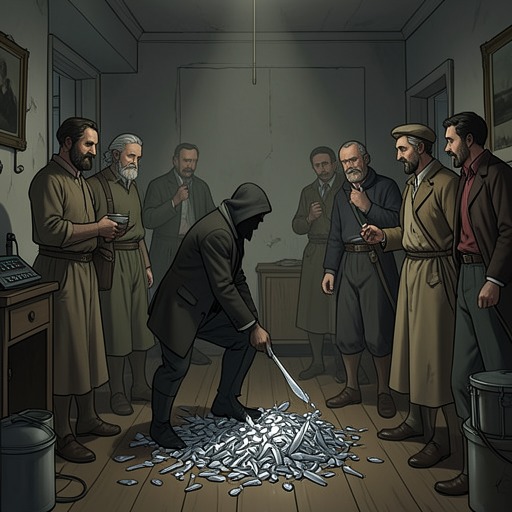
The phrase emerges as Griffin instructs Robin Swift in the use of a pepperbox revolver. Robin objects that he will never fire it, but Griffin replies that its importance lies in making someone believe he might. The weapon is thus both practical instrument and political symbol: its power depends not only on the damage it can cause but on the uncertainty and fear it introduces into an opponent’s calculations. Griffin rejects the faith in human goodness held by some of his colleagues and declares that decolonization must be violent.
Griffin’s argument develops from the conflict over the Opium trade and Britain’s planned war against China. British trading interests, foremost Jardine, Matheson & Company, seek wider access to Chinese markets, the removal of restrictions on imports such as opium, and compensation for more than twenty thousand confiscated chests. The demands are presented as commercial negotiation, but the documents Robin discovers include detailed sketches of Canton’s docks, Chinese naval vessels, forts, coastal defences, and troop placements. The commercial dispute has therefore become a military project, with translation, diplomacy, private trade, and naval force working together to prepare imperial expansion.
The Logic of Systemic Disruption
Griffin argues that the Empire possesses vastly greater military resources, yet that superiority conceals a weakness. Imperial trade is “high-strung and vulnerable to shocks” because capitalism has made it dependent on tightly connected supply lines, markets, labour systems, and flows of capital. A disruption in one place can produce falling prices and wider instability. The empire cannot simply destroy its own sources of profit: it cannot fire freely on the labour, markets, and commodities from which its wealth is extracted without injuring itself.
This logic also explains Griffin’s comparison with slave revolts. The power of enslaved people does not arise from matching an empire’s weapons or armies; it arises from the fact that the system needs the labour it exploits. Griffin treats that dependence as a concealed balance of power. Colonial subjects have been taught to regard the imperial arrangement as inevitable because they see British guns, silver-working, and ships and conclude that resistance has already failed. Violence, in his account, interrupts that psychological surrender as well as the material system. It demonstrates what the oppressed are willing to sacrifice and makes visible possibilities that imperial ideology has kept unthinkable.
The expression consequently contains a paradox. Violence is presented as a way to make the unequal field more equal, but its effectiveness depends on restraint within the structure it attacks: the empire is vulnerable precisely because it cannot afford to lose what it exploits. Griffin’s theory is therefore less a promise of battlefield victory than an account of imperial fragility.
Babel as the Strategic Weak Point
The theory acquires a concrete institutional form in the struggle over Babel. Britain requires the Royal Institute of Translation because its scholars provide Chinese, Arabic, Sanskrit, and other languages needed for trade, diplomacy, administration, and colonial expansion. Babel appears powerful because it is central, but its centrality also makes it an exposed point of failure. The tower’s own silver-working system mirrors imperial organisation: a central network supplies power to dependent peripheral bars, just as Babel supplies linguistic capacity to British outposts and imperial operations.
When Babel is denied to the Empire, the relationship reverses. The Institute is no longer merely an instrument serving British expansion; it becomes an asset Britain cannot damage without damaging itself. The resistance leaders conclude that the Empire’s hands are tied because Babel is economically indispensable. By holding the tower and withholding its labour, they can create a systemic shock without possessing the British Army’s numbers or the Empire’s weapons. The phrase thus moves from Griffin’s private lesson in armed intimidation to the collective strategy of Babel’s occupation and strike.
Consequences in Infrastructure and Daily Life
The later effects of the strike reveal what “the system” actually contains. Babel’s work sustains the silver-working infrastructure behind London’s modern conveniences: ice-making machines, brewery engines, flour mills, locomotives, textile machinery, plough-frames, seed drills, threshing machines, and drainage pipes. The dependence is not immediately total, because regional centres in London, Liverpool, Edinburgh, and Birmingham can provide a temporary stopgap. They lack the same maintenance ledgers, however, and cannot reproduce Babel’s capacity indefinitely.
The breakdown begins to appear in transportation. Many English carts rely on speed-based match-pairs that let carriages travel faster and more safely. Once those bars fail, drivers who have grown accustomed to letting the silver-work manage difficult turns cannot compensate. Oxford’s roads fill with overturned wagons and cabs, while a family of eight in the Cotswolds falls into a ravine after a driver misjudges a turn. The postal system suffers a related failure: bars using the French-English pair parcelle-parcel make heavy parcels seem lighter than they are, and postal carriages collapse when horses must carry loads three times their intended weight.
These consequences give the expression its material proof. The strike does not need to destroy every machine directly. It interrupts the specialised knowledge and maintenance chain that allows those machines to function, allowing delay, dependence, and accumulated strain to turn a linguistic institution into a national crisis. The violence of the system is exposed through its breakdown, while the counter-violence of refusal operates through denial of indispensable labour.
Political and Thematic Significance
“Violence shocks the system” condenses the novel’s connection between language and empire. Babel’s translators do not stand outside imperial power: their match-pairs, telegraphy, diplomacy, and silver-working help organise a world in which Britain can negotiate from strength and prepare war against China. Yet the same infrastructure creates the conditions for resistance. A system designed to centralise and monetise linguistic power becomes vulnerable when its workers withdraw their cooperation.
The expression also contrasts sharply with the language of British honour and free trade. Jardine, Matheson & Company describe the confiscation of opium as an attack on British property and use it to demand war; Parliament is urged to defend national honour, while the deeper motive is access to China’s silver and the imperial power that silver would finance. Griffin’s formula strips away that moral disguise. It identifies the proposed war and the resistance to it as struggles over an extractive system, not isolated disputes between governments.
Its final force lies in the reversal it demands from Robin. At first, Robin sees the Empire’s weapons and infrastructure as proof that opposition is futile. Griffin asks him to imagine the world from the opposite direction: not as a hierarchy already settled, but as a network whose apparent strength depends on countless vulnerable connections. The shot Robin fires misses the birch, yet the moment still changes his understanding of power. The gun’s immediate target is untouched; the possibility of action, and of a shock moving through a larger system, has nevertheless become real.