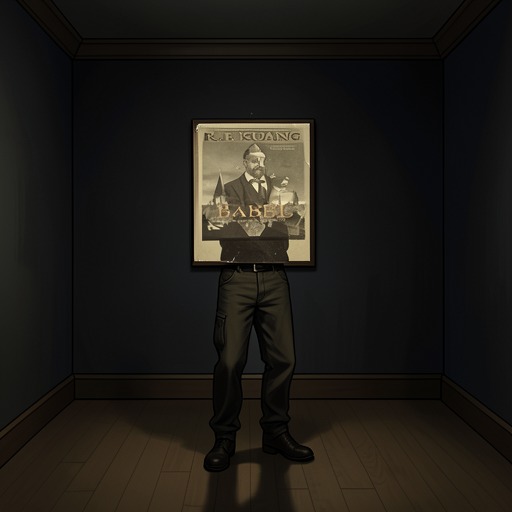
We’re not the only ones
Babel“We’re not the only ones” is the final sentence of a letter written by Griffin Lovell and later memorized by Victoire Desgraves. Its decisive significance lies in its doubleness: the words offer reassurance that resistance survives beyond the known circle of friends, yet they also withhold the identities and purpose of those who remain. In the aftermath of Babel’s destruction, the expression becomes both a fragment of evidence and a fragile promise of political continuity.
Discovery in Griffin’s Papers
Robin Swift encounters the expression while searching Griffin Lovell’s room with Victoire Desgraves. The room contains stacks of Griffin’s notes and letters, written in a cramped, spidered English hand that resembles Robin’s own handwriting and their father’s. The papers reveal Griffin as a frenetic but meticulous writer and expose the breadth of a network Robin had not suspected: correspondence had reached recipients in Boston, New York, Cairo, and Singapore, although the addressees were concealed behind coded literary names such as “Mr Pickwick” and “King Ahab,” or deliberately ordinary names such as “Mr Brown” and “Mr Pink.”
Among these papers, Victoire finds a thin sealed envelope addressed to Robin Swift. Griffin’s forceful scrawl identifies the recipient, but the circumstances of composition make the letter mysterious. Griffin could not have written it after Anthony Ribben brought Robin and Victoire to Hermes, because Griffin had not known where they were at that point. The letter therefore appears to have been written after Robin Swift broke with Hermes and declared that he wanted nothing more to do with Griffin Lovell. The expression is thus embedded in a message whose very existence complicates Robin’s understanding of his brother and of the network surrounding him.
The Letter Robin Leaves Unopened
Robin Swift never opens Griffin Lovell’s letter. Victoire Desgraves does, and she reads it so repeatedly that she memorizes it. The difference between them gives the expression its emotional force: for Robin, the letter remains a sealed object carrying the possibility of an unwanted truth; for Victoire, it becomes an interior possession and a surviving piece of Griffin’s voice.
The sentence follows three names—Martlet, Oriel, and Rook—whose identities Victoire does not know. She also does not know what the sentence means. The names and the closing words therefore function as a deliberate gap in the narrative, leaving the reader and Victoire to imagine a larger organization without receiving its full explanation. The expression does not resolve Griffin’s network; it proves that the visible network is incomplete.
Hope After Destruction
Victoire’s later circumstances give the expression a second meaning. She carries envelopes containing Anthony Ribben’s parting advice and the code names of contacts in Mauritius, the Seychelles, and Paris. She knows of a base in Ireland and boards a ship to America because it is the first vessel on which she can secure passage and because she must leave England as quickly as possible. Her route is uncertain, but the existence of contacts and bases makes the world beyond Babel materially real rather than merely imagined.
She keeps Griffin Lovell’s letter while leaving England, and the sentence becomes the one certainty she can retain. She does not yet know who Martlet, Oriel, or Rook are, but she believes that she will find out one day; the truth, she anticipates, will dazzle and horrify her. For the present, the names are “lovely syllables” filled with possibility, and possibility—identified explicitly with hope—is what she can cling to after the deaths and destruction around her.
Meaning and Narrative Function
The expression converts absence into a form of presence. Griffin Lovell is gone, Robin Swift is dead, and Ramiz Rafi Mirza has been torn down in his prime, while Letitia Price remains alive but is understood by Victoire as a possible pursuer. Victoire carries silver in her pockets and in the inseams of her dress, so much that she feels stiff and heavy when she moves; the material burden of survival accompanies the verbal fragment that keeps a future open.
As an expression, “We’re not the only ones” is deliberately modest. It does not name a program, announce a victory, or identify an army. Its force comes from the plural pronoun and from the refusal to let the known dead define the whole movement. The sentence preserves a collective subject without making that subject visible. It therefore works simultaneously as a coded message, an emotional consolation, a clue for future investigation, and a statement that resistance extends beyond the characters and institutions already destroyed.
The closing line also changes how Griffin Lovell’s earlier secrecy is read. His coded correspondence is no longer only evidence of concealment; it suggests a dispersed structure whose members communicate across Boston, New York, Cairo, Singapore, Mauritius, the Seychelles, Paris, and Ireland. The expression leaves that structure unresolved, but its unresolved quality is the point: after catastrophe, hope survives not as knowledge but as the conviction that knowledge may still be reached. haugesund