Lavinia orders every kauri tree cut down
BarkskinsLavinia’s order to cut every kauri on the company’s New Zealand land is a decisive reversal: faced with a damaged fortune, she chooses immediate timber revenue over the promise of selective cutting and replanting. The decision makes the divide between her commercial urgency and Dieter’s long view of forest stewardship visible in the same landscape the couple had approached with competing purposes.
The Conservation Promise
Dieter had pressed Duke & Breitsprecher to retain cutover land, replant it, and manage it through a separate Maintenance Timberland division. He asked the company to think on the scale of decades, arguing that planted acreage could become valuable timber or support future paper production. The policy added a measure of conservation to the company’s reputation, though it remained entangled with its aim of securing future wealth.
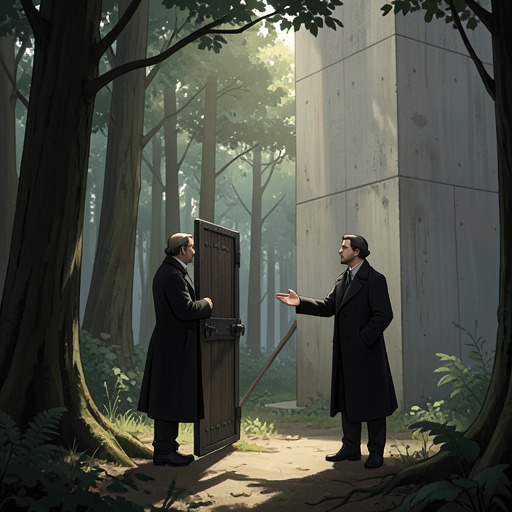
The New Zealand kauri visit gave that principle a concrete form. Lavinia acknowledged that she was there to assess trees for cutting, while Dieter wanted to know whether seedlings could be planted to replace mature trees. Ahorangi explained that the largest kauri were thousands of years old and that a seedling would need a hundred human generations to replace one fallen giant. Dieter nevertheless defended planting for the world’s health and for people not yet born. The enormous gap between a human business horizon and a tree’s life became the measure of the promise they were making.
Financial Crisis and Reversal
That promise was tested when Duke & Breitsprecher teetered after Lawyer Flense had rifled company assets. Lavinia blamed him for taking her ancestral heritage, although her personal property, including valuable Chicago land holdings, remained untouched. Dieter urged her to rebuild the company and pointed to the remaining forests of the Northwest, the mills Flense had not taken, and the kauri land in New Zealand. Lavinia agreed that the New Zealand timber remained an asset, but recalled their commitment to the Ovals not to clear-cut and leave; she also regretted that her experiments with kauri seeds had failed because the soil conditions were unsuitable.
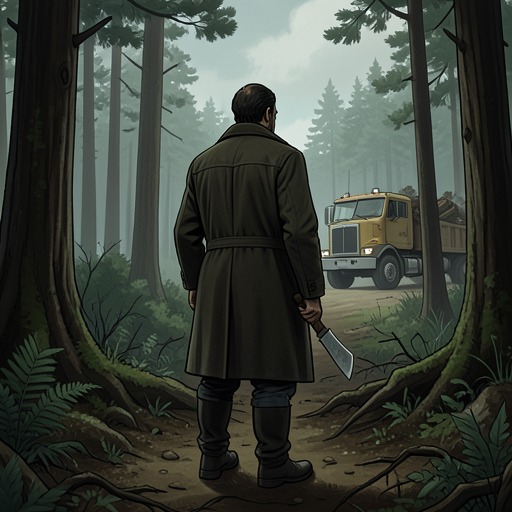
She then sent orders to cut all the kauri, sparing none. The text directly links the decision to her desire to rebuild her fortune. The company still had plywood and paper mills bringing in money, and Lavinia expected to use new technical advances and milling machinery to keep Duke & Breitsprecher alive. The order was therefore not presented as the only possible means of survival: it was a choice to convert the remaining kauri stand into immediate commercial recovery, despite the earlier undertaking.
Competing Timescales and Consequences
The decision reverses the ethic Dieter had articulated when he argued that people should plant trees they would never live to see mature. His stewardship plan sought to make future timber supply depend on deliberate regeneration rather than on the assumption that another untouched forest would always be available. Earlier, James Duke had celebrated Michigan’s white pines as a supply so vast that a thousand men could not cut them in a thousand years; Armenius Breitsprecher recognized in that appetite a drive toward clearing the continent and feared the waste, soil damage, and erosion it would bring. Lavinia’s later order gives this wider pattern a specific corporate consequence in New Zealand.
The kauri were not interchangeable with quick-growing seedlings: Ahorangi’s account made clear that replacement would take a hundred generations. Although Dieter’s proposal treated planting as a responsibility extending beyond the company’s own lifetime, Lavinia’s failed experiments and financial emergency ended in total cutting rather than a revised restoration plan. The episode brings the novel’s recurring conflict between forests as enduring living systems and forests as saleable stock into the company’s private crisis. Its immediate benefit is the prospect of renewed wealth; its ecological cost is borne on a timescale far longer than the recovery Lavinia seeks.