1693
Arrival in New France
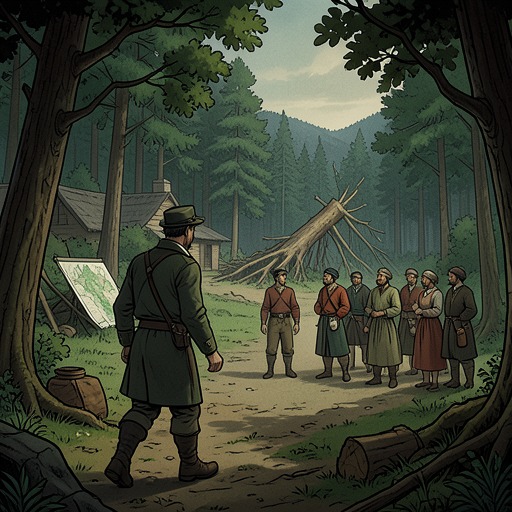
René Sér and Charles Dauvray arrived in [New France](entity:location-recall-location-new-france-b70d7980eb07), became indentured servants, and were assigned to Claude Trépani. René, a woodsman from the Monts d'Orléans, was amazed by the seemingly endless forest; Dauvray had already
After the arrival in New France
Duquet’s Disappearance
Du Kai resented his service conditions and suspected whether Trepagni would give him land. When he disappeared into the forest, Trepagni told René that a werewolf took him away, thereby covering up the fact that the escapee had already escaped. René stayed behind and
1690s
Trépagny’s Secret Manor
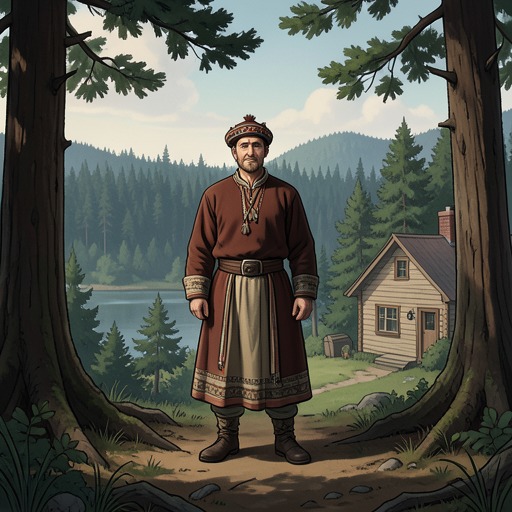
After his term of service, René searched everywhere for land he could claim for himself, and by chance discovered the hidden stone manor of Terpagni, the Triumphal Manor. The manor was hidden at the end of a formal tree-lined avenue, its opulence and grandeur revealing
First winter in New France
Renardette Joins the Household
after a settler died in the cold, mr. bouchard asked claudius trepani to take in his daughter leonnette. her birthmark caused fear among the people of vobike. trepani called the supposed demon mark a fox and renamed the girl renaud
After Trépagny returns from France
Trépagny Expels Mari
Claude Trepagny returned in gentleman's attire, announcing his intention to marry Melissande de Moutonnu. He had already begun to look down upon the Mi'kmaq way of life, and ordered Mary and her children to leave, giving them money to travel far away
1690s, after Trépagny’s return
The Wedding Feast
after the french bride of trepani arrived, the chateau de triomphe hosted a banquet for a group of traveling merchants. the bride discovered the meager reality behind trepani's grand promises, and he persuaded her to stay with flattery; meanwhile, marie returned to prepare the
Soon after the wedding
Mari’s Coerced Marriage
Melisande threatens to return to [France](entity:location-recall-location-4f282e1af8a7) and reclaim her dowry, so Claude Trenard, to avoid losing his status and wealth, arranges for René and Marie to marry. René resists, but around him, those powerful men declare the decision a fait accompli and promise him
After René and Mari’s marriage
Trépagny’s Pursuit
Claude Trepagny and Elfez set out to pursue Dukay, bringing along René's stepson as a servant. Before leaving, he hid a box containing teeth and hair under the threshold of the manor. In the end, Elfez returned alone, wounded and
During René and Mari’s marriage
Mari’s Story of Captivity
Mary told Rene that French sailors had kidnapped them when they were children along with other Mi'kmaq people, and taken them to [Paris](entity:location-recall-location-657453741ed3). Her mother, brother, and infant had died during the captivity and the voyage; she survived smallpox and returned to her homeland, but also brought a
Early eighteenth century
René’s Death in the Woods
Many years after cutting down trees, René was found dead, kneeling in the forest, with an axe embedded in a cypress. The head hunter cut off his scalp to claim the reward, leaving his family to endure the violence that accompanied their settled life. His son, Achille, inherited
1690s, after his escape
Duquet Survives the Wilderness
After escaping from Claude Trepagny, Dukay fell in the wilderness, suffering from illness, severely injured, and nearly blind, crawling around the pond. A band of Odawa hunters found him, but they did not approach close because they were afraid of the diseases brought by Europeans. Finally
Early 1700s
Duquet Learns to Read
Du Kai realized that the fur trade could not bring long-term wealth, so he determined to accumulate wealth through wood. To improve his prospects, he and the Trepagni brothers kidnapped Father Navarrete, forcing him to teach Du Kai to read, write, and arithmetic. Du Kai quickly learned
Early eighteenth century
First Voyage to China
Du Ke boarded the ship "Stinerend" of Otter H. Feldvening to [China](entity:location-recall-location-134e6ca3a450) to observe how international merchants negotiate, manage risks, and transport goods. In [Guangzhou](entity:location-recall-location-d3c2166895f4), he sold precious furs for silver and learned about the high demand for an expensive root and rare woods. Chinese
1711
Duquet Marries Cornelia
for many years, du kei has pursued his father's business relationships, eventually marrying corinna ross from amsterdam. the engagement stipulated that corinna and their children would remain in the netherlands, allowing du kei to travel widely and build a business empire
Early eighteenth century
Duquet Kills McBogle’s Son
An English woodsman cut down pines on land he believed was his own when Du Kei confronted him and interrogated him, beating a boy to death. The boy confessed that the thieves were under the employ of MacBurg, who was connected to the timber operator Elias Cook. The injured boy
Early eighteenth century
Duquet’s Death
Years later, as [Charles Duke](entity:character-recall-character-charles-duke-4e55ba2dab15), Duquet travels alone through the [Maine woods](entity:location-recall-location-0bcafc7985dc) to meet [Dud McBogle](entity:character-recall-character-dud-mcbogle-38a2d587f6a3). McBogle recognizes him as the man who killed his son and has been waiting for the chance to retaliate.
Duke is killed beside McBogle’s sawmill before he can complete his plans. His wealth and business pass to his adopted sons, while his blood descendants remain hidden from the family company he founded.
After René’s death
The Sel Children Leave Home
[Renardette](entity:character-recall-character-renardette-50a10204398b) and her partner [Démon Meillard](entity:character-recall-character-d-mon-meillard-1f23a78c21b2) repeatedly visit René’s home and claim its contents. Achille suspects the pair may have murdered his father, while [Elphège](entity:character-recall-character-elph-ge-a9d6fa47d96a) and [Theotiste](entity:character-recall-character-theotiste-5d1e85df863b) worry that they will seize the property by exploiting colonial law.
The older brothers return and persuade Achille, Noë, and Zoë to leave the house and seek their mother’s homeland. Their departure marks a choice to prioritize kinship and Mi’kmaw belonging over property acquired under French rules.
After leaving René’s home
The Family Returns to Mi’kma’ki
The Sel siblings travel through [Odanak](entity:location-recall-location-odanak-b958e1dc734f) and onward to [Mi’kma’ki](entity:location-recall-location-mi-kma-ki-d75d78996dc5), carrying their mother [Mari](entity:character-recall-character-mari-adcd09d62db2)’s bones. They find a homeland still rich in rivers and coastal life, but already altered by Acadian farms, drainage, hunting, and trade.
They reunite with Cache Emil and learn that their father Lolan’s kin are alive. Their return offers a connection to family and traditional knowledge, but it cannot restore the land or the social world that colonization has changed.
After the return to Mi’kma’ki
The Children Build New Lives
The Sel siblings marry and establish lives among Mi’kmaw and Acadian neighbors. Achille becomes a renowned hunter, while [Theotiste](entity:character-recall-character-theotiste-5d1e85df863b) and [Elphège](entity:character-recall-character-elph-ge-a9d6fa47d96a) learn the rivers and take wage work as settlers and logging companies reshape the region.
[Sosep](entity:character-recall-character-sosep-26bea8c4148f) warns that the [Mi’kmaq](entity:character-recall-character-mi-kmaq-b4fd88593cad) must preserve their world within their minds as well as survive in the newcomers’ world. The family’s lives become a negotiation between memory, cultural continuity, money, and forced change.
Mid-nineteenth century
Beatrix Dies of Cancer
Beatrix develops advanced stomach cancer. [Dr. Mukhtar](entity:character-recall-character-dr-mukhtar-414278e84276) eases her pain and stays with her as she talks about her childhood, her father Outger’s experiments in education, and her attempt to recover an Indigenous identity she could not acquire through books alone.
She dies after falling in love with the doctor. Her will leaves her home to Elise, her woodland to her sons, and personal gifts to [Kuntaw](entity:character-recall-character-kuntaw-cdcf1286e19b) and the younger children, while Kuntaw withdraws into grief and returns to the forest.
Mid-nineteenth century
Jinot Enters the Lumber Camps
[Jinot](entity:character-recall-character-jinot-82d600303a3a) grows up around [Penobscot Bay](entity:location-recall-location-ef1b41f02574), joins [Simon Marchand](entity:character-recall-character-simon-marchand-0f73c986db36)’s camp, and discovers a place among choppers and rivermen. He befriends [Franceway](entity:character-recall-character-franceway-a1c54f865f71), whose songs and companionship help him endure the camps’ brutal work.
During a log jam, a falling timber kills Franceway before Jinot’s eyes. The death ends his childhood and deepens his attachment to the transient community of workers who live and die in the forest economy.
1825
The Miramichi Fire
A dry, hot season turns routine smoking and clearing fires into a vast conflagration. [Jinot](entity:character-recall-character-jinot-82d600303a3a) and his crew flee through a burning forest and survive in a river pool, but Amboise and other companions are among the dead.
The burns leave Jinot’s leg contracted and nearly useless. [Jim Sillyboy](entity:character-recall-character-jim-sillyboy-a893e521ef75) treats him with honey, plant medicines, and painful massage, then carefully cuts the scar tissue, allowing him to walk again.
After the Miramichi Fire
Jinot Becomes an Ax Maker
Unable to return to river work, [Jinot](entity:character-recall-character-jinot-82d600303a3a) takes a job at [Albert Bone](entity:character-recall-character-albert-bone-d53a13cafc4d)’s axe factory. Bone values his woods experience and teaches him forging, tempering, grinding, and the business of manufacturing.
Jinot befriends foreman [Joseph Dogg](entity:character-recall-character-joseph-dogg-32a9dc30e30e) and marries Minnie Boss. The factory offers stability and family life, but his Mi’kmaw knowledge and connection to the woods remain central to how he understands himself.
After the Miramichi Fire
Jinot Reunites with Elise
Following the accidental death of his son Amboise, [Jinot](entity:character-recall-character-jinot-82d600303a3a) writes to his half-brother Francis-Outger and learns that Elise lives in [Boston](entity:location-recall-location-ccccb9ca0ba9). He visits her and meets her family, including Skerry, whose education has been constrained by expectations that Indigenous students should become missionaries.
The reunion restores some kinship but cannot erase years of separation or the losses both siblings have endured. Jinot also learns that their grandfather [Kuntaw](entity:character-recall-character-kuntaw-cdcf1286e19b) has returned to [Mi’kma’ki](entity:location-recall-location-mi-kma-ki-d75d78996dc5).
Later nineteenth century
Jinot Dies in New Zealand
[Jinot](entity:character-recall-character-jinot-82d600303a3a) travels with [Albert Bone](entity:character-recall-character-albert-bone-d53a13cafc4d) to [New Zealand](entity:location-recall-location-new-zealand-a25d5a689a9c), where Bone hopes to establish an axe factory. Bone is murdered by a Māori chief after attempting to impose his venture and reclaiming an axe he had given as a demonstration.
Jinot is confined by the missionaries, then sent to work in kauri logging to earn passage home. His injured leg fails while he is cutting a giant tree, and an infected wound kills him before he can return to his relatives.
After Jinot’s disappearance
Search for Jinot
[Joseph Dogg](entity:character-recall-character-joseph-dogg-32a9dc30e30e) and [Etienne Sel](entity:character-recall-character-etienne-sel-c230eb09301c) travel to [New Zealand](entity:location-recall-location-new-zealand-a25d5a689a9c) to find [Jinot](entity:character-recall-character-jinot-82d600303a3a) and investigate [Albert Bone](entity:character-recall-character-albert-bone-d53a13cafc4d)’s disappearance. They confront Reverend [Rainburrow](entity:character-recall-character-rainburrow-cab7b7a3ae72), who falsely claims Bone and Jinot are dead and has kept Bone’s money box.
[Arana Palmer](entity:character-recall-character-arana-palmer-3a2a20d2af25) confirms that Jinot died after a logging injury and shows the visitors the kauri stump where he worked. Etienne explains that he has come to bring Jinot home to [Mi’kma’ki](entity:location-recall-location-mi-kma-ki-d75d78996dc5), revealing the family’s continuing effort to recover its dead and sustain its kinship ties.
Nineteenth century, after Kuntaw’s death
The Sels Return to Shubenacadie
[Kuntaw](entity:character-recall-character-kuntaw-cdcf1286e19b)’s descendants return to [Shubenacadie](entity:location-recall-location-shubenacadie-4fd9e3326ad2), hoping to live among Mi’kmaw relatives despite hunger, illness, and shrinking access to traditional food and land. Settlers and companies have taken rivers, forests, and eel grounds, while the Sels increasingly rely on wage work.
They debate learning English, reading, and property law as survival strategies. Skerry proposes teaching children, and the family recognizes that cultural continuity will require adapting without surrendering its identity.
Late nineteenth to early twentieth century
Jinot’s Descendants in the Camps
For generations the Sel family works in logging camps across the northeast and farther west. [Blony Jacko](entity:character-recall-character-blony-jacko-4df4aaa1e352) becomes a climber but dies when a spar splits around him; Pollo loses a foot to a cable and becomes a camp cook; Molti later dies when a snapped cable strikes him.
The dangerous work is passed down as the forests are stripped and machinery replaces axes and river drives. [Lobert Sel](entity:character-recall-character-lobert-sel-e465907817b4) hopes to spare his children the woods, but economic pressure repeatedly sends them back into logging.
Early twentieth century
Egga Escapes the Residential School
Lobert sends his son [Edgar-Jim Sel](entity:character-recall-character-edgar-jim-sel-a414059d7e1f), called Egga, to [Shubenacadie residential school](entity:organization-recall-organization-shubenacadie-5a90a7a41795) believing education will protect him from dangerous logging work. Instead, priests force the children into labor and subject them to beatings and sexual abuse.
Egga escapes and makes his way to the United States, where he becomes a fisherman and later marries [Brenda](entity:character-recall-character-brenda-e39cbd8c0058), a Wampanoag woman. He tries to put his painful Mi’kmaw past aside, though Brenda urges their daughters to know their family and heritage.
1917
The Halifax Explosion
The [Halifax](entity:location-recall-location-a34801a22fff) Explosion destroys the Mi’kmaw village at [Tufts Cove](entity:location-recall-location-067082ca5c7e), killing Jim Sel and four of his children. Lobert moves his pregnant wife, Nanty, inland to [Shubenacadie](entity:location-recall-location-shubenacadie-4fd9e3326ad2), where the family tries to rebuild.
The blast is another catastrophic interruption in a family history already shaped by displacement, violence, and precarious work. Egga remains away, unaware of the full extent of the family’s losses.
Mid-twentieth century
Sapatisia’s Attack and Departure
Egga’s daughter Sapatisia becomes intensely interested in plants and forests, but her emotional intensity leads to a violent crisis at university. She attacks a married ecology professor with a knife, is expelled, and leaves for [Shubenacadie](entity:location-recall-location-shubenacadie-4fd9e3326ad2) to learn about her family and Mi’kmaw identity.
Her parents see her search as both a return to a denied heritage and a difficult attempt to live with the damage done to forests and Indigenous communities. Sapatisia’s later work emerges from this collision of personal history and ecological concern.
Late twentieth century
Jeanne and Felix Seek Their Future
[Jeanne Sel](entity:character-recall-character-jeanne-sel-efe3e1770f6f) and [Felix Mius](entity:character-recall-character-felix-mius-6c2b01575bcd) struggle through community college while considering forestry and botany. A lecture by [Alfred Onehube](entity:character-recall-character-alfred-onehube-79b948b51e32) on industrial damage to the boreal forest makes them feel their studies must lead to action.
They find an article about Sapatisia, learn she is related, and decide to seek her out. Their journey begins the transition from distant interest in environmental crisis to practical work in forest restoration.
Near the end of the novel
Joining the Tree Project
Jeanne and Felix reach Sapatisia’s coastal home and ask why traditional medicinal plants may no longer work as they once did. She explains that pollution, climate change, and the disappearance of old forests have altered the ecological relationships on which those plants depended.
Sapatisia recruits them into the [Breitsprecher Tree Project](entity:organization-recall-organization-breitsprecher-tr-54cf0d513645), where they will plant and monitor seedlings, study damaged soils, and learn to consider the forest as an interconnected system. The work is explicitly intergenerational: none of them will live to see the ancient forests fully return, but they begin anyway.
Final night
The Moonlit Warning
On the first night of the restoration project, the group shares food and conversation beneath a rising red moon. [Tom Paulin](entity:character-recall-character-tom-paulin-f13689700598) carries the memory of lost comrades and finds meaning in planting trees; Felix and Jeanne begin to see a possible life of service in forest work.
Above them, the moon illuminates damaged forests, peat bogs, and the rising sea. Sapatisia lies awake, afraid of fires, climate disruption, and the possibility that restoration may come too late, yet she remains committed to trying.