Duke and Breitsprecher enter the wood-pulp and paper business
BarkskinsDuke and Breitsprecher enter the wood-pulp and paper business when Lavinia Duke acts on a proposal to make paper from wood, including small logs and logging waste. The decision broadens the company’s markets and marks a new stage in the commercial use of forests: material once treated as unusable becomes a prospective source of profit.
From Timber to Pulp
The decision follows an earlier calculation by Charles Duquet, who judged the fur trade too vulnerable to oversupply, scarcity, animal decline, and fickle markets to secure lasting wealth. He imagined forests as an enduring commodity that could supply ships, houses, and fuel, and planned to turn from furs to timber once he had prepared himself. His confidence rested on the assumption that forests were vast and self-replacing, an assumption that underlies the later expansion from lumber into paper.
The book also places the timber business within a wider trading network. On a voyage through India, Outger Verdwijnen acquired spices and opium as cargo, and Duquet considered whether a triangular route might serve a lumber merchant. The episode connects his commercial imagination to overseas exchange, while foreshadowing the global markets into which later timber enterprises would seek to sell.
Stirrup’s Proposal
The immediate opening comes through Miss Heinrich, who revisits proposals from the company’s Inventor’s Day. Among them is a submission from Mr. Stirrup, a Maine rag merchant who has established a paper mill on the Mattawannscot River. He reports experimenting with wood pulp blended with rags and, more significantly, with paper made from wood pulp alone. His samples and descriptions of different woods and processes give the proposal a practical basis, though Miss Heinrich does not understand the technical terms sulfite and sulfate.
Annag Duncan examines the samples rather than dismissing the proposal for its unfamiliar terminology. She encourages Miss Heinrich to take it directly to Lavinia Duke, noting that Lavinia may not have read the submission carefully when it was first presented. The recommendation makes the route into the company’s decision-making visible: attention from a junior employee, supported by Annag’s judgment, brings a potentially consequential idea to the executive who can act on it.
Lavinia’s Decision
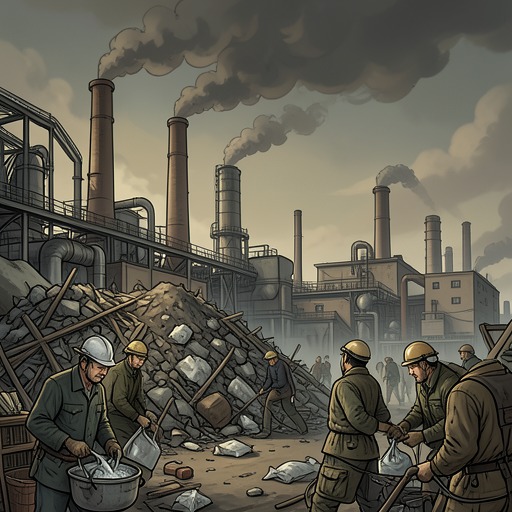
Lavinia reads Stirrup’s pages, examines the paper samples, and commends Miss Heinrich with a promotion and a salary increase. She immediately sees that small logs, slash, and other wood unsuitable for ordinary lumber could be pulped into inexpensive paper. The proposal therefore changes the meaning of waste: material left over from logging becomes a possible product and a new revenue stream.
Lavinia moves from evaluating the idea to initiating a business response, directing Miss Heinrich to write to Stirrup. She also considers whether Duke and Breitsprecher could build its own paper mill. The episode presents diversification not as an abstract hope but as a sequence of concrete decisions: evidence in the form of samples, recognition of a market, reward for the employee who brought the proposal forward, and correspondence with the mill owner.
Forests, Markets, and Consequences
The company’s interest in paper belongs to an expanding chain that joins forests to mills and distant buyers. Earlier timber operations described in the novel cut trees for lumber and cleared forests by burning accumulated wood and vegetation, leaving stumps and waste behind as camps moved onward. Stirrup’s process offers a way to extract value from some of the material that lumber production leaves unused, but it also gives the firm a commercial reason to treat more of the forest as usable feedstock.
The move is framed as preparation for a larger industrial future. The narrative calls the paper initiative a step that would take Duke and Breitsprecher into the next century, emphasizing both its promise and its reach. Its innovation lies in converting low-value wood into a commodity; its environmental implication is that reducing waste within production can still deepen the larger system of forest extraction.