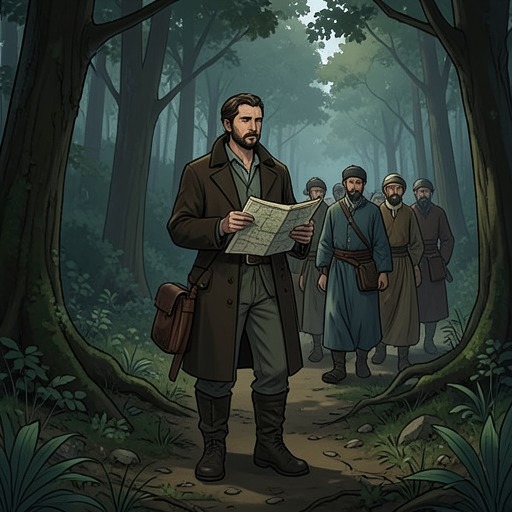
New France river-to-forest land-strip allocation
BarkskinsNew France river-to-forest land-strip allocation organized settlement around long parcels running from a river to the forest, joining farmland, higher ground, and woodland in a single holding. Presented as an equitable answer to the scattered occupation of meadows, the system also made forest clearance a condition of settlement and tied inhabitants to the seigneur who controlled the land. Across the novel, its promise of orderly distribution sits uneasily beside the destruction of woodland and the legal dispossession of Indigenous families.
Design and purpose
Monsieur Trépagny explains the arrangement when René asks why settlers cut forest rather than build in existing clearings. Trépagny treats the question as a challenge to the purpose of settlement: the aim, he says, is to clear and subdue the wilderness. The river-to-forest strip, by contrast, is presented as a deliberate and fair allocation. Each settler receives fertile farming soil near the river, higher land safe from floods, and forest trees for timber and fuel. The woodland is not merely an obstacle to the farm; it is one of the resources built into the parcel.
The structure is contrasted with taking up open meadows haphazardly. Its apparent balance comes from giving each household a varied run of land rather than a single patch of one kind. Yet Trépagny’s explanation also makes clearance central to the scheme: men must change the land to live in it. The property pattern therefore combines practical access to different terrain with a colonial ideal in which forest is wilderness to be subdued and converted into productive holdings.
Seigneurial obligations and settlement
The arrangement places the settler within a hierarchy as well as on a parcel. When Monsieur Bouchard discusses René’s prospective land, he advises choosing a wooded site and clearing it, but cautions him not to cut a yellow birch because the spring would dry up; the clearing should instead serve as cow pasture. Even this practical instruction qualifies the drive to fell trees: a particular tree has value because it sustains water, while the rest of the woodland is treated as a resource for farms and settlement.
Bouchard also insists that Monsieur Trépagny will remain seigneur of the extensive holding. Settlers who grow grain are expected to bring it to the seigneur’s mill, and Bouchard describes building a mill and encouraging more inhabitants as duties attached to the seigneur’s position. René points out that Trépagny does not yet have a mill; Bouchard answers that he will certainly build one. The strip system thus links land distribution to obligations over agricultural processing and to the anticipated growth of a seigneurial estate.
Clearance and its costs
As settlement spreads around Wobik, the claimed benefits of the system become visible in a landscape transformed by clearing. René is described as a woodcutter with a few cows and sheep, cutting firewood and making potash; several farms now lie between the village and his home. The speaker calls this progress in clearing and destroying the wilderness. That double description exposes the cost embedded in the language of improvement: the cleared land supports farms and livestock, while the woodland that stood there is irreversibly reduced.
Mari mourns woodland grottoes where medicinal plants once grew but have disappeared under settlers’ industry. Her knowledge and healing work make the loss concrete: clearance removes places and plants on which people depend, not simply unused trees. Her opposition to settlers’ expansion is dismissed as vengeance, while her Mi’kmaq sons have gone to St. Francis. The contrast between the strip system’s promise of equitable allotment and the loss experienced by those whose relationships to the woodland do not rest on settler title reveals how its fairness is defined—and whose claims it leaves outside its terms.
Title, inheritance, and dispossession
The conflict over René Sel’s property shows how formal title can turn the settlement order into a means of exclusion. Renardette and Démon Meillard arrive to assert that René, whose title was notarized, bequeathed the property to his adopted daughter. Démon calls her French and denies that the Indigenous people living there, who claim to be René’s children, have any claim. He proposes recording a sale in Captain Bouchard’s ledger and invokes white legal business to make the transaction binding.
Achille answers with a competing legal fact: the ledger also records that the house belonged to René and that René married Mari under white law. The dispute is therefore not simply between documented and undocumented ownership. A colonial record can preserve evidence of René’s marriage and household while being mobilized to deny the family’s inheritance. The land system’s ordered parcels and formal conveyances promise clarity, but the novel shows that legal recognition is unevenly applied, and that paperwork can help transfer a home away from the people who claim kinship and residence there.
Forest management and the long view
The novel sets this early settlement logic against later attempts to think about forests across generations. Dieter’s correspondence with George Perkins Marsh attends to tree loss, soil erosion, water, and the disappearance of birds; his later plan for a separately managed division would retain cutover land for replanting rather than sell it to speculators. He argues that timber may become scarce and valuable and that forestry decisions must be judged over decades, not merely by immediate returns.
That longer horizon sharpens the contrast with a settlement model premised on converting forest to farms and treating timber as one benefit of a parcel. Dieter’s conviction that seeds should be planted for a world future generations will inherit does not erase the earlier dispossession or restore vanished woodland. It does, however, mark a different measure of land use: not only what a holding can yield to its present owner, but whether its forest can continue to live and replenish itself.