Sustainable forestry principles
BarkskinsSustainable forestry principles in the novel oppose the assumption that forests are limitless stores of saleable timber. They connect forest management to soil, water, natural and assisted regeneration, and a responsibility that extends beyond a single business cycle or human lifetime. The contrast is embodied in Dieter Breitsprecher’s insistence on conserving and replanting cutover lands, and later in Conrad Breitsprecher’s effort to make seedlings and site preparation part of the timber business itself.
From Timber Commodity to Forest System
When Charles Duquet turns from the volatility of the fur trade toward timber, he treats the forest as a resource whose scale and apparent capacity to renew itself promise lasting wealth. His plan is to keep earning through furs while preparing to enter the wood business, which he imagines could supply ships, houses, and fuel. The commercial insight is decisive, but its premise—that the forest replaces itself and can supply profits indefinitely—also establishes the expansive view of nature that sustainable forestry will challenge.
The distinction between a forest and a stock of merchantable wood becomes stark in the later descriptions of logging in New Zealand. Shore stations combine camps and trading posts, while warehouses, sawmills, and small shipyards connect timber cutting to wider markets. Operators move on after taking the most valuable timber, leaving stumps and waste; felled trees are burned along with the other life and growth of the forest. The forest is treated as available for profit, while the damage remains in the place from which the goods have been removed. Against this pattern, sustainable forestry means attending to the whole site and its capacity to persist, not simply extracting the trees with immediate market value.
What Destructive Logging Leaves Behind
Armenius Breitsprecher identifies the practical knowledge absent from American logging as well as its consequences. In his account, foresters should understand shelter belts, thinning and pruning, hedgerows and coppices, and the relationship between forest, soil, and water. He observes that American loggers do not even leave seed trees on extensive cutover lands. After heavy rain or snow, soil runs downhill; erosion is not treated as a warning that land management has failed but accepted as an ordinary condition.
The forms of timber use help explain the pressure behind this damage. Wood serves for railroad ties and charcoal production, while households consume nearly a hundred cords over a long winter. At the same time, clearing for farms and houses is often done by setting large areas alight. Farmers may then leave when the burned soil proves unsuitable for their purposes and repeat the process farther west. Dieter’s criticism of waste is pointed: only a small fraction of the standing forest becomes lumber, while much is burned or abandoned. Sustainable forestry therefore involves more than replacing a harvested tree; it addresses the unnecessary destruction of wood, the depletion of soils, and the failure to manage land for future use.
The novel also sets this industrial practice against Indigenous forest knowledge. Armenius describes Indigenous people as attentive observers of water, weather, animals, and growing things, and says they used different parts of trees for tools and medicines rather than cutting lavishly. This comparison makes forest knowledge a matter of practice and restraint, not simply technical expertise. The contrast also exposes how a culture that regards extensive forests as endless can fail to recognize the value of what it is destroying.
Conservation Within a Timber Company
Dieter’s critique becomes an attempt to change company practice when he joins Duke & Breitsprecher. Though Lavinia retains control of the company and Dieter becomes its public figurehead, he secures a separate division, Maintenance Timberland, to hold, replant, and manage cutover pine lands rather than sell them to speculators. He also retains acreage outside the merger. This is the company’s first visible commitment to conservation, but it coexists with an enterprise still oriented toward expansion and profit.
Dieter argues to the board that timber will become scarce and more valuable, and that maintaining forestland can preserve future returns in lumber or paper. The argument translates stewardship into the company’s own economic language: land that is replanted and held over decades can remain productive rather than being treated as a short-term asset. He points to older Breitsprecher land that he planted two decades earlier and that now bears sturdy trees, evidence that forest recovery operates on a timescale longer than immediate investment decisions. His proposal asks the board to think in decades rather than months or a few years.
The same tension appears in the company’s search for overseas timber. Duke & Breitsprecher sends its best pine to Sydney, and a prospective buyer seeks a long-term supply contract while also expressing interest in New Zealand kauri. The commercial network that once promised abundant timber thus continues to reach into new forests. Dieter’s presence in the business does not erase that extractive reach; it gives the novel a way to distinguish conservation measures from the broader pressures of timber commerce.
Regeneration and Responsibility Across Generations
In New Zealand, Dieter’s position is tested by the scale of kauri growth. Lavinia is there to assess the trees for cutting, while Dieter asks whether young kauri could be planted to replace the mature ones. The local explanation is that a mature kauri may be thousands of years old and that replacing one with a seedling would take a hundred human generations. Dieter nevertheless argues for planting: the purpose is the health of the world and the well-being of people not yet born, even though those who plant will never see the trees mature. Sustainable forestry here is not a promise of quick replacement; it is an ethic that accepts a profound gap between the time of extraction and the time of ecological renewal.
Dieter’s later response to federal timber laws reveals how easily conservation language can be undermined by policy and commercial influence. He objects to the Timber Culture Act, Timber Cutting Act, and Timber and Stone Act, which are presented as conservation measures but, in his view, contain loopholes. He particularly condemns the land-lieu clause, which allows logged land to be exchanged for untouched timberland, thereby enabling lumber interests to move their access to new forests rather than restore the forests already cut. His frustration is sharpened by his awareness that Lavinia employs lobbyists and that he is implicated by association. The episode complicates the idea that sustainable principles can be secured by law alone: rules designed in conservation’s name may still preserve the machinery of extraction.
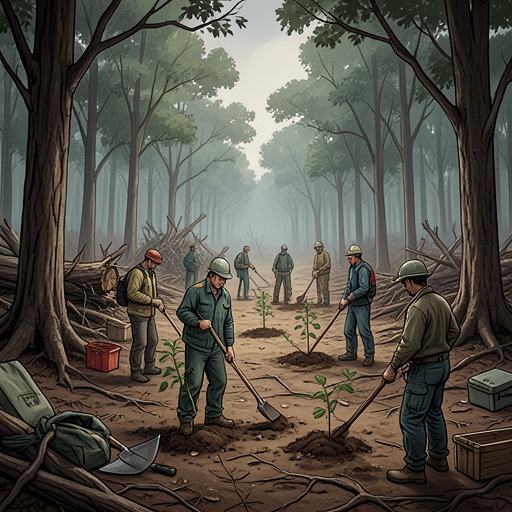
The principles take a more practical form in Conrad Breitsprecher’s later forestry work. After deciding that he must study forestry before devising a new plan, he examines why broadly marketed bare-root seedlings often die on rough logged sites. His conclusion is that the problem cannot be solved by supplying seedlings alone: successful regeneration depends on preparing the ground and persuading timber companies that planting is part of their own future. Companies must think in decades and centuries, because leaving a few wild trees on barren cuts has not produced reliable regeneration. Conrad decides that Breitsprecher will offer site preparation as a service, making the restoration of logged land part of the commercial process rather than an afterthought.
His plans also treat forestry as a field for testing, not a formula that can be applied everywhere. He considers seedlings grown in soil-filled kraft-paper cylinders, which perform better than bare-root seedlings at the same site, and asks how nursery space, species, labor, maintenance, seedling size, and price affect what can be produced. His questions connect scientific experimentation to the economic conditions that determine whether reforestation can be sustained. The novel’s principle is therefore not simply that trees should be planted, but that forests require informed, site-conscious care and institutions willing to pay for it.
The Principle’s Moral and Narrative Force
Across these episodes, sustainable forestry is measured against a recurring mismatch of timescales. Commercial actors seek immediate returns from trees that take generations to grow; land can be exhausted in a season, while recovery depends on long-term attention. Dieter’s seed planting makes that imbalance visible: a person can undertake work whose intended beneficiaries will live far beyond the planter. His position offers an alternative to the idea that nature has value only when it can be converted into profit, even as the company’s continued pursuit of timber shows how difficult it is to separate conservation from the business that drives extraction.
The novel also refuses to present restoration as a simple reversal of destruction. Replanting, seed trees, and better preparation can help forests return, but they do not make waste, erosion, burned habitat, or lost time inconsequential. By moving from Duquet’s vision of forest wealth, through Armenius and Dieter’s critique, to Conrad’s forestry study and service plan, the narrative turns sustainable forestry into both a practical discipline and an intergenerational obligation: the living must manage forests for conditions and communities they may never witness.