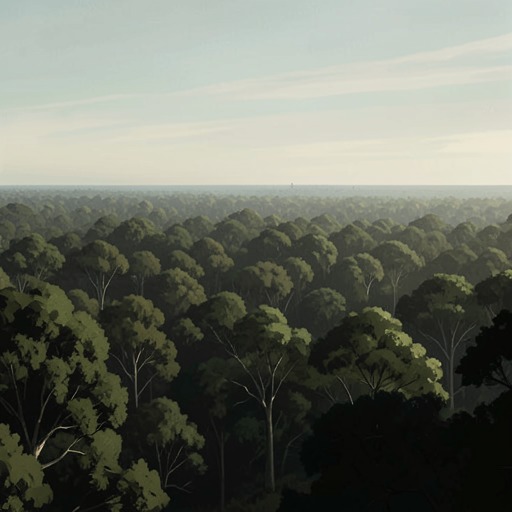
North American frontier deforestation and depletion
BarkskinsNorth American frontier deforestation and depletion is not a single episode but a recurring historical process: forests are declared limitless, converted into trade goods and farmland, and exhausted faster than they can recover. Its costs extend beyond lost trees to Indigenous dispossession, degraded soil, and a culture of extraction that repeatedly moves west or overseas in search of the next stand.
The Forest Imagined as Wealth
Charles Duquet arrives at timber as an answer to the instability of fur. Beaver and other animals can disappear, and markets can swing between surplus and scarcity; the forest, by contrast, seems to him an enduring commodity that Europe lacks. He imagines timber supplying ships, houses, and fuel, and believes profits might continue indefinitely. His conviction depends on treating the forest’s apparent vastness and capacity for renewal as guarantees of permanence.
That assumption emerges alongside the novel’s account of an economy reaching across regions. In India, Captain Verdwijnen trades ceramics and silks for produce and spices and takes on Patna opium for medicinal trade in Amsterdam. Duquet notices the possibility of a three-corner trading route and thinks of lumber as a commodity that might travel through such networks. Timber is thus imagined not merely as material from a local woodlot, but as the basis of a scalable, far-reaching commercial system.
The promise of inexhaustible supply becomes a shared frontier belief. As migrants arrive, the continent is described in the language of abundance: immense forests, minerals, fish, and game, and vast tracts of land understood as waiting to be taken. Lumber markets along the Mississippi and Missouri demand more wood for houses, barns, fences, and other construction. Railroads carry lumber to prairie settlements and return with livestock for Chicago’s expanding stockyards. Even when towns burn, the logic remains that more trees can be cut. The market’s appetite turns supposed abundance into a rationale for continuing extraction.
Settlement and the Loss of Forest Land
The conversion of forest to farmland is shown in the account of the Duke family’s Ohio holdings. Settlers arrived in large numbers, cut and burned almost all the white pine, and replaced the trees with farms. The change happened in little more than a year across thousands of acres. Because the property seemed empty except for trees, the newcomers treated it as available for the taking; the absence of a trespass agent and the long interval between inspections left the owners unable to stop the loss in time.
The same episode exposes the limits of ownership when land is not actively watched, but the novel’s account also makes clear that this is more than a lapse in company oversight. The settlers’ sense that the forest was free for the taking erased the difference between land that appeared unoccupied and land already held and used. Across the book’s longer colonial history, that idea of availability collides with Indigenous claims: Père Crème argues that the Mi’kmaq love a country France is taking, and Theotiste objects that the French king could not give away land that was not his. Forest clearance is therefore bound to contested authority and possession, not just to the demand for lumber.
On the frontier, the clearing proceeds through linked acts of cutting, burning, and settlement. It leaves no room in the extractive calculation for the forest as a community of plants, animals, and people. The loss is not confined to trees sold as timber: the land is remade for farms, while the original forest and its uses are displaced.
Extraction, Waste, and Ecological Damage
Armenius Breitsprecher recognizes the consequences of the Duke company’s expanding ambition when it encounters Michigan’s great white pine. He sees the company’s appetite as large enough to clear a continent. The wasteful destruction of sound wood, the damage to soil, and the erosion of the land make the discovery morally troubling to him, even as he remains involved in acquiring the forest. He has received only scattered, relatively small parcels for his work and realizes that securing any substantial share of the Michigan pine would require him to maneuver for it. His position joins commercial participation to misgiving: he condemns the system while still calculating his place within it.
His later explanation to Dieter makes the practical failures explicit. American operators, he says, do not understand shelter belts, thinning, pruning, hedgerows, coppicing, or the relationship between soil, water, and forest. They leave no seed trees on vast cutover lands. Heavy rain or deep snow can then send exposed soil downhill, turning the aftermath of logging into continuing damage. To Breitsprecher, the failure is not only that too many trees are removed; it is that the land is left without the measures needed for regeneration.
The uses that keep the cutting profitable multiply the pressure. Railroad ties consume timber, charcoal furnaces use enormous quantities of wood, and households burn close to a hundred cords over long winters. Meanwhile, settlers set large areas alight to make room for farms and houses. When the soil proves poor, some move west and repeat the process. Breitsprecher contrasts this practice with Indigenous forest knowledge: he describes Indigenous people as careful observers of water, weather, animals, and growing things, using different parts of trees for tools and medicines and cutting less lavishly. The contrast makes clear that depletion follows not from forests being intrinsically disposable, but from a particular system of use and valuation.
A Repeating Frontier, from New England to the Pacific
The novel presents frontier depletion as a pattern that travels. In the northern New Zealand shore forest, widely separated stations combine logging camps with trading posts for flax, spars, and lumber. Warehouses, sawmills, and small shipyards attract Europeans who take the most valuable shore timber and move on. First kahikatea, then kauri, are cut in intense succession. Felled timber lies in such quantity that it can carpet the ground; it is then burned as a quick way to clear the remaining forest, including vines, birds, insects, fruit, and other growth. The newcomers know the forest as a source of profit, not as an ecology they need to understand or preserve.
The choice of destinations changes, but the commercial premise does not. After Duke & Breitsprecher sends its first shipload of best pine to Sydney, Australia, a buyer seeks a decade-long supply contract and expresses interest in kauri, largely grown in New Zealand. The company is invited to establish logging camps there. The scene links American timber wealth to overseas demand and shows how a supply chain can transfer the frontier’s extractive model across oceans: new markets prompt the search for new forests, while ecological costs remain where the trees stand.
The recurring language of abundance masks cumulative loss. In Ohio, the white pine is gone within a year of the settlers’ arrival; in Michigan, clear-cutting threatens soil and future regrowth; in New Zealand, a succession of valuable species is felled and the residue burned. The damage appears in different places and at different speeds, but each episode repeats the assumption that a depleted forest can be replaced by another one just beyond the current frontier.
Indigenous Dispossession and the Meaning of Survival
For the Mi’kmaq, the forest belongs within a lived country, not an empty reserve of saleable materials. Père Crème tells a French authority that the Mi’kmaq love their country and that generations have lived there; the land’s value cannot be reduced to its usefulness to France. Later, Sosep describes the cumulative pressure of settlement: newcomers’ animals damage food sources, boats and nets take fish, and introduced plants overtake local ones. His account connects the loss of forest and other resources to a growing imbalance between many newcomers and a small Indigenous population.
Sosep remembers a time when the woods were theirs and they could go wherever they wished without hindrance. He does not treat cultural continuity as a return to life without change. Instead, he urges his people to hold Mi’kmaw ways in mind and to live in two worlds, keeping alive a vision in which plants, animals, birds, and people are persons who help one another. That teaching gives the forest a significance the extractive economy cannot recognize: it is part of a relation among beings, not merely a supply waiting to be converted into wealth.
The novel also places forest loss within the longer machinery of assimilation. At Shubenacadie residential school, Mi’kmaw children’s culture and language undergo a sustained assault. The school’s promise of education is set against the destruction of cultural continuity, connecting the depletion of land and resources with the forced weakening of the knowledge and relationships through which that land is understood. The result is not one dramatic disappearance but an accumulation of losses across generations.
Depletion as a Historical Pattern
These episodes make depletion both material and ideological. Forests are cut for masts, lumber, fuel, railroads, and farmland; the assumption that they will replenish themselves permits traders and settlers to disregard limits, while inadequate forestry leaves logged land exposed to erosion. Colonial claims further cast inhabited territory as available, and successive expansions carry extraction into new regions when earlier ones are diminished.
The book’s chronology gives that process the force of slow violence: damage accumulates across forests, soils, Indigenous livelihoods, and cultural transmission rather than arriving as one isolated disaster. The frontier appears to move because forests remain, but its movement depends on treating every next forest as an inexhaustible substitute. Against that logic, Sosep’s insistence on remembering Mi’kmaw ways preserves a different measure of value—one grounded in reciprocal life and continuity rather than the speed at which land can be cleared.