Mi’kmaw cultural decline and displacement
BarkskinsMi’kmaw cultural decline and displacement is a gradual, intergenerational process in which land loss and colonial pressure unsettle everyday practices, separate families from traditional livelihoods, and weaken the transmission of knowledge. The novel does not present that change as a single rupture: it accumulates through settlement, altered food systems, migration, assimilation, and institutional abuse. Alongside the losses, it records continuing acts of teaching and remembrance, making cultural survival an active effort rather than a simple return to an untouched past.
Land, Livelihood, and Colonial Pressure
The conflict begins with incompatible understandings of land. French colonial authority treats territory as something to apportion and transform: Monsieur Trépagny explains that river-to-forest strips provide settlers with fields, high ground, and timber, and presents clearing as necessary to make the land habitable. Père Crème, by contrast, recognizes that the Mi’kmaq love a country France is taking and that their children are being changed through colonial goods and forceful customs. His defense of their attachment to a land where generations had lived is set against the imperial assumption that territory can be transferred between European powers. When Sosep tells Theotiste that the French king has given their lands to the British, she answers that it is not his land to give.
Settlement changes not only boundaries but the material conditions of Mi’kmaw life. Sosep describes a steadily advancing pressure: settlers’ animals damage food sources, boats and nets take fish, and introduced plants displace local ones. The Mi’kmaq, he warns, are few while the newcomers are many. His account of lost freedom to travel through the woods links displacement to the erosion of subsistence and place-based autonomy. The community must, he argues, keep Mi’kmaw ways alive in thought and practice, sustaining a world in which plants, animals, birds, and people are persons who help one another.
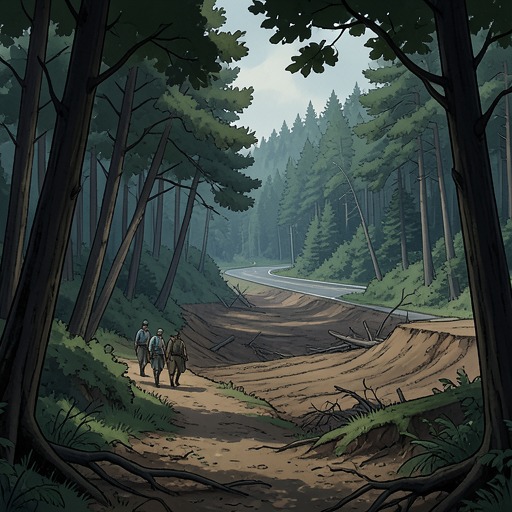
The change is also visible in the settlement landscape. Around the Penobscot, narrow tracks multiply into roads, and logging and farming push along the bay and upriver. Wheat and hay fields occupy cleared ground; turned root wads form barriers against settlers’ livestock, while houses gather into rows behind fences. The old Charles Duquet house remains isolated within uncut acreage, an exception amid the remade landscape. The contrast makes the forest’s transformation a record of settlement: roads and fields expand as the spaces supporting older patterns of life contract.
Knowledge and Intergenerational Transmission
Mi’kmaw knowledge appears in the novel as practiced attention to relationships among species, seasons, and places, rather than as a detached store of facts. Mari makes three eel traps, supplies bait, and takes René to suitable places along the river; after learning the technique, he brings her eels nearly every day. Her teaching offers a concrete instance of ecological knowledge in use, while the French colonial perspective around her tends to measure the land by cultivation and extraction. Père Crème’s letter similarly struggles to describe a worldview in which trees, plants, fish, moose, and bears are regarded as equals and daily life follows seasonal abundance. He recognizes that his own categories fail to contain what he observes.
That knowledge is vulnerable when children grow up away from its social and material setting. Tonny, raised around a trading post after Kuntaw leaves, rejects the prospect of being taken to the Mi’kmaw village and says that Mi’kmaw ways are no longer good. He grows up without a bow or gun, depending on his wits and odd work. Older women tell him about his father, Grasshopper Slayer, and his skill with a bow, but the stories reach him as a source of embarrassment, while firearms and easier hunting have displaced the long practice of tracking and stalking. His life demonstrates how assimilation can take hold not only through explicit instruction but through disrupted family bonds and changing conditions of survival.
Kuntaw later understands his departure as a personal failure with cultural consequences. He tells Amboise that he is ashamed to have left Mi’kma’ki, his people, and his son, and sees himself as helping to destroy the old ways. With Beatrix, he attempts to teach the forest as an interconnected system: animal tracks, plant seasons, scents, weather, leaves, and water belong together. He also teaches his grandchildren how to hunt, paddle, make and mend things, and fish. He fashions child-sized bows for Amboise and Jinot, linking their play to his own childhood practice. Yet he knows these lessons cannot reproduce a whole way of life when the conditions that once gave them meaning have vanished. His teaching is valuable precisely because it cannot by itself restore the world from which the knowledge came.
Displacement, Assimilation, and Community Change
The novel depicts displacement as a pressure on both collective belonging and individual identity. When the Sel family moves from Maine to the Gatineau, its members encounter white settlers who categorize them as métis or, disparagingly, “half-breeds.” In Maine, neighbors assume that the Mi’kmaq are disappearing; Josime counters that they are being absorbed into the settler population, pointing to his sister Elise’s children as nearly white. In the Gatineau, the family is treated as neither Mi’kmaq nor white. Josime’s bitter description of what they have become—tree choppers—reduces a complex identity to the labor available to them. The movement of the family does not resolve their displacement; it relocates it.
At the Mi’kmaw village, Amboise and Jinot find a community shaped by reduced access to land and weakened subsistence practices. Eel weirs lie neglected, and agency bread and pork have become easier to obtain than eels. The visit also exposes the pressure borne by particular relatives, including Elise, whose husband is not good to her and whose grief over a lost child is recalled. Amboise offers her a way to leave, and she gathers her few possessions and runs for the boat landing. That departure is an act of escape from an immediate harmful situation, but it occurs within a broader landscape in which community resources and independence have diminished.
Auguste gives the change a generational measure. Remembering the activities of his youth, he recalls hunting, fishing, eel gathering, making bows, arrows, crooked knives, canoes, and paddles, as well as games, feasts, and dances. He contrasts that active life with the idle men gathered at the post, then includes himself in the decline by reaching for his bottle. The scene does not reduce cultural change to nostalgia: it shows how lost access to land and livelihood makes older practices harder to sustain, while dependence and personal grief become part of the same history.
Assimilation and Institutional Harm
The account of the Shubenacadie residential school presents institutional assimilation as a direct assault on cultural continuity. After the Halifax Explosion destroys the Mi’kmaw village at Tufts Cove and kills members of Lobert’s family, Lobert moves his household inland to the reserve. He works for timber-company wages paid in logs and builds a three-room house. Hoping education will give his son better work than cutting trees, he agrees to Egga’s enrollment after officials tell him that the children may otherwise be taken by welfare authorities. Lobert and Nanty visit monthly with smoked eel, bread, sardines, and cake, trusting the appearance of pleasantness offered by the religious staff.
That trust is contradicted by Egga’s experience. Rather than receiving the education his parents expect, he spends his days shoveling coal and learns to read pressure gauges. The school’s treatment of the children, and the larger forty-year damage to their culture and language, makes assimilation an imposed institutional process rather than a voluntary abandonment of tradition. The comparison to the explosion registers a different kind of catastrophe: one that unfolds over years through coercive schooling and the severing of children from language and community knowledge.
Continuity and the Meaning of Decline
The novel’s account of decline is neither a claim that Mi’kmaw culture simply disappears nor a story of recovery without loss. Sosep’s insistence that the community must keep its world fresh in thought identifies memory and practice as forms of resistance to encroachment. Mari’s teaching, Kuntaw’s instruction to his grandchildren, and the stories older women tell Tonny all carry knowledge forward, even when settlement and family separation make its transmission uncertain. These acts preserve connections, but the narrative also marks the limits on what individuals can restore: Kuntaw can teach skills, yet he cannot recreate the shared life that once surrounded them.
The result is a history of cumulative pressure rather than one decisive ending. Land is cleared and enclosed; food systems change; families move; children are absorbed into settler institutions and categories; and traditional practices lose the conditions that sustained them. At the same time, Mi’kmaw characters continue to name the injustice, teach what they can, and remember the relations among people, animals, plants, and land. Cultural continuity survives in these efforts, but it does so under conditions shaped by dispossession and unequal power.