Forest degradation
BarkskinsForest degradation is one of Barkskins’s central historical processes: forests are treated as an apparently inexhaustible resource, cut and burned for trade and settlement, and left altered in ways that outlast the people who profit from them. The novel follows this damage from New France to the forests of New Zealand and the boreal region, showing how commercial decisions accumulate into changes in wildlife, soil, water, and human life. Its later restoration work does not promise an easy reversal; it confronts both ecological complexity and the danger of challenging profitable destruction.
An apparently endless resource
The commercial logic of degradation appears early in Charles Duquet’s plans. After watching the fur trade swing between glut and scarcity, he rejects animals and other living resources as too vulnerable to overtrapping, disease, and fickle markets. The forest seems different to him: vast, replaceable, and capable of supplying timber for ships, houses, and heat. He imagines a commodity that Europe lacks and that can generate wealth indefinitely, while treating transport and markets as the main obstacles. The belief that forests will replenish themselves makes extraction appear not merely profitable but permanent.
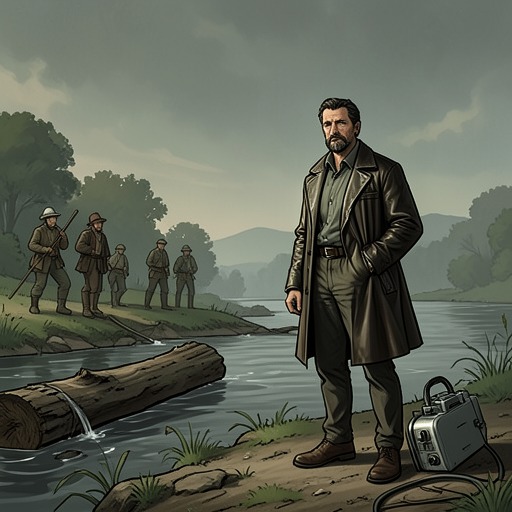
That confidence is in tension with what René Sel experiences as he cuts trees in New France. Crown corvée gangs widen a westward trail into a road, settlers arrive, and daily chopping pushes birds and game away. Men plant maize between the stumps; deer and moose retreat, followed northward by wolves. René cannot stop his work, yet the forest’s scale makes his blows seem insignificant: there are always more trees on the horizon, and shoots rise from stumps and living roots. The scene holds two truths together. The forest can regenerate in particular places, but the apparent abundance around René does not erase the ongoing loss of habitat and the displacement of animals.
By the time Sosep and Theotiste reach Mi’kmaw country, the changes are visible in the uses and distribution of the land. French Acadian families have plowed woodland and fruitful edges for maize and turnips and drained salt marshes to make hay for livestock. Moose, caribou, and bear have retreated, while beaver numbers have fallen under intense trapping. Beaver skins have become a form of white-man money, and the practice of placing a skin on a grave has diminished. Theotiste imagines continued exchange—meat for maize and pumpkins—and a life alongside the Acadians. Sosep answers that their choices are limited. The landscape’s capacity to feed people remains, but access to it and the customs bound up with it have changed.
Extraction, settlement, and waste
In New Zealand, degradation is organized through a network of shore stations that serve as logging camps and trading posts. European enterprises deal in flax, spars, and lumber; warehouses, sawmills, and small shipyards draw settlers to harbors with deep water and nearby timber. They take the most valuable forest growth and move on, leaving stumps and deep accumulations of waste. Cutting proceeds from kahikatea to kauri; felled trees carpet the ground, and the mass is then burned as a quick way to clear the land. The fire consumes not just timber but brush, vines, birds, insects, fruit, bats, ferns, and forest litter. The sequence makes the commercial chain plain: timber is extracted and transported, while much of the forest that cannot be turned directly into saleable wood is destroyed at the site.
The novel also exposes how landholding and political advantage reinforce extraction. At a company meeting, Piet sees how powerful landholders have secured adjoining five-hundred-acre corners around grants, accumulating thousands of heavily timbered acres through stealth and holding. Duke & Sons has stayed outside politics, but the destruction of coastal timber in a major wildfire shifts the balance: the company’s interior river holdings have escaped the flames, and owners whose timber was lost look toward those lands. Fire is therefore both a source of immediate devastation and a force that redistributes the value of remaining forests.
The loss of forest can also arrive through agricultural settlement rather than a timber company’s planned harvest. Lennart Vogel tells James Duke that the Ohio property James’s father bought is no longer the pine forest he remembers. Settlers have arrived in great numbers, cut and burned nearly all the trees, and replaced them with farms; fine white pine has been heaped up for burning. The several thousand acres have not simply changed owners or uses: the forest that justified the investment has largely disappeared. The episode links migration and farming to the same destructive assumption that land is most valuable once cleared.
Later, Dieter Breitsprecher condemns the waste built into American logging policy. He argues that conservation laws such as the Timber Culture Act, the Timber Cutting Act, and the Timber and Stone Act contain extensive loopholes. In his account, only a small fraction of standing forest becomes lumber; much is burned or abandoned. He singles out the land-lieu clause, which lets a person exchange woodland donated to protected forest for an equal area elsewhere, including untouched timberland. The arrangement can turn nominal conservation into a route for securing new forest to cut. Dieter recognizes the contradiction personally: he objects to the lobbying and land swaps but knows that Lavinia employs lobbyists and that he is implicated through their company.
Damage beyond the cut trees
Forest degradation is not confined to the loss of standing timber. At an evening lecture, Dr. Alfred Onehube describes a natural cycle in which spruce budworm outbreaks recur roughly every thirty or forty years, eventually exhaust their food supply, and are followed by dead trees, fire, and new growth. After the Second World War, however, the demand for wood pulp and paper and the availability of surplus aircraft and chemical weapons altered the response. When budworm spread through the boreal forests in the 1940s, the Forest Service sprayed DDT. The chemical killed the small aquatic animals that fed Atlantic salmon in the Miramichi River, turning a river known for its salmon run into a place of ecological damage. Onehube then warns that people cannot confidently predict the effects of large-scale clear-cutting in a fragile ecosystem: the unknowns are numerous, and the limits of knowledge are themselves unknown.
Sapatisia Sel’s account of restoration gives that uncertainty a practical form. The Breitsprecher Tree Project works with as many as thirty conservation groups, though its Nova Scotia crew has only six people. It plants trees, monitors experimental plots for as long as ten years, and records the condition of earlier plantings. One plot showed widespread chlorosis; at another, Sapatisia studies the effect of mycorrhizal fungi on seedling growth, because burned soil may lack these fungi and seedlings can struggle without their contribution to nutrient and mineral intake. Replanting is thus not treated as a matter of putting trees back. It requires observation of soil conditions, biological relationships, and the different outcomes at individual sites.
That work also takes place amid threats that are not visible in a planting plot. Before the crew begins, Sapatisia realizes she has not told them that forest restoration workers have been attacked and killed, or that attempts to interrupt profitable destruction can bring reprisal and campaigns of falsehood. She is also thinking about peat-rich boreal forest fires: these fires burn intensely, and crown fires can affect the earth’s albedo. Her delay in telling the group reflects the distance between a restoration plan presented as fieldwork and the political and physical risks attached to resisting extraction.
Restoration, limits, and narrative meaning
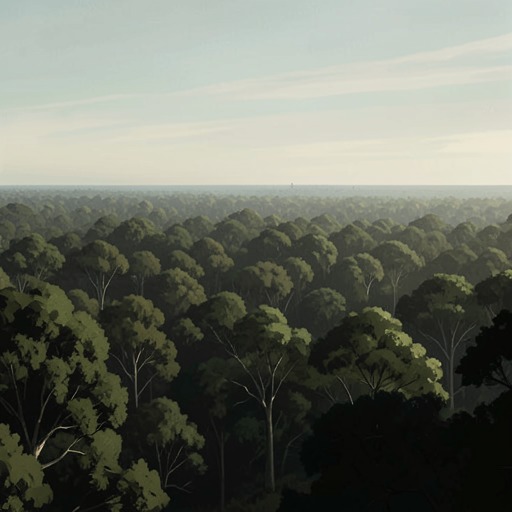
The novel gives damaged forests a history longer than any one business decision. Duquet imagines timber wealth extending for generations; later Dieter argues that woodland held and replanted over decades can become valuable in the future. Against those long horizons, the waste of cut-and-burn practices is especially stark: forests take time to grow, but extraction and clearing can remove them rapidly, and the consequences reach beyond the timber market to rivers, wildlife, soil, and communities. The pattern recurs across different economies, from fur-trade settlements and farmland to overseas logging and pulp production.
Sapatisia’s private fears keep the risks of restoration in view. She wonders whether her group can work together, assesses the potential of Felix, Jeanne, and Tom Paulin, and remembers Mayara, an activist killed after taking a foreign journalist to see destructive cutting in a protected sanctuary. The memory connects environmental witness to personal danger: documenting a devastated forest can provoke violent retaliation. The crew’s work is not an abstract appeal to care for nature, but a vulnerable effort undertaken in a world where destruction remains profitable and those who oppose it may pay a price.
The closing image refuses a simple assurance that restoration will succeed. Under the moon, the coast holds ravaged forest, silent harvesting machines, and black peat bog; the sea continues to rise toward the light. Sapatisia has not given up, and the novel acknowledges people trying to repair damage and forests trying to grow again. But it sets that persistence beside the scale of what has been lost and the possibility that repair may come too late. Forest degradation is therefore both a material process and a problem of time: its causes are repeated across generations, its effects are uneven and difficult to measure, and its restoration demands attention to living systems rather than faith in an endless supply of trees.