Mi’kmaq land loss and displacement
BarkskinsMi’kmaq land loss and displacement is a long process of territorial appropriation, ecological change, and political exclusion, not a single transfer or migration. The novel sets French and British claims to land against Mi’kmaq understandings of country as an enduring home that no European monarch could rightfully give away. As farms, livestock, trade, and settlement spread, the consequences accumulate in diminished access to food and customary territories, the weakening of community authority, and, in Achille’s story, the destruction of his home and family. Across these episodes, displacement means not only being driven from a place but confronting a system that increasingly denies the people who belong there the power to determine its use.
Territory and Competing Claims
The conflict is made explicit when Theotiste hears that the French king has given Mi’kmaq lands to the British. Her response is categorical: the land is theirs, not the king’s to give. Sosep explains that Mi’kmaq people face advances from both colonial powers. The French treat them as soldiers and seek to convert their children and women through force and colonial influence, while representing allies as if they were subjects. In his account, presents are a means of securing Mi’kmaq support, not proof that the French king owns the country or can dispose of it. The British claim still more territory and, Sosep says, offer no presents. His account exposes the gap between European assertions of sovereignty and the political relationship Mi’kmaq people understand themselves to have entered.
The novel repeatedly sets customary and colonial systems of landholding against one another. Monsieur Trépagny defends the New France practice of allocating long strips from river to forest, arguing that each settler gains fertile soil, higher ground, and timber. For René, the arrangement also explains why settlers clear forest rather than build in existing meadows. Its practical rationale, however, is bound to a program of transformation: the woods are treated as wilderness to be subdued and made useful to settlers. Later, after the Sel family reaches Mi’kmaw country, Cache Emil and Sosep assign hunting and fishing territories to the young people. Rouge Emil understands what the older men’s customary act cannot change: white land divisions have displaced those territories with house sites, gardens, and pasture. The contrast is not simply between two ways to organize property; it is between a living system of use and relationship and a colonial regime that increasingly decides which claims count.
That struggle also appears in disputes over recorded title. René’s property was held under a notarized title and, as Démon Meillard argues, bequeathed to Renardette. He dismisses the Sel children’s claim of descent and insists that they have no claim as squatters. The dispute turns on the unequal authority of documentary proof: René’s marriage to Mari and the children’s account of their parentage do not secure them recognition when a sale is presented as lawful white business. The scene connects intimate family history to the larger land conflict: colonial legal forms can affirm a settler’s ownership while denying the standing of the Indigenous family whose home and kinship are bound to the same property.
Settlement and the Changing Country
The novel traces dispossession through changes in the everyday landscape. Sosep warns Theotiste that French and English settlement has already altered the country. French Acadian families occupy the shore; woodland edges that once supplied berries and edible roots are plowed for crops, and salt marshes are drained for livestock. Large animals have retreated, while beaver numbers have fallen under the demand for pelts exchanged for guns and metal pots. The beaver skin’s place in burial practice also recedes as it becomes a form of colonial money. Land loss is thus joined to a transformation of subsistence and custom: the resources that sustain community life are depleted or redirected into settler agriculture and trade.
The pressures intensify as settlers’ animals and methods compete directly with Mi’kmaq food gathering. Pigs forage in the forest, learn to dig clams, and arrive on the shore as the tide ebbs, making it harder for Mi’kmaw women to gather shellfish. Sosep describes the larger imbalance as a wave: settlers are numerous, their animals damage food sources, their boats and nets take fish, and introduced plants overtake local ones. He recognizes that individual settlers may not intend harm, but stresses that their numbers and expanding occupation produce harm all the same. His account makes displacement visible as a cumulative process in which access can be lost through agriculture, livestock, fishing, and settlement before a community is formally expelled from a particular site.
The environmental knowledge at stake is not incidental to this history. Mari’s eel traps, bait, and guidance allow René to fish successfully, while her knowledge of healing plants makes her valued beyond her household. Yet settlers’ industry destroys woodland grottos where some plants grew, and she increasingly mourns their loss. In a letter, Père Crème reflects on Mi’kmaq seasonal life and on their regard for trees, plants, fish, and animals as equals. He recognizes that they speak to beings the French regard as resources, while his own instruction urges building, farming, and ordering time around settled production. The novel makes the contrast legible through practice as well as principle: knowledge rooted in living with a place confronts an economy that clears, extracts, and classifies it.
Political Exclusion and Survival
Sosep’s warning that Mi’kmaq people must live in two worlds is an answer to loss, not an acceptance of it. He remembers a time when people could travel through the woods without hindrance and says that time has passed. To survive, he urges his community to keep its own world present: a world in which plants, animals, birds, and people are persons who help one another. This instruction gives cultural continuity a political force. When land and customary authority are constrained by outside rules, sustaining Mi’kmaq ways of understanding the world becomes a means of resisting the idea that colonial settlement is the only order that can endure.
Political exclusion also takes the form of military pressure and the refusal to recognize Mi’kmaq as a people with their own interests. Sosep says that Mi’kmaq fighters capture English boats, but that their numbers are small and illness is common. Père Crème, speaking to a French authority, argues that Mi’kmaq people suffer, love their country, and face the corruption of their children by colonial goods and forceful practices. His protest is set against official concerns for French territory and strategic access: sympathy for the people whose country is being taken can be treated as a lack of zeal for France. The exchange shows how a colonial state can describe Indigenous people as useful allies when threatened while marginalizing their claims when territory and power are at stake.
Home, Expulsion, and Consequence
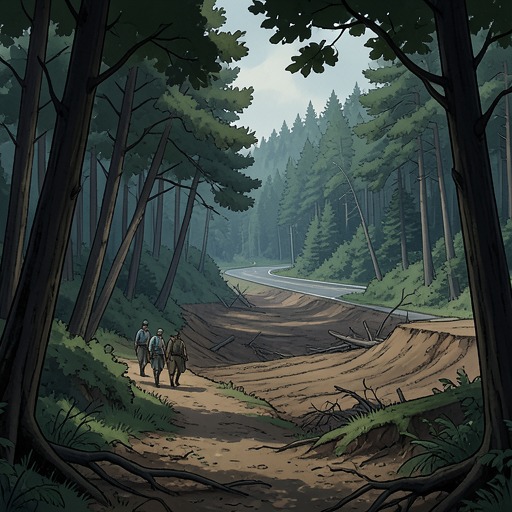
The most concentrated rupture comes when Achille and his companions return from a summer hunting journey. Two hundred English settlers are cutting trees and building log houses where Achille’s wikuom had stood, backed by thirty armed soldiers. Achille demands to know where his wife and children are. In the aftermath of the attack, he learns that Isobel and his younger children have been killed and that the family’s home has been destroyed. The episode turns the larger history of settlement into the loss of a particular household: people return to their home place and find that settlers have occupied it, leaving Achille to confront both the disappearance of his family and the destruction of the life organized around that place.
Achille’s response makes the consequence of dispossession explicit. He tells his brothers that the English have taken his wife and children and that Sosep had foreseen what would come. He rejects hunting and declares his life in Mi’kma’ki finished; he will leave the land of his mother for Maine to work in lumbering and despoil the settlers’ land in return. The decision does not undo what has happened or restore his home. Instead, it marks a terrible reversal: a man whose life and identity had been shaped by hunting turns toward the extractive work that has helped destroy his community’s country.
The history continues beyond this individual rupture. In 1917, the Halifax Explosion destroys the Mi’kmaw village at Tufts Cove; Lobert Sel’s brother and four of his children are among those killed. Lobert moves his family inland to Shubenacadie, where he finds some balance but remains poor, working for timber wages and using logs to build a three-room house. He later signs consent forms allowing his children to attend residential school, believing education will give them better work than cutting trees. The novel describes the ensuing forty years as a devastating assault on Mi’kmaw children, culture, and language. The connection between land displacement and cultural assimilation is therefore not abstract: when communities are forced to move and families seek security within institutions controlled by outsiders, the pressure on language and cultural continuity follows them.
Narrative Significance
Across generations, the novel refuses to reduce land loss to a legal transaction or a sequence of frontier settlements. It traces the links between land apportionment, recorded title, agricultural conversion, resource trade, armed settlement, and institutional assimilation. Each can be presented as an ordinary practice or an administrative arrangement; together, they steadily limit Mi’kmaq access to territory, food, community authority, and cultural life. The recurring contrast between Mi’kmaq belonging and colonial ownership reveals how claims to improve, divide, or exchange land presume that it is available for appropriation.
At the same time, the narrative preserves competing accounts of what land means. Mi’kmaq country is remembered through seasonal abundance, customary routes, hunting and fishing territories, and reciprocal relations among living beings. Colonial accounts recast those relations as idleness, disorder, or a failure to cultivate, while their legal and economic systems render land legible as property and resource. Sosep’s insistence on keeping the Mi’kmaq world alive under encroachment provides the counterpoint: dispossession constrains where people can live and how they can live, but it does not erase their understanding of the land or their continuing claims to it.