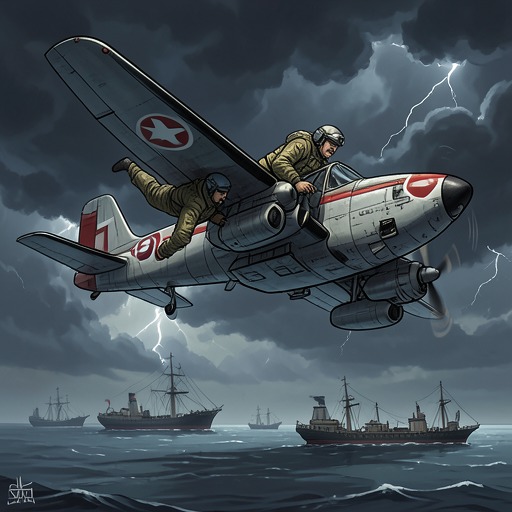
“Thousands May Fall”
Blackwater“Thousands May Fall” is the name of a Tharcian frigate whose role in the battle gives an apparently threatening phrase a more complicated meaning. It arrives among the ships that relieve Roland under fire, then reappears in conversation with Duncan: the pilots first joke about its ominous sound, before Roland recalls that the words refer to a reassuring song his mother sang in church. The name thus joins the material work of escort and protection to the pilots’ effort to find comfort, and humor, amid combat.
The Name in Battle
The frigate enters the action as Tharcian ships race toward the battlefield. Roland sees the name illuminated on its side while his own Panzerter is being struck. The sudden easing of fire follows: railgun rounds hammer the corvettes, and defensive guns protect rather than target Roland and the other pilot. In this setting, the frigate’s name first registers as a conspicuous label on a warship arriving at a moment of danger.
Roland calls it a vaguely threatening name for an escort, not realizing that he is still on the communications channel shared with the other pilot. The pilot agrees with the irony: an escort, by definition, is meant to keep people from falling. Their exchange turns the ship’s name into a joke about the difference between the promise of protection and the phrase’s grim surface. Commander Anna cuts the conversation short, orders Roland to return to base, and tells him to bring his playmate along. Roland drops his battered shield so he can recover the crippled Panzerter IV; the other pilot replies that he has a name. The brief banter occurs within a practical rescue and return order, not apart from the battle’s demands.
A Second Encounter and a Shared Reference
The frigate’s name returns when the Blackwater launches the two Panzerters into the action. Its heavy escort orientation, “up” relative to the Lagrange point, gives the squadron additional acceleration as it climbs. Orbit patrol cutters, escort frigates, and the destroyers Venomous and Violence join the upward movement. Duncan recognizes Thousands May Fall as the ship that saved them before, making its prior protective role part of the pilots’ conversation. He says that this history, rather than the name itself, is what makes him feel better.
Roland then revises the initial reading of the phrase. He thinks it refers to a Bible verse and explains that smaller ships are often named after Bible passages, song lyrics, poems, and speeches. He remembers the words as part of a song his mother used to sing in church. Duncan questions the apparent mismatch between a church song and the prospect of thousands falling. Roland recalls the song’s reassuring gist: terrible things may happen around the listener, but will not come near. His account does not establish the precise text or source of the ship’s name; it conveys the meaning he remembers and the personal association attached to it.
Protection, Irony, and Reassurance
The name’s meaning remains suspended between menace and comfort. Duncan’s first response rests on the plain-language contrast: a ship tasked with escort sounds as though it announces mass casualties. Roland’s recollection supplies a different register, in which the phrase evokes protection from surrounding disaster. Neither interpretation erases the other. The navy’s use of a consoling religious reference as a warship name is precisely what makes Duncan remark that it has turned something reassuring into a threat.
That irony is set against the frigate’s concrete actions. Later, when Roland and Duncan are in no condition to pursue a fleeing Panzerter, the captain of the Venomous tells them that the fleet had their backs and needed them to hold the enemy machines still for its new weapon. The surrounding force has provided protection, but the pilots’ survival has also depended on their own contribution to the fight. Afterward, Roland pulls Duncan’s machine with him as they turn back toward the shoal zone. In this sequence, the name functions less as a guarantee that danger will not arrive than as a phrase the pilots can reinterpret while relying on one another and on their escorting ships.
Place in the Pilots’ Story
The exchange gives a moment of levity to a narrative otherwise governed by immediate tactical pressures: Roland is ordered to withdraw with a damaged machine, later launches back into combat with Duncan, and ultimately has to bring his wingman away from the engagement. The ship’s repeated appearance links those separate moments of danger and support. Its name first provokes a joke from a pilot Roland has not yet recognized as a conversational partner; later it becomes a shared reference with Duncan, whose presence lets Roland laugh and feel less alone in the work.
Roland’s remembered song also makes reassurance an active interpretation rather than a certainty supplied by the name itself. The phrase cannot prevent the losses implied by war, nor does the scene promise that harm will stay away. Instead, the pilots move between the threatening wording, the ship’s protective role, and the memory of a song about being spared. The contrast captures the limited but meaningful comfort available to them: not immunity from danger, but escort, companionship, and a moment of recognition in its midst.