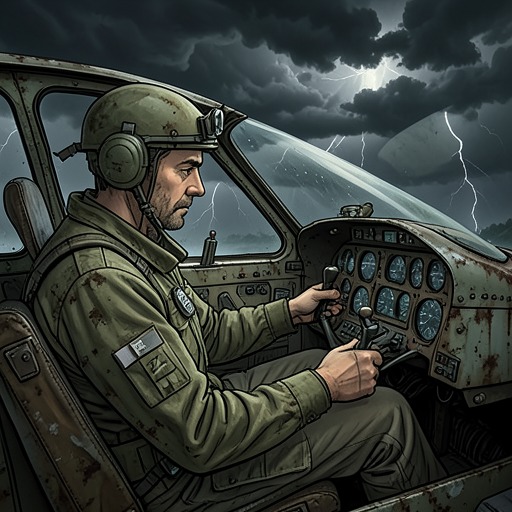
“a better pilot in an older machine”
Blackwater“a better pilot in an older machine” is Roland Horn’s combat maxim: a skilled pilot can overcome the advantage of a newer, more capable aircraft. Introduced while Roland argues that experienced hands matter more than technical superiority, the phrase becomes a measure of his confidence—and a claim put under pressure when he faces the Panthers.
The Maxim and Its Context
Roland states the belief in response to Valentin Fulbright’s warning that the Union’s multi-role Panzerters outperform every Mark III and Mark IV by a considerable margin. Fulbright doubts that the Panther, though close in performance, is available in sufficient numbers to answer the newer machines. Roland counters that there are still people at their controls, and argues that a better pilot in an older machine can beat an inexperienced or inept pilot in a new one.
The argument is personal as well as tactical. Roland invokes his grandfather, who, he says, shot down thirty Union pilots in a Mark II during the last war. That example gives the maxim a family precedent: old equipment need not decide the result if the pilot can make better use of it. Fulbright answers that the Union has revamped its pilot-training program and is growing pilots in tubes, pointing to institutional training and engineered personnel as further advantages beyond the machines themselves.
A Declaration Put to the Test
The phrase first carries the force of a boast. Roland says he will shoot down a Panzerter in a Mark III and make it look easy, even as Fulbright insists the newer design is next-generation technology. Their disagreement sets up a contrast between Roland’s confidence in individual skill and the scale of the Union’s technological and training advantages.
That contrast sharpens when three Panthers emerge from a burning hangar. Roland’s targeting computer registers them as friendly, but he identifies their unfamiliar design: they stand taller than his Panzerter III, with sleeker bodies, thickly armored torsos, and enhanced sensors. Their different weapons—a torpedo launcher, a submachine gun, and the customary 88-mm rifle—make their superiority more than a matter of appearance. The torpedo-armed Panther fires into other hangars, causing severe damage despite the reduced range of its weapons in the atmosphere.
Skill Against the Machine
The Panthers climb faster than Roland can follow, and his own machine shakes with knocking sounds. Yet the rifle-carrying Panther’s three shots, fired as if for execution, are easy for Roland to evade. He reads the attack as a possible sign that the opposing pilot lacks experience: the enemy has superior equipment, but does not seem to be using it with much tactical subtlety. In that moment, the maxim appears to describe a real opening for Roland’s skill.
The scene refuses to turn that opening into proof of safety. While dodging, Roland hears a roar behind him and sees shells strike civilian residences and farmhouses. A collision alarm then pulls his attention back to the immediate threat: the submachine-gun-armed Panther is charging him. The maxim thus remains a proposition under combat pressure, not a guarantee of victory. Pilot skill may expose weaknesses in a better machine, but it cannot erase the danger its weapons pose to Roland or to those beyond the battlefield.
Meaning and Limits
The expression brings together the book’s competing measures of military power: equipment, training, and individual judgment. Roland grounds his confidence in the human element and in his grandfather’s record; Fulbright stresses the Union’s upgraded training and the Panthers’ generational lead. The exchange leaves neither side’s premise untouched: superior technology is formidable, but the encounters show that its performance still depends on the person at the controls.
Its sharper implication lies in the difference between winning a duel and controlling a battle. Roland can evade the rifleman’s shots and suspect inexperience, yet the Panthers’ attack has already set hangars ablaze and put civilian homes in the path of fire. The maxim names a possible advantage for the pilot, not command over every consequence of combat.