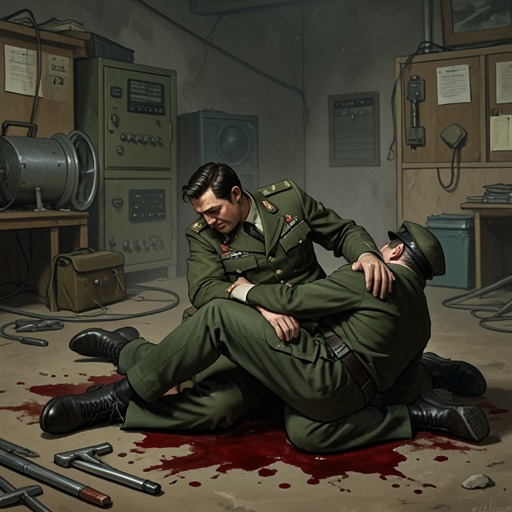
“eggs and omelettes” · “for the greater good”
Blackwater“eggs and omelettes” / “for the greater good” is a paired expression used by Valentin Fulbright to defend his actions to Roland Horn during their fight. Fulbright invokes a larger purpose to justify ingratiating himself with the Union, while Roland’s immediate question about the people killed exposes the human cost his slogan leaves unanswered.
The phrases in context
As Fulbright’s Panther presses Roland back in combat, Fulbright reaches him on a private channel and says that he is “in deep” but that the situation will “pay off in the end.” He explains that he needed to ingratiate himself with the Union, then offers “eggs and omelettes” as shorthand for accepting harm as the price of an outcome he considers worthwhile. He follows this with “for the greater good,” casting his choices as serving a purpose beyond himself.
The exchange does not take place apart from violence: Fulbright breaks his lock and attacks again as he makes his case. The language of calculation therefore accompanies an ongoing fight rather than a reflective explanation after it. His effort to frame the consequences as necessary competes with the immediate danger Roland faces.
Roland’s response
Roland does not accept the argument. He answers, “I don’t,” and asks how many people Fulbright killed. The question shifts the exchange from the asserted value of Fulbright’s goal to the lives affected by his conduct. The available scene gives no number in reply; its emphasis is instead on Roland refusing to treat the deaths as an abstract ingredient in a larger calculation.
Fulbright answers by repeating the paired ideas, saying, “Hey, eggs and omelettes, greater good, you know?” He then dismisses Roland as narrow-minded and says that he tried. The repetition does not resolve Roland’s question or establish the success of Fulbright’s stated purpose. It shows him returning to the same defense even as the two pilots remain opposed.
Rhetorical and narrative significance
The expressions work as a compact rationale: “eggs and omelettes” makes sacrifice sound like an unavoidable cost, while “for the greater good” assigns that cost a supposedly larger justification. Fulbright’s casual repetition contrasts with Roland’s direct question about the people killed. In the scene, the gap between a broad claim about ends and a specific demand to account for deaths is the point of the exchange.
The phrases consequently become a refrain of failed persuasion. Fulbright invokes them to explain himself, but Roland’s response remains focused on responsibility rather than accepting the proposed bargain. As Fulbright breaks away toward open space, the argument remains unresolved, carried forward not as an agreed principle but as a marker of the moral and personal divide between the two pilots.