Blackwater's Relief Mission to Civilians in the Debris Field
BlackwaterBlackwater's Relief Mission to Civilians in the Debris Field turns Roland Horn's Panzerter into a supply craft as well as a weapon. In the shoal zone below Island Fredrick, where crowded civilian ships are difficult to provision and vulnerable to isolation, Roland ferries medical supplies and food between vessels. The work is repetitive and precarious, but its stakes are concrete: children need care, adults need to eat, and the military force escorting them must protect its own capacity to fight without treating civilian survival as incidental.
Evacuation and the Relief Problem
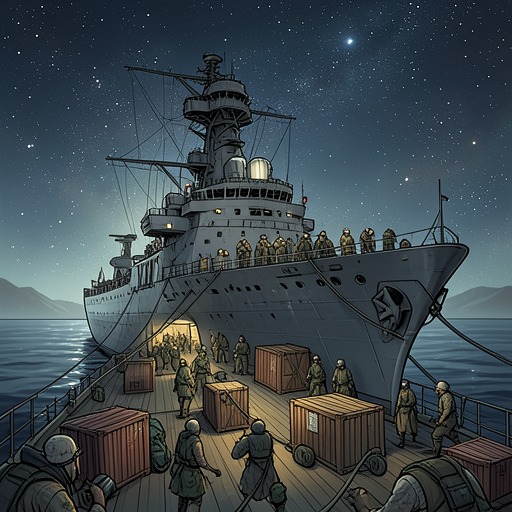
The relief effort grows out of an evacuation under attack. Captain Henri Marcell invokes Article Four of the Maritime Code of Conduct when he requests that the passenger liner River Jewel take on evacuees. As the liner is addressed, an enemy assault ship approaches the docks and Marcell's crew opens fire. The sequence places the rescue obligation beside an immediate military threat: civilians need ships willing to receive them, while the ships and docking facilities needed for evacuation are themselves targets.
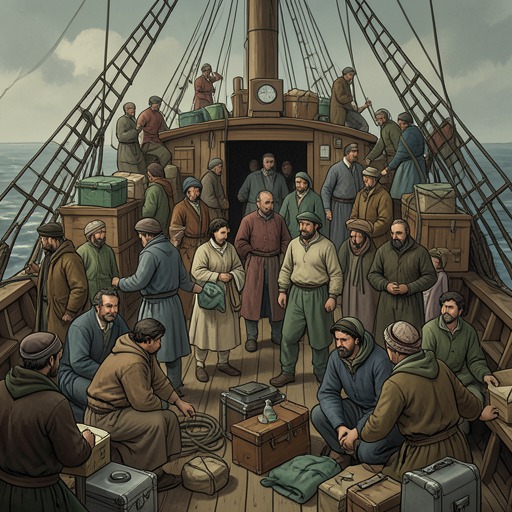
The evacuees are crowded into civilian vessels that were not designed for an extended journey. Many have been boarded in haste, bringing panicked people and their pets aboard. In the shoal zone, civilian ships must remain close to a cutter or warship to avoid losing communications and visibility beyond a short range. The escorting fleet must therefore manage not just protection but also the practical limits of keeping many vulnerable ships together.
Food, water, and ammunition become linked parts of that problem. Marcell asks for inventories of provisions aboard every civilian and military vessel and for ammunition counts from the warships. He has to consider whether to ration his own crew to give more to civilians, or keep feeding the crew normally so it remains fit for near-constant combat. That choice is sharpened by the prospect of lasting harm to children's health if their needs are neglected, and by the increased food demands of a crew whose number of pilots has recently doubled.
Medical Supplies for Children
On 2 November 2135, Commander Anna Strauss wakes Roland in his berth aboard Blackwater with a request that he carry medical supplies to a passenger liner. The children aboard have particular needs. The conversation identifies the limits of one possible treatment: nanites can reduce the strain of high-G maneuvers and help prevent bone-density loss or improperly healed injuries, but they may not be suitable for growing children. Their bodies might reject the nanites, leaving them ill or stunting their growth.
The proposed help is instead temporary and nutritional: dietary supplements and specially formulated milk blends intended to last until the refugees reach Deimos. Anna makes clear that these are not long-term answers, but a means of bridging the journey. Roland questions whether children could be given nanites without a doctor; Anna explains that nanites are not the plan. He gets dressed and prepares to make the delivery, turning the discussion of medical risk into an immediate errand rather than an abstract concern.
Repeated Runs Through the Shoal Zone
By the time Roland reports that he is making delivery number five, the task has become an established part of the fleet's relief work. He pilots between ships, collecting provisions and carrying them to passenger vessels. Blackwater's crew keeps assigning him further runs: after one delivery, Gunny directs him from Party Hardy to Queen Royal, describing the route in terms of food at one point and people to feed at the other.
Roland asks why Ensign Duncan Glenn cannot take some of the errands. Gunny says Glenn's machine is still under repair and that he would be at particular risk if he left the hangar. The exchange shows that this work depends on the availability of an operable Panzerter and a pilot judged capable of making the trip; Roland's delivery role is not interchangeable with a simple assignment of any spare pilot.
At Party Hardy, Roland loads freeze-dried food and dehydrated meals into the limited space behind his cockpit seat. His concern that the supplies may not do enough does not stop him from carrying them. He also avoids using his thrusters in a way that could send the freighter tumbling or create another emergency: he releases the ship and waits for its own nozzles to move it away before departing. Even a short transfer requires him to consider the safety of the vessel he is helping.
Children, Food, and the Meaning of the Work
The deliveries bring Roland into direct contact with the people the fleet is trying to protect. As he leaves the SS Meriweather, children cheer when he puts on his helmet; some are eager to meet a real pilot they have already watched fight. He consciously holds onto their faces and the recognition that they see him as a hero. In conversation with Gunny, he says he has been making extra time to talk with the children and that they seem to love it. Gunny urges him to remember those moments when the work becomes cold and lonely, because they remind him what he is fighting for.
The food runs extend that contact beyond a single ship. At Queen Royal, Roland hands supplies to tired-looking adults and eager children. The freighter crew labels certain containers as candy for the children, but Roland remains anxious that he will run out before the next group arrives. That detail gives the mission a smaller measure of success than a military victory: whether each waiting child can receive a treat, as well as whether the adults receive food.
The choice of supplies is also shaped by what the civilian ships can provide. Gunny explains that cruise and passenger liners have hydroponic suites capable of supplying fresh food, more extensively than the navy's ships. A long-distance hauler might instead carry seeds, embryos, and water; passenger ships offer a more immediate means of feeding people. The fleet needs armor and ammunition for its warships, but can use the civilian liners' food-producing capacity to support a larger number of evacuees.
Risk, Responsibility, and the Mission's Limits
Relief work does not take place outside the war. A Union cruiser is identified as the source of interference affecting operations in the area, and the plan is to move civilians into the shoal zone once the jamming is stopped. Roland recognizes that the route is dangerous, but understands it as the available means of protecting the civilians from the Union. He is also assigned to missions near combat: when Blackwater is in a docking bay, his initial defensive responsibility is to shoot down missiles or landers that threaten it. In another engagement, disabled assault craft release shuttles and Panzerters from their bays, underscoring how rapidly the environment around the relief effort can become hostile.
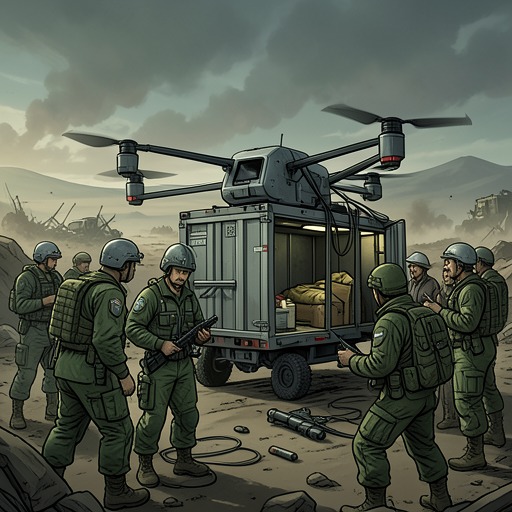
The prospect of danger becomes explicit when Roland and Gunny consider recovering a supply drone. Roland acknowledges that the drone might be a trap, but calls the attempt a calculated risk. He explains his reason in terms of the civilians' immediate need for food and the fact that they did not choose to be drawn into the war. He connects their predicament with what happened at Vespa, adding that he is now the one in charge. Anna warns that the fleet is operating on borrowed time while Union forces move through the area. The relief mission is therefore neither secure nor sufficient by itself; every delivery takes place against a narrowing window and an enemy presence.
The series of errands gives humanitarian aid a visible place within a military narrative. Roland's machine has been tested for weapons and thrusters, and elsewhere in the fleet the shortage of expected Panzerters threatens available firepower. Here, however, the Panzerter carries milk blends, medical supplies, and meals through the dust between civilian ships. The mission does not remove the danger or solve the fleet's shortages. It shows the work required to keep evacuees alive within those constraints, and makes the faces of the children—not an abstraction called the civilian population—the measure Roland is asked to remember.