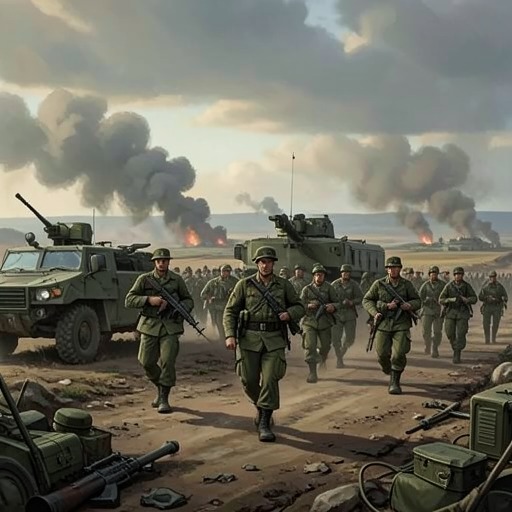
Mar de Paulo
BlackwaterMar de Paulo is a contested theater of the Tharcian–Union war whose battle ends in a stalemate and prompts the Union forces to withdraw toward their own space. The result gives the isolated Tharcian defenders a temporary reprieve, but not a resolution: their supply lines remain strained, and the wider conflict continues to shape decisions across the surrounding system.
Strategic Setting
The fighting at Mar de Paulo forms part of a broader Union offensive. The Union attacks several sectors at once, forcing Tharcian commanders to weigh local defense against the availability of help elsewhere. The 3rd Fleet succeeds in making the Union withdraw from Mar de Paulo, but the retreat leaves damage behind and does not immediately free the fleet to reinforce other forces.
The location’s strategic significance is reflected in the competing efforts to shape what the enemy believes. A taskforce plan calls for five reconnaissance and electronic-warfare cruisers to imitate civilian ships fleeing the Amazon Sea, while larger vessels conceal themselves in the radar shadows of smaller ships. The deception is intended to distort the timing and scale of the apparent threat to Phobos and Deimos, illustrating how the battle’s stakes extend beyond direct exchanges of fire to the movement of reinforcements and the interpretation of signals.
Civilian Ships and the Wider Battle
Civilian traffic becomes entangled with military operations. A flotilla enters the system claiming to be fleeing a Union attack, but its unusually uniform formation and measured speed arouse suspicion. When the passenger liner River Jewel is contacted, Marcell invokes Article Four of the Maritime Code of Conduct and requests that it take aboard evacuees. The appeal to a maritime duty to receive people in danger occurs amid an active military crisis, where civilian vessels are also potential cover for deception.
The ships are poorly prepared for an extended journey: many have been rapidly boarded and crowded with frightened civilians and their pets. Their dependence on nearby cutters or warships for communication and awareness makes their safety inseparable from the fleet’s fortunes. Marcell must also consider how to divide limited food and water between civilians and crews whose demands have risen with near-constant combat, making the campaign’s consequences material as well as strategic.
Combat and Deception
The fighting includes attacks by Union assault landers and the use of improvised advantages in the constrained environment of the shoal zones. Roland checks his fire when he realizes that shooting through the landers’ engine exhaust would be ineffective, then maneuvers for a better angle while point defenses track him. Elsewhere, patrol cutters enter a dangerous engagement despite Marcell’s warning that they lack the firepower for it. The episode shows how rapidly local choices can expose smaller vessels to risks created by the larger battle.
Marcell later responds to Union deception with deception of his own. After recognizing that the enemy has concealed its strength and intentions through a reverse Gray stack maneuver, he orders a broadcast claiming that a large taskforce from the belt is five hours away after refueling at Deimos. He admits that he cannot confirm there are ships in the position he names; the hope is that the Union will hear the claim and be forced to react rather than dictate events. A coordinated missile-and-mine attack likewise uses the Union’s attention against it: while point defenses engage the threat they expect, a missile they mistake for another minelayer releases warheads against a destroyer.
Outcome and Significance
Marcell later hears from the pilots that the battle for Mar de Paulo has ended in a stalemate. For the first time since the war began, the Union forces are retreating toward their own space. The withdrawal is a meaningful change in the immediate pattern of the war, but the account treats it as an improvement rather than a decisive victory.
The limits of that success remain plain. The Union taskforce’s strength had made the local threat formidable, while the fleet needed elsewhere is still unable to offer timely relief: the 3rd Fleet must return to Deimos and refuel before it can help. The Tharcian forces remain cut off from colonies in the Jupiter and Saturn systems, and moving resources to or from the planetary surface is difficult while the Union retains a direct route to the planet. Mar de Paulo therefore marks a temporary reversal in momentum, not an end to isolation or supply pressure.