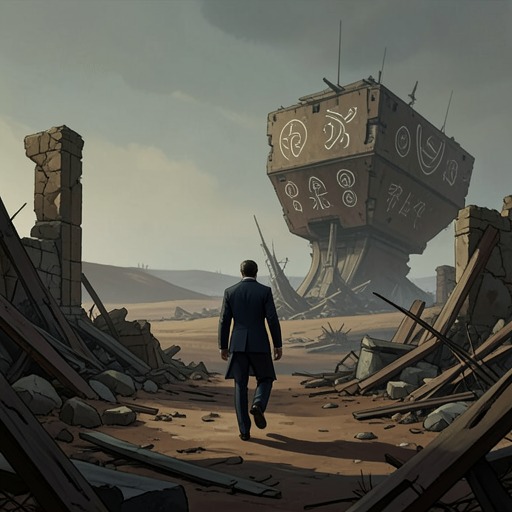
Verdun
BlackwaterVerdun is a ruined colony settlement drifting in the shoal zone below Island Fredrick, where its material remains turn a combat zone into an unresolved historical mystery. Rocco Swift recognizes the name on its battered hull and discovers a marked VX-73 cylinder, but withholds that discovery from Valentin Fulbright; the settlement’s full connection to the colony that disappeared after announcing its departure from the solar system remains unknown.
Location and Setting
Verdun lies in the shoal zone below Island Fredrick, in the Lusatia cluster of Tharcian space, at Mars Lagrange 9 (Promise), within the Mars Sphere. The date attached to the exploration is 2 November 2135. The settlement is not a functioning habitat: it has become part of a field of wreckage and dust, where ruined ships and old colonies complicate sensors and movement. Micrometeorite impacts and erosion by the dust have steadily abraded its exterior, leaving its history difficult to read from the structure itself.
The colony’s shell is hollow and unfinished. Its dark interior takes time to resolve even through Roland Horn’s light-enhancing cameras; exposed metal and concrete show through the walls, while remnants of rock and prefabricated structures cling in patches to the inner surface. Debris drifts through the abandoned space. A body floats past, almost preserved in the airless enclosure, its appearance suggesting that the colony’s occupants died in conditions of catastrophic depressurization. The discovery gives the ruin the character of a tomb, though the precise cause of its destruction is not established.
Rocco Swift’s Investigation
Rocco reaches Verdun after an explosion has washed out his sensors. He doubts the reliability of the Early Warning and Control Martians’ returns amid dust and metallic particles from the surrounding settlement ruins, and orders his squadron to conduct a full-spectrum scan for outbound signals. The debris field is not merely a hazard to detection: the dead colony itself becomes a possible source of the unexplained conditions around them. Rocco wonders how a settlement with staff dedicated to maintaining its air and water systems could have fallen into a shoal zone unless its population died suddenly.
As he searches the hull, Rocco first considers the shattered docking collar drifting nearby as a possible explanation for the colony’s state, then decides it probably broke when the settlement fell into the zone. He flies alongside the exterior, using shoulder-mounted floodlights to inspect its surface. Their glare reveals a huge painted name, damaged by micrometeorites and dust but still legible: Verdun. The name catches at his memory, though he cannot immediately say why.
A second reflection leads him to a cylinder jutting from the settlement’s outer hull near its midsection. It stands taller than his Panzerter, with pipes running into the colony and sealant welts around the connections. Rocco lands beside it and notices a handle sized for a Panzerter. The installation’s markings sharpen the unease: VX-73 appears beneath a skull and crossbones inside a yellow-and-black triangle. Rocco recognizes enough to feel that the object may matter, but the evidence at this point does not explain what the cylinder contains or why it was installed there.
Historical Identity and Unresolved Clues
The name Verdun links the physical wreck to two distinct histories. When Rocco asks Fulbright whether it means anything to him, Fulbright recalls the major battle fought there during the first Earth war. He also identifies a later settlement bearing the same name: a North Sea Federation colony that announced it was leaving the solar system a century after that battle, then disappeared. This account supplies a historical parallel for the ruined habitat without proving that the colony in the shoal zone is that vanished settlement.
Rocco does not mention the VX-73 markings when Fulbright asks why he brought up the name. He says only that it sounded familiar and that he could not remember where he had heard it. Privately, he decides to postpone investigating the possible connection until after the battle. The concealed clue therefore remains unresolved at the end of the encounter: the name and the hazardous-looking installation converge on the same broken hull, but Rocco chooses not to disclose what he has found.
Ruin as Battlefield and Tomb
Verdun’s remains affect the action as well as the investigation. Roland Horn later maneuvers through the colony with Charlotte Huber aboard, weaving between dust and structures built along the inner wall. He compares the settlement to a tomb, reasoning that, whatever the cause—accident, design flaw, or pirates—a colony that had evidently seen substantial use has become its residents’ final resting place. The possibility of several causes remains open; the ruin offers no conclusive account of the disaster.
The abandoned architecture also becomes cover and weapon. Roland braces the Ozelot’s shield against the ceiling and pushes off the floor, sending a massive, unmoored skyscraper toward four Union corvettes packed too tightly to maneuver freely. Their point-defense rounds pierce the concrete, glass, and steel but do not slow its momentum. The structure crushes the first escort, then breaks apart, flinging heavy debris that damages other machines and turns the wrecked colony into an extension of the battle. Verdun thus joins two kinds of violence in a single setting: an unexplained catastrophe that emptied a settlement, and a present fight in which its dead infrastructure is made lethal again.