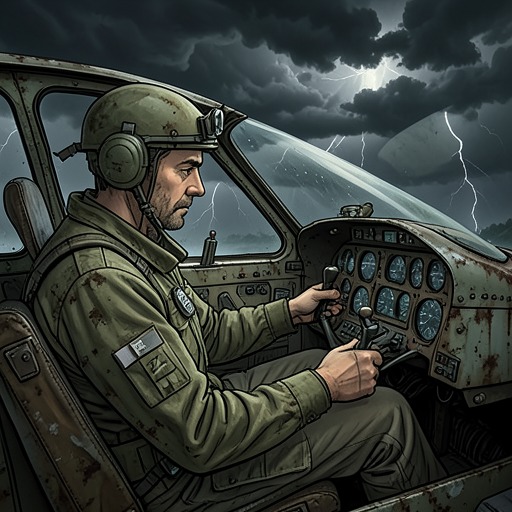
Naval Air Station Richtoften
BlackwaterNaval Air Station Richtoften is a Tharcian naval aviation base on Space Colony Fredrick, in the Lusatia cluster at Mars Lagrange 9 (Promise). The story presents it as both a working test and maintenance facility and a vulnerable military site: flight routines and repair work continue there even as the surrounding conflict threatens the installation and shapes operations beyond it.
Setting and Operations
At 1400 Colony Time on 2 November 2135, Naval Air Station Richtoften is identified as being on Fredrick, in Tharcian space. Roland Horn leaves the barracks and reports for work amid signs that other pilots have been cleaning up after a party. Later, at Hangar Four, he is conducting a practical test of a Panzerter III. The sequence establishes the base as a place of ordinary squadron life and hands-on equipment evaluation, rather than solely a launch point for combat.
The test assignment is specific: Roland is to walk the Panzerter around inside the colony to assess its thrusters in a pressurized environment, then fly to the colony’s edge and fire its Vulcans downrange. The installation therefore serves as a proving ground where performance in vacuum is not considered sufficient evidence of readiness. Testing the machine inside the colony supplies a different kind of operational feedback.
Maintenance and Readiness
The base’s combat capability depends on skilled maintenance as well as pilots. Chief Technician Bailey tells Rocco Swift that the Panzerter’s knee joints have had to be replaced again because he is pushing them beyond standard tolerances. Rocco’s retort—that he will try to remember this while Tharcian forces are shooting at him—sets immediate battlefield pressure against the less visible work of keeping a machine serviceable. His machine’s operational status is not assumed; it is checked and maintained by technicians who identify the strain accumulated in use.
This support burden extends beyond a single aircraft. The Blackwater, an escort-designated vessel carrying substantial armament and thirty-six Panzerters, is described as needing Marcell to physically retrieve the machines and their pilots. Elsewhere, Marcell notes that his force has received spare parts, fuel, and food but not the Panzerters it was meant to receive. That shortfall reduces available firepower, and he hopes the young pilot at the colony succeeds. These details place the station’s aircraft and personnel within a larger logistical problem: equipment at a base matters only if it can be repaired, supplied, and brought to the force that needs it.
Attack and Wider Conflict
The base’s routine is violently interrupted during Roland’s thruster test. At 1630, he pauses on the runway after hearing a rumble; an explosion tears through another barracks building, and smoke rises from the barracks area. He contacts ground control to ask what is happening, while the fires illuminate the remains of both barracks buildings. The controller can only say that the situation is still being assessed. The scene leaves the attack’s immediate circumstances unresolved, but makes the installation itself a site of active danger rather than a secure rear area.
The consequences of the conflict reach beyond the base. Roland is told that a Union cruiser is generating interference and that, once it stops jamming, Captain Henri Marcell intends to gather whatever forces he can and escort civilians into the shoal zone. Roland recognizes the plan as reckless but understands it as the remaining way to protect them from the Union. The episode connects the threatened aviation station to a broader struggle involving civilian evacuation, electronic interference, and the limited forces available to respond.
Narrative Significance
Naval Air Station Richtoften brings together the material and human conditions that determine whether military power can be used: a test pilot must assess an unproven system, maintainers monitor wear and restore equipment, and commanders contend with missing machines and supplies. The contrast between Roland’s controlled test routine and the explosions at the barracks turns a technical setting into an exposed one, where preparation cannot guarantee safety.
The station also frames military readiness as collective labor. Panzerter capability depends on technicians replacing stressed joints, on personnel conducting tests under the right conditions, and on ships and squadrons receiving their promised aircraft. As the conflict expands toward the attempted protection of civilians, the base’s significance lies not only in what launches from it, but in how its people and equipment are sustained—and how quickly that work can be overtaken by events.