Ozelot secrecy compromised
BlackwaterOzelot secrecy compromised describes the loss of confidentiality surrounding a Tharcian advanced Panzerter program. Its significance is twofold: an operational test exposes the existence and capabilities of the previously unknown machine to the Union, but that exposure also gives the Union concrete intelligence about the direction of Tharcian development.
Discovery in Combat
During the engagement, Rocco Swift identifies the weapon on an enemy machine as a laser more powerful than anything his side has encountered. He orders his units to press the attack and try to overheat it, reasoning that their own issued lasers became ineffective after only a few shots. The enemy weapon, however, fires at higher output and continues beyond that limit. The encounter turns a hidden technical advantage into an observable battlefield fact.
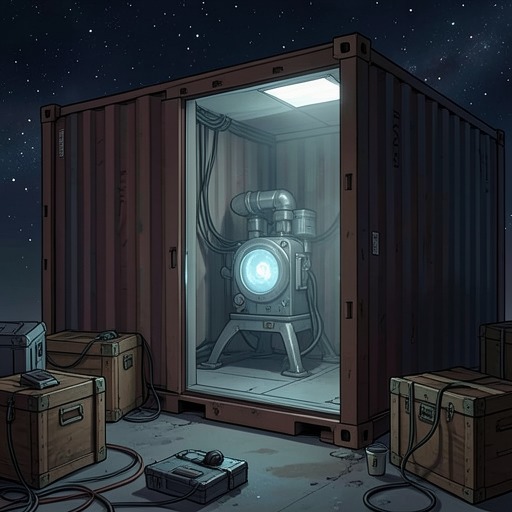
The machine’s capabilities are subsequently examined in detail. Its joints appear to have higher tolerances and faster reactions; additional nozzles on its backpack account for its exceptional thrust; and its power plant supports a laser rifle that can fire more than three high-output shots without the overheating problem familiar to Union forces. These observations make the disclosure more than confirmation that a new machine exists: they reveal several design priorities and performance advantages.
Intelligence Gained by the Union
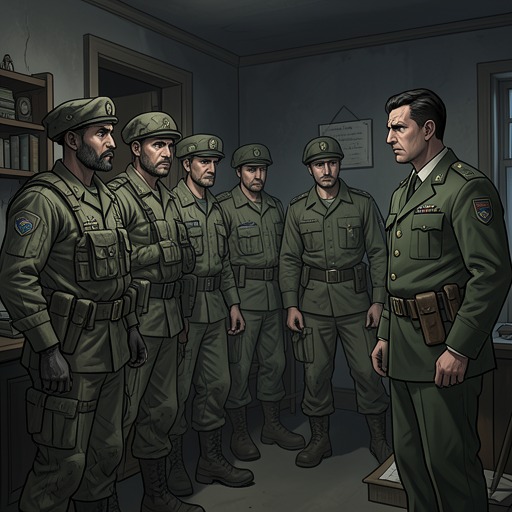
Fleet Admiral Von Braun tells Agent Raven that the encounter forced the enemy to reveal its hand. The Union now knows that Tharcian forces have been developing Panzerters unknown to them, has evidence of how those designs are trending, and has a basis for anticipating what they may face. The information changes the Union’s problem from detecting an unexplained battlefield anomaly to asking where the machines are being developed and by what means.
Von Braun identifies a large space station as the likely lead to those answers and directs Raven and Fulbright to go there. The secrecy breach therefore initiates a further intelligence inquiry: knowledge of the new machine’s battlefield properties points toward the infrastructure behind its development.
Tharcian Assessment and Consequences
On 4 November 2135, at the Tharcian Naval Command Complex on Deimos, Von Braun reads a report stating that the Ozelot’s existence has been compromised. He regards disclosure as something that would have happened eventually, but the report also records the immediate value of the field test: Warrant Officer Huber’s “Emergency Field Test” shot down five Martians, disabled a sixth, and destroyed two corvettes.
That result leaves the Tharcian command with a mixed assessment. The Ozelot’s performance has demonstrated its promise, while its use has sacrificed the confidentiality of the program. Von Braun’s private regret that they should have waited to authorize the Panther underscores the acquisition pressures surrounding new systems: despite his advice to Congress, the Naval Acquisitions Committee wanted the Panther because Rainer Orbital Industries claimed to have a working space- and ground-type ready. The compromised Ozelot thus sits within a broader contest over development, procurement, and how quickly new weapons should be fielded.
Strategic Significance
The disclosure is shaped by the same contest of information that runs through the surrounding operations. Tharcian commanders use electronic warfare to disguise a task force as civilian ships fleeing the Amazon Sea and to make a larger force appear to consist of smaller vessels. Later, Henri Marcell answers a Union maneuver by broadcasting a deliberately unverified warning about a force allegedly approaching from the belt, hoping to make the Union react rather than dictate events. Against this background, the Ozelot’s exposure marks the limit of concealment: whatever the tactical success of a test, a machine used in combat can provide an opponent with observable evidence.
The resulting exchange is not a simple reversal of advantage. The Union gains technical knowledge and a lead toward the development site; the Tharcian test demonstrates substantial combat effectiveness while revealing the program’s existence. The episode makes secrecy itself a battlefield resource—one whose loss can be accepted as a cost, but whose consequences immediately reshape what each side knows and what it must investigate next.