Promise refugee and supply crisis
BlackwaterThe Promise refugee and supply crisis is the logistical and humanitarian pressure shaping the flotilla’s survival in the shoal zone below Island Fredrick. As civilians flee through a debris-filled, communications-limited environment, Captain Henri Marcell must balance their food and water against the readiness of the ships and crews protecting them. The crisis is not separate from the fighting: civilian vessels are intercepted, children need specialized nutrition, and the same military machines that defend the flotilla become delivery vehicles for aid.
The retreat and its constraints
At 1830 Colony Time on 2 November 2135, the TNV Blackwater is moving through the shoal zone beneath Island Fredrick. The flotilla’s position inside the shoal zone gives its military vessels access to maps and astrogation buoys, which extend their awareness beyond the immediate debris and let them communicate with one another. Civilian ships have no comparable independent reach: they must remain close to a cutter or warship or risk being isolated, unable to see or communicate beyond a short range. Their dependence on military escorts is therefore both navigational and practical.
The refugees have been taken aboard in haste. Civilian vessels were not equipped for a prolonged voyage; many had instead been rapidly boarded and filled with frightened civilians and their pets. The makeshift evacuation has moved people out of immediate danger without resolving how they will be sustained on the journey. Marcell recognizes that food and water now have to be managed across a collection of ships with differing supplies and capabilities, while the shoal itself limits how freely civilian craft can operate.
The military ships face their own supply limits. Marcell orders a fleet-wide accounting of food and water, alongside a round count for the military vessels, because a ship whose point-defense cannons run out of ammunition may be unable to protect the convoy. The request makes the interdependence explicit: rations, water, and ammunition are all parts of the same survival problem, and a decision made for the civilians can affect the flotilla’s ability to defend them.
Marcell’s command dilemma
Marcell has to choose how to distribute what remains. He considers rationing his own people strictly while giving more freely to civilians, or maintaining his crews’ normal food so they remain at peak performance. Persistent combat raises the crew’s calorie requirements, especially for the pilots, whose numbers have recently doubled. At the same time, inadequate food for children could have lasting consequences for their health. Neither choice is simply a matter of immediate comfort: military readiness may determine whether the flotilla remains protected, while deprivation among the young can affect their future.
The children sharpen a dilemma that might otherwise be framed as a calculation of efficiency. Marcell resents making them bear hardship they did not choose, yet knows that weakening the crews could put everyone at risk. He is now effectively in command of an improvised squadron: the destroyer captains defer to him, and no one else appears to contest that arrangement. The authority he has acquired is thus inseparable from responsibility for the civilian population and from decisions for which neither option is painless.
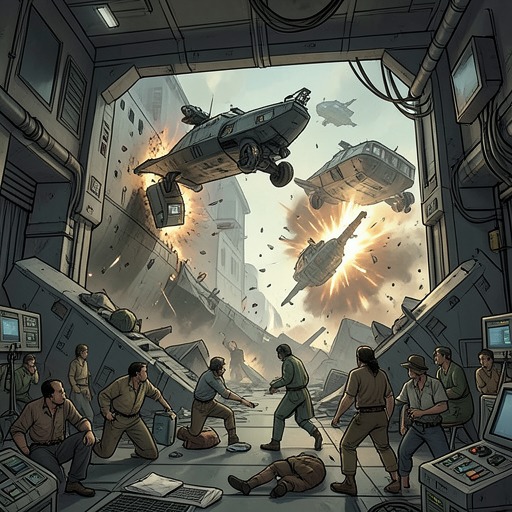
The choice is interrupted by news that civilian vessels are trying to break away from the Pommern cluster and Union ships are moving to intercept them. Marcell orders Violence and Venomous, five escorts, and the fighters commanded by Anna Strauss into action; Roland Horn and Duncan Glenn are sent immediately on the flight mission. The need to protect more escaping civilians postpones the provisions decision, but does not diminish it. The crisis repeatedly forces the commander to shift from planning how to sustain the flotilla to preventing its people from being captured or cut off.
Civilian protection and medical needs
Marcell invokes the Maritime Code of Conduct’s fourth article when he contacts the passenger liner River Jewel and requests that it take on evacuees. He does so after ordering the ship’s starboard batteries to illuminate the liner with their targeting sensors. The appeal to a civilian vessel’s duty to receive evacuees is therefore backed by a visible show of force. The episode presents rescue as both a stated obligation and a practical demand made in a war zone, where compliance and civilian safety cannot be treated as abstract questions.
Aid is not limited to moving people between ships. Anna Strauss asks Roland to take medical supplies to a passenger liner whose children have specific needs. She explains that nanite injections, normally used to reduce the effects of high-G maneuvers and prevent bone-density loss or improperly healed injuries, can be unsafe for children whose bodies are still growing. They may become ill or have their growth stunted. Rather than administer nanites without a doctor, the flotilla is relying on dietary supplements and specialized milk blends as temporary measures expected to last until it reaches Deimos. The stopgap is concrete but finite: the children’s needs are being addressed, while the limits of the available care remain in view.
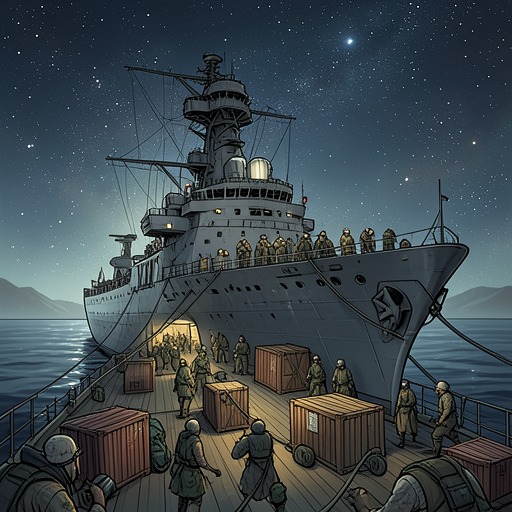
Roland’s deliveries make the civilian burden visible in small, specific acts. Children on the SS Meriweather are excited to meet a pilot they have seen fighting; they cheer as he dons his helmet and enters the airlock. He carries packages of freeze-dried food and dehydrated meals in the cramped space behind his Panzerter’s seat, then threads through the debris to deliver supplies to another liner, the Queen Royal. There he hands food to tired adults and eager children. Some containers are marked with candy for the children, but the supply is limited, and Roland worries that he will run out before the next child can be given sweets. The deliveries provide immediate relief without implying that a few cockpit-sized loads can meet the needs of the entire refugee population.
The supply drone and an unresolved crisis
The prospect of a larger source of provisions appears when Rocco Swift discovers a Tharcian shipping drone among the wreckage of a bulk hauler. Such drones are the backbone of Tharcian interplanetary logistics and commerce. Rocco’s first response is to see the number of people who could be fed, and the water they could receive, if the drone were captured. His attention briefly shifts from his identity as a distinguished ace to his memory of being a hungry child on a distant settlement. He decides that his flight will take the drone after investigating a nearby heat source, though the method has yet to be worked out.
Gunny later explains why a long-distance hauler could be more useful than its apparent cargo suggests. Passenger liners and cruise ships have hydroponic suites that enable them to serve fresh food; the Blackwater and some newer destroyers have hydroponics too, but on a smaller scale because military vessels must allocate room to armor and ammunition. Capturing the drone could therefore feed many people more efficiently than relying on the flotilla’s limited stores. It is a logistical opportunity, not a guaranteed rescue: the drone still has to be secured, and the enemy remains active in the area.
Roland and Gunny accept that the drone might be a trap, but regard the attempt as a calculated risk. Roland argues that the civilians did not choose to be drawn into the war, as had also been the case at Vespa, and that he is now the one responsible for them. Anna warns that Union forces are moving through the area and that the flotilla is fortunate the whole task force has not been committed to finding it. The decision to pursue food thus carries a military danger that cannot be detached from the humanitarian motive.
The crisis remains unresolved in the available scenes. Military escorts and the shoal-zone navigation network help keep ships connected; food runs, temporary child-health measures, and the attempt to seize a supply drone offer ways to prolong the refugees’ survival. But civilians remain reliant on warships, crews must stay capable of fighting, and the Union threat continues to constrain movement. The flotilla’s predicament makes logistics a matter of command and protection: every meal delivered, escort deployed, or risk accepted is also a decision about who can endure the journey to Deimos.