Tharcian–Union War
BlackwaterThe Tharcian–Union War is the continuing armed conflict between the Foundation Pact and the Central Alliance, a struggle that turns the inhabited Martian sphere into both a battlefield and a contested political order. Its effects are visible not only in fleet engagements but also in occupied territory, threatened colonies, displaced populations, and the food, fuel, ammunition, and evacuation decisions that shape military action. The conflict’s central significance is this entanglement: control of space and populations cannot be separated from the practical work of keeping combatants and civilians alive.
Political and Military Setting
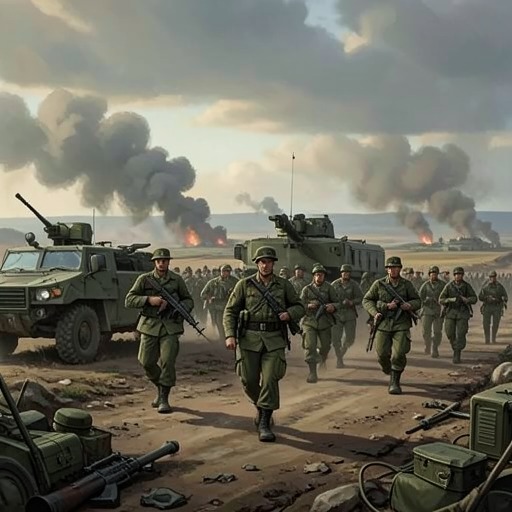
The war pits the Foundation Pact, which includes the Union of Martian Republics, against the Central Alliance, which includes the Republic of Tharsis. The Union is a major military power within the Pact. Its Mobile Assault Guards are an elite force equipped with advanced matériel and frequently selected to test new technologies; since the war began, their methods have influenced how the Union’s armies fight. Their prominence indicates that the conflict is not simply a series of local clashes: it is also a contest in which elite forces and their practices shape the wider military effort.
Military strength also works alongside political control. The Union’s Internal Review Service functions as an internal security service and military police force, concerned with managing dissent in Union territory and forcibly integrating occupied areas into the Union. The war therefore extends beyond defeating an opposing force. Occupation and incorporation are among its political stakes, and security institutions help translate military gains into attempted governance. The existence of occupied Olympia, also called the Olympian Martian Republic, makes the relationship between territorial control and political identity concrete.
The War Reaches the Colonies
The conflict’s reach is measured in inhabited settlements as well as military positions. Fredrick is a cylindrical space colony five kilometers in diameter and twenty kilometers long, with most configurations able to house at least 1.25 million people. Its scale makes the colony more than a backdrop to combat: it is a major population center whose docking collar, bays, and Panzerter airlock connect civilian life to military movement. Its agricultural ring normally contributes to the colony’s food supply, while Fredrick’s agricultural production also adds to its exports.
The prospect of fighting reaching Fredrick is already present before Roland sees the Blackwater arrive. Novac warns that the war will come to the colony sooner or later, pointing to refugees breaking orbit in growing numbers and intensifying fighting in the Jupiter Sphere and the belt. News is uncertain: since the fall of Vespa, Novac has heard nothing reliable. That combination of rising displacement and incomplete information gives the war a distinctive civilian texture. Events at the front are felt at Fredrick through people arriving and through the uncertainty surrounding the fate of distant settlements, before any settled sense of the wider situation is available.
The Blackwater’s arrival links the colony’s ordinary infrastructure to the demands of the war. Though scheduled as a heavy escort, the ship carries thirty-six Panzerters and firepower that makes it closer to a squadron than a conventional escort carrier. Yet the ship’s capacity does not remove its logistical vulnerability: Marcell must physically go to retrieve the craft and pilots, and the expected Panzerters are not delivered. In another episode, his force has taken on spare parts, fuel, and food but still lacks the aircraft it was supposed to receive. The shortfall is a direct reduction in available firepower, making the colony’s role as a source of matériel and personnel operationally consequential.
Combat, Information, and Supply
The conflict is fought under conditions in which incomplete information can determine how much force is used and when. When Schuster reports that hostile vessels are masking their drive signatures with spoofing, Marcell notes that the Gulf Squadron lacks assets devoted to countering electronic warfare. Orbit patrol does have them. His proposed response is to let the squadron illuminate the ships with targeting sensors, hoping that a single vessel will shoot and expose the deception. The plan depends on interpreting signals and on anticipating an adversary’s reaction, rather than on firepower alone.
The same informational pressure appears when Roland cannot reach the Blackwater through the jamming. With the radio link reduced to garbled static, he uses a pencil and notepad to record an enemy flotilla’s composition. He identifies a scout cruiser, estimates the classes of its destroyer escorts, and counts eight torpedoes available to him. His estimate that four torpedoes might be needed to destroy the cruiser must account for compartmentalization and point defenses that could intercept one. The scene makes calculation under uncertainty part of the work of combat: a pilot must turn limited observation into an estimate of what his weapons can accomplish.
Supply failures can also emerge in the middle of an engagement. When Rocco asks what has happened, Whaler reports that an entire salvo consisted of dud rounds and that the magazines may be defective. Rocco is still fighting among Panzerters when he receives the report. The failure is not an abstract procurement problem: it means that an expected attack has not functioned, leaving the pilots to act amid the immediate uncertainty of unreliable ammunition.
Rocco’s attack on a convoy likewise begins with an inference about what it is carrying. He identifies the ships as military transports and judges that their cargo is likely valuable, then commits his Panzerters to pursuing them despite the escorts and the convoy’s steep dive. The transports’ engines and thrusters favor endurance over high performance, while the escorts approach from above. In this encounter, transport design, escort position, and the attackers’ judgment about the cargo all shape the tactical problem. The episode also shows why supply traffic becomes a target in its own right: what moves through space can matter as much as what holds a position.
Evacuation and Civilian Obligations
Civilian movement is one of the war’s recurring constraints. The passenger vessels have not been fitted for a long journey; many are crowded with panicking civilians and their pets, and they must remain close to a cutter or warship if they are to communicate or see beyond a very short range. These limits make evacuation dependent on military vessels not just for protection but for maintaining contact and coordination. A civilian ship separated from its escort risks isolation even without being directly attacked.
Marcell invokes the Maritime Code of Conduct when he contacts the passenger liner River Jewel, requesting that it take on evacuees under Article Four. The rule supplies a formal basis for asking a civilian vessel to receive people, and Marcell’s accompanying question asks whether the ship has objections. Yet the call unfolds amid an active military threat: at the same moment, Schuster reports a double-hulled assault ship approaching the docks. Marcell recognizes the vessel and his batteries open fire before it can react. The contrast between an appeal to receive evacuees and the urgent engagement at the docks captures the war’s competing demands without making civilian protection and military action separate questions.
The challenge continues after civilians have been taken aboard. Marcell orders a fleet-wide accounting of food and water on civilian and military ships, alongside ammunition counts for military vessels, because point-defense cannons must not run dry during a fight. The reports will inform a choice he already sees as painful: ration his own people and give more freely to the civilians, or continue feeding the crew normally to preserve their effectiveness. His pilots have recently doubled in number, and near-constant combat increases the calories the crew requires. At the same time, denying civilians adequate food risks lasting harm to children. The decision is not resolved by a clean distinction between military necessity and humanitarian need; either distribution has consequences for people whose survival depends on the fleet.
That responsibility is also expressed in Marcell’s exchange with Anna. He explains that he saw a chance to keep people fed and that those civilians had not chosen to be caught up in the war, as had been the case at Vespa. Anna answers that the Union is moving through their location and that they are fortunate the entire task force has not been committed to finding them. Her warning places the act of feeding civilians within a shrinking margin of safety. The war’s humanitarian work is therefore neither outside the conflict nor secure from it: it takes place under threat, consumes supplies, and depends on decisions made by commanders who remain exposed to enemy action.
A War of Entangled Consequences
Across these episodes, military capability is repeatedly bounded by material conditions. The Blackwater can carry a squadron’s worth of Panzerters, but must collect its aircraft and pilots; Marcell’s fleet can acquire food, fuel, and spare parts, yet still miss the machines meant to expand its firepower. Roland has eight torpedoes, but must judge how many a defended cruiser would take. Rocco’s pilots can pursue a convoy, but a salvo of defective rounds can undermine their attack. These are different failures and calculations, but each makes logistics part of the conflict’s immediate course rather than an afterthought.
The political and civilian consequences run alongside those battlefield limits. The Union’s security service seeks to manage dissent and integrate occupied territories; refugees flee as fighting spreads across the sphere; and crowded civilian vessels rely on warships for safe passage and communication. Marcell’s appeal to a maritime rule and his later concern over children’s nutrition place the protection of evacuees inside command decisions, where it competes with ammunition, fuel, and the demands of combat. The Tharcian–Union War is thus presented as a struggle for territory and military advantage whose reach is measured equally by occupation, displacement, supply, and the responsibilities imposed on those carrying civilians through it.