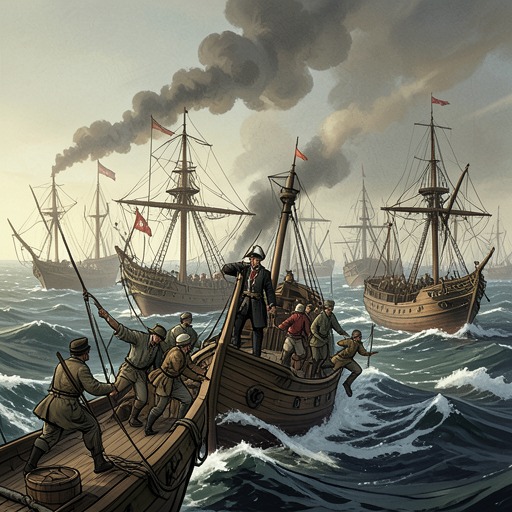
Promise under Union attack
BlackwaterPromise under Union attack is the Union fleet’s surprise assault on the Tharcian colony system at Mars Lagrange 9 on 2 November 2135. Its defining feature is the convergence of strategic deception and civilian peril: the attackers concealed their fleet behind smaller ships, while the defenders’ response quickly became a struggle to hold the colonies, protect evacuation routes, and keep displaced people supplied.
The feint and the alarm
The attack was preceded by a Union plan to manipulate Tharcian expectations through electronic warfare. Five Recon and Electronic Warfare cruisers were to spoof a civilian flotilla fleeing the Amazon Sea; reports relayed toward Deimos would then make the Tharcians believe that an attack had begun hours earlier than it had. The intended effect was to draw forces toward Deimos before they were ready, disrupting the defense of Phobos. The deception depended not only on false transmissions but on how those transmissions would be timed against genuine reports from the Lagrange point.
The Union force also disguised its size. Battlecruisers and heavy cruisers hid in the radar shadow of light cruisers and smaller vessels, while electronic warfare made the formation appear to contain many more small ships. The plan’s use of radar shadow was a deliberate reversal of a tactic the Tharcians had encountered at Vespa, where the Union had concealed smaller ships behind capital ships to exaggerate fleet strength. Here the apparent civilian flotilla and misleading ship disposition made the approaching force difficult to read until the larger vessels emerged.
At Naval Air Station Richtoften on Fredrick, Roland Horn was on the runway when an explosion struck another barracks building and smoke rose from the barracks area. Colony alarms then sounded to warn that an enemy fleet had been sighted nearby. Ground control confirmed that a Panzerter was being stolen, turning the developing crisis into an immediate threat at the base as well as a wider invasion.
The fleet’s first reversals
At 1700 colony time, aboard the TNV Blackwater in the docking bay of Island Fredrick, Henri Marcell watched the engagement deteriorate. The Union’s battlecarriers and heavy cruisers emerged from behind their screen of smaller ships, accompanied by waves of Panzerters. A Union light cruiser, leaking atmosphere, drifted toward the shoal zone or reentry, and Tharcian torpedo frigates inflicted severe damage on the Union screen; nevertheless, Marcell judged that losing either the Impervious or the Advantage could leave the Gulf Squadron unable to overcome the attack.
The fighting reached the docking bays as Union destroyers and corvettes fired missiles and other ships entered the bays. Marcell and his crew recognized that the vessels approaching were assault ships and that Union marines were attempting to take the colonies intact. The assault thus threatened both Tharcian military forces and the inhabited colony infrastructure. At the same time, Roland’s Panzerter was repaired and rearmed, making him available to fight while the fleet faced an attack on its own docking area.
The assault also tested the defenders’ capacity to protect people and ships without losing the station from which they had to operate. Marcell invoked Article Four of the Maritime Code of Conduct when he requested that the passenger liner River Jewel take on evacuees. The appeal came with an unmistakable show of force: every starboard battery fixed its targeting sensors on the liner. The scene presents the evacuation as a concrete military demand made under threat, rather than as a separate humanitarian effort insulated from combat.
Fighting through the shoal zone
Roland’s defense extended from the colony toward the shoal zone below Island Fredrick. When two Union assault landers burned through the Lusatia cluster and reversed thrust, he raised his rifle but withheld fire while their engines were in the line of attack; he understood that rounds fired through the exhaust would melt and be pushed away. He maneuvered for a better angle despite the landers’ point-defense fire, then struck the closer ship’s port-side engineering section. Its thrusters failed, and its crew cut power to the opposite thrusters to keep the vessel from breaking apart.
Roland disabled the second lander by concentrating fire on its connecting trusses. As the crippled craft began to break up, its bay doors opened. Shuttles emerged, followed by Panzerters, revealing that the assault ships carried a force able to continue the attack in smaller craft. The sequence marks the shift from stopping the landers themselves to confronting the forces they had delivered.
The engagement later turned improvised structures in the shoal zone into obstacles and weapons. Four Union corvettes, unable to maneuver freely in formation around the Panzerters, cut their thrusters and tried to reverse course, but had no time to escape a tumbling skyscraper. Their point-defense cannons could punch through the building, yet the small rounds did not meaningfully alter its momentum; without a motor or warhead to detonate, there was nothing to destroy it. The structure struck an escort and collapsed under forces it was not built to withstand, while debris damaged nearby machines. The episode shows the limits of firepower against mass and momentum in the shoal zone, where the environment could change the balance of an engagement.
Evacuation, scarcity, and risk
The withdrawal of civilians did not end their exposure to the battle. Many ships had not been equipped for a long journey; they were crowded with panicking evacuees and their pets. Marcell ordered Schuster to collect each vessel’s food and water supplies, as well as military ammunition counts, because the fleet could not allow its point-defense cannons to run dry during a fight. He faced a simultaneous rationing decision: feed the crew at its normal level to sustain combat performance, or share more freely with civilians. Combat raised the calorie needs of the crew, especially the pilots, whose numbers had recently doubled, while inadequate food and water for civilians risked longer-term effects on children’s health.
The danger was not limited to supplies. Anna Strauss explained that nanites used to reduce the bodily stress of high-G maneuvers could also help prevent bone-density loss and improper healing, but children might react badly because their bodies were still growing. Without a doctor, treatment could make them sick or stunt their growth. The discussion makes clear that measures useful to adult pilots could not simply be assumed safe for children among the evacuees.
The search for food brought another calculated risk. Roland acknowledged that he and Gunny had considered whether a supply drone might be a trap, but he had chosen to act because the civilians needed food. He understood their situation through the earlier suffering at Vespa: the displaced people had not chosen to become part of a war, and this time he was in a position of responsibility. Anna warned that the Union was moving through the area and that the fleet was fortunate not to have committed its entire taskforce to finding them. The immediate opportunity to feed civilians therefore stood against the danger of revealing or exposing the group.
For Roland, civilian protection also took the form of personal contact. Before returning to his machine, he smiled and waved to children aboard the SS Meriweather, many of whom were excited to meet a pilot they had seen fighting. Their response made his public role as a pilot inseparable from the burden of being a reassuring presence to people living through the attack.
A defense under strain
The attack exposed the limits of a defense assembled from combatants and civilian or law-enforcement vessels. Marcell had not included the orbit patrol in his plan. When two patrol cutters broke through the shoal zone behind the escorts and headed directly for a reconnaissance cruiser, he ordered them back, warning that they lacked the firepower for the fight. The corvettes pursued the escorts instead, but the reconnaissance cruiser’s point defenses fired on the cutters; rounds penetrated their thin armor, and one cutter exploded after leaking atmosphere met the powder from destroyed torpedoes. The remaining cutter answered that the patrol ships had the mass. The exchange captures a defense in which resolve and physical presence could not erase the disparity in equipment.
Promise under Union attack consequently becomes more than a contest between fleets. Its chronology moves from manufactured signals and mistaken readings to revealed assault ships, contested docking bays, and combat among the debris of the shoal zone. At every stage, the military outcome bears on people who cannot simply withdraw from the fighting: colonists, children, evacuees, and crews responsible for their survival. The defense is shown not as a clean line between battle and rescue, but as a series of choices in which protecting the colonies and sustaining the people within them remain inseparable.