Roland and Duncan's Cover for the Civilian Fleet's Escape
BlackwaterRoland and Duncan's Cover for the Civilian Fleet's Escape is a space engagement in the Lusatia cluster in which two Panzerter pilots try to protect an unarmed civilian flotilla from Union torpedo craft and Panzerters. Their intervention disrupts the attack and buys the flotilla cover, but the defense exacts a cost: both pilots are left unable to pursue the last Union machine, and the excerpt ends with them heading back toward the shoal zone rather than confirming the civilians' escape.
Assignment and Stakes
On 2 November 2135, aboard the TNV Blackwater in space near Island Fredrick, Commander Anna Strauss divided the interception between Roland and Duncan. Roland was to engage the enemy's torpedo Panzerters; Duncan was assigned the torpedo boats and destroyers. The distinction gave each pilot a defined part of the defense, while putting the civilian fleet's safety at the center of their sortie.
The impending movement of the civilians was announced over the fleet channel, and Roland launched into the battle. Their route ran through the wreckage of ships from both sides and broken colonies. Water from artificial lakes and rivers had also escaped into space, where it remained in enormous masses. The civilian formation—cruise liners and a bulk passenger liner—had no armor and only point defenses intended for micrometeorites and debris, not combat. That vulnerability made a successful interception consequential even before the enemy was in view.
Using the Debris to Intercept
Roland and Duncan were not moving through an empty battlefield. Roland urged the pair to kick off debris to gain speed, treating momentum and the surrounding wreckage as part of their defense. He had surged ahead in his excitement and had to wait for Duncan's slower Panzerter IV to catch up. Their brief separation exposed a practical tension in the mission: speed could help them survive, but the two pilots needed to remain close enough to work together.
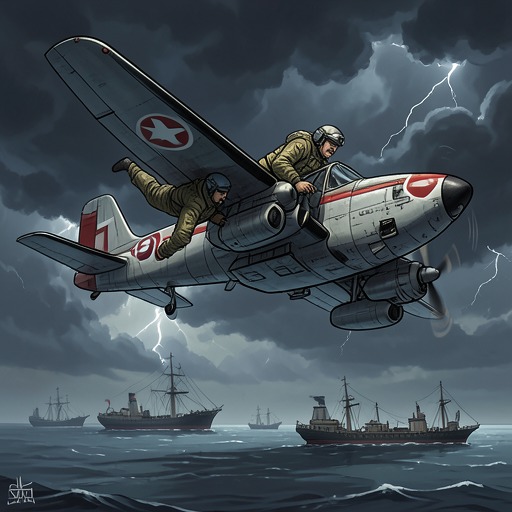
The Union destroyers opened fire with railguns, while their corvettes maneuvered away from the barrage. Roland recognized that the apparent attack was also arranging targets for the Panzerters. He spotted a flight of enemy machines among the corvettes, but the torpedo boats presented a more immediate threat. Within a minute, he and Duncan reached them.
Roland attacked the lead torpedo boat, perforating its forward hull and detonating its magazine, then struck another boat's engineering section and stopped its drive. Duncan also engaged at close range: he dislodged a corvette's point-defense turret and sent a torpedo into its cold drive. As the corvette turned toward him, he pushed off his platform and fired again. Together, the pilots destroyed two-thirds of the Union torpedo force within seconds, sharply reducing the immediate danger to the flotilla.
Engagement with Union Panzerters
The Union machines then turned toward the pilots. Roland judged that the corvettes had been dealt with and withdrew from the torpedo boats rather than continue pressing that attack. He and Duncan raced back through the debris toward the larger engagement, where the Tharcian ships Venomous and Violence were still fighting and Union craft were firing torpedoes into the flotilla. Venomous was also using its railguns against the Union Panzerters.
Roland used the terrain to enter an intercept against three Union machines equipped with torpedo tubes and bulky backpacks. Their gray and indigo finish distinguished them from those he had encountered near Fredrick, but their lack of anti-Panzerter weapons initially favored his own approach. He fired to scatter them, then concentrated on the slowest to react. After his first burst glanced off its torso armor, a second hit its side; the machine stopped fighting. He brought down another while struggling to keep pace with the faster machines, whose straight-line thrust advantage was offset by their less nimble turns.
The last opponent changed the nature of the fight. It discarded its launcher and drew an axe-like plasma weapon. Roland lost his shield and rifle in the exchange, and his Panzerter sustained damage as he blocked a further strike and counterattacked with his own sword. Before the Union machine could finish its attack, flames emerged from its armor and it stopped functioning. The excerpt does not identify what caused its destruction, so Roland's survival in that exchange is clear but the intervention is not.
Duncan, meanwhile, was struck by another Union machine and driven into the path of a second. The two attacks disabled his Panzerter, which then collided with Roland's machine. Both pilots were left in no condition to give chase as the Union machines aimed their torpedo tubes at them. At that moment, both attackers were destroyed. The captain of Venomous told the Panzerter pilots that the ship had needed them to hold the enemy in place for its new weapon, but the weapon itself is not described in this account.
Withdrawal and Significance
With both pilots' machines damaged and one Union Panzerter fleeing, Roland could not continue the pursuit. He drew a sigh and pulled Duncan along as they turned back toward the shoal zone. That ending is deliberately narrower than a declaration of victory: the two have broken up much of the immediate torpedo threat and survived the encounter, but the escaping Union machine remains at large, and the flotilla's eventual safety is not established here.
The engagement depends on coordination at several scales. Strauss's division of targets gives the pilots complementary tasks; Roland and Duncan's attacks disable two-thirds of the torpedo force; and Venomous supplies the decisive help once they are pinned by enemy Panzerters. At the same time, the fight makes clear that shielding unarmed civilian ships does not mean controlling the whole battle. The pilots can open a path through the attack, but their damaged machines and the enemy's continued presence limit what they can do next.