Tuber's legal and social status
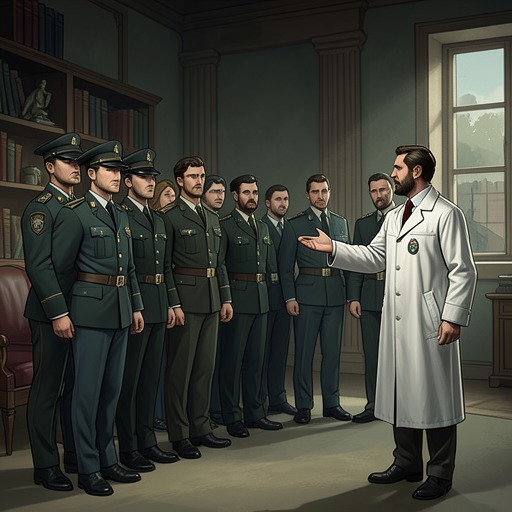
BlackwaterTuber's legal and social status is defined by a contradiction: they are engineered for useful work, including military service, yet denied reproductive autonomy and barred from public office. The account identifies a limited exception for combat-template Tuber, who may hold officer ranks. This combination makes Tuber neither simply outside the military system nor equal participants in its political order; their place is authorized selectively, according to the function they were designed to perform.
Definition and legal position
Tuber are artificial humans grown en masse and tailored for particular duties, including combat and manual labor. Their production is described in terms of scale and assigned purpose: people are created to fill roles the society requires, rather than entering those roles through an ordinary account of individual choice or background.
The stated legal restrictions are explicit. Tuber are forcibly sterilized and forbidden from holding public office. The exception for combat templates is limited to military rank: they may serve as officers, but that permission does not erase the general exclusion from public office. The distinction places military command within a sanctioned domain of service while keeping Tuber outside civic authority.
Military service and institutional use
The surrounding military structure makes the exception consequential. The Mobile Assault Guards are the Union of Martian Republics' elite forces, equipped with the best available matériel and frequently selected to field-test new technologies. Since the war began, they have strongly shaped the conduct of the Union's armies. In that setting, the ability of combat-template Tuber to hold officer ranks is not a merely theoretical allowance: it establishes that Tuber may occupy positions of command within a force central to wartime practice.
The evidence also shows military work organized through conventional units and responsibilities. In a squadron briefing aboard the PFSS Grain & Steel, commanders gather while the air wing's commander and deputy prepare the briefing; later, a second flight is ordered to assist a fourth flight, and Wayne Wendel Wheeler agrees to join the operation. These scenes establish the operational setting in which combat personnel are assigned, coordinated, and sent toward targets, though they do not identify any of the participants as Tuber. They therefore illustrate the military system around the legal exception without establishing how often Tuber serve in it or what individual experiences they have.
Service, authority, and social exclusion
The rule governing officer ranks distinguishes authorized military service from broader public participation. Tuber can be admitted to a hierarchy that directs combat, but the stated prohibition still denies them public office. The distinction suggests a status organized around usefulness to institutions: the military may permit command when tied to a combat template, while civic authority remains unavailable. The evidence does not specify whether every military command post is treated as public office; it does, however, state both the general prohibition and the special military-rank exception, making the boundary itself central to their status.
Other institutional scenes show that Union military life contains competing forms of authority and administration. A political officer attends a briefing aboard the PFSS Grain & Steel, while the Internal Review Service is identified as the Union's internal security and military-police service, concerned with dissent and the forcible integration of occupied territory. These facts situate Tuber's restrictions in a society where political and military power are institutionally organized. They do not establish that the political officer or the Internal Review Service administers Tuber policy, so the connection is contextual rather than a direct account of enforcement.
Meaning and limits of the evidence
The status described is a form of selective inclusion. Tuber are included in the economy as workers and in the armed forces as combat personnel; some combat templates may even become officers. At the same time, forced sterilization and the bar on public office restrict their bodily autonomy and political standing. Their permitted authority is therefore real but bounded: military rank does not amount to equal civic status.
The narrative's military context emphasizes practical reliance on coordination and specialist roles. Commanders distribute flights between targets, ships depend on astrogation buoys to communicate beyond their immediate surroundings, and officers must manage personnel and supplies under wartime pressure. Against this focus on function, the definition of Tuber makes their assigned purpose especially visible: they are created for work, while the law reserves political participation from them. The available evidence states the rule and its military exception, but does not describe an individual Tuber's response, a legal challenge, or any change in the policy. The status remains a structural fact rather than a resolved personal arc.