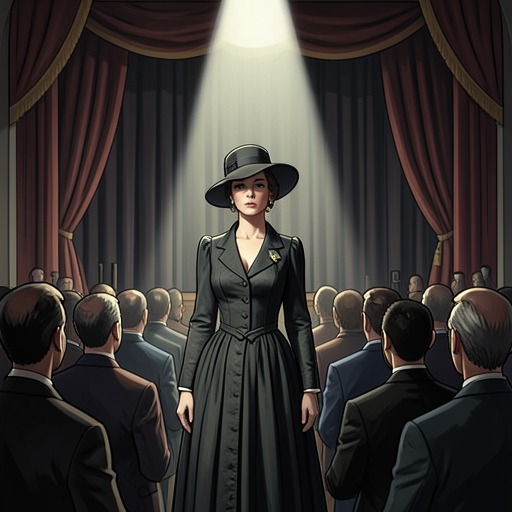
Marilyn Monroe’s prescription-drug dependence
BlondeMarilyn Monroe’s prescription-drug dependence is presented not as an isolated habit but as an increasingly dangerous part of her working and private life. In Reno, medication blurs the boundary between sleep and waking just as she must perform; on the set of The Misfits, her doctor and Whitey try to manage the consequences. Later, she seeks several forms of care while obtaining prescriptions from doctors unaware of one another, a pattern that makes help itself part of the danger.
Development and Medical Context
The novel places Marilyn’s dependence against an earlier family history of psychiatric illness and institutional treatment. Gladys Mortensen, her mother, had experienced voices since the birth of her last child and learned to ignore them. After Gladys was admitted to Norwalk State Hospital, she received courses of electroshock treatment and medication intended to prevent severe mood episodes. When Marilyn visited after ten years apart, Gladys was described as having reached the highest level of recovery considered possible in her case. These details establish a family context in which mental distress and medical intervention are longstanding realities, but the narrative does not establish that Gladys’s illness caused Marilyn’s later dependence.
By the time Marilyn was earning money as both a model for the Preene Agency and a beginning actress, she had returned to see Gladys. The visit brought mother and daughter physically together without repairing their distance: Marilyn wept and embraced her mother, while Gladys neither returned the embrace nor pulled away. The scene gives medication and hospitalization a personal as well as clinical setting. Marilyn’s later struggle unfolds against a history in which treatment can reduce crises without restoring intimacy or undoing years of separation.
Reno: Sleep, Work, and Loss of Control
During the filming of The Misfits in Reno, Marilyn’s medication use is tied to severe sleep disruption and acute difficulty facing work. She had spent the night without sleep, or remained in a drugged torpor despite having her eyes open. Before the scheduled start of filming, she shut herself in the bathroom at the Zephyr Hotel and would not come out. Her husband pleaded with her and threatened to have the door removed; she shouted that she wanted to be left alone. He went to the set without her and offered explanations for her absence, while the director arranged to shoot scenes that did not require her.
When Whitey later returned with Doc Fell, Marilyn had slumped forward and was breathing with difficulty. Her hair had been prepared for the part of Roslyn, but she was not yet dressed for the scene. Doc Fell managed to revive her, then reprimanded her for disobeying him by mixing medications and for consulting other doctors. Whitey cleaned her face and began her makeup again, calling her attention back when she seemed to drift. The scene they were waiting to film required Roslyn to drink, dance alone, and embrace a tree; the contrast between that planned performance and Marilyn’s condition in the dressing room makes the work depend on a body that medication has left precarious.
The crisis also intensifies the estrangement between Marilyn and her husband, the Playwright. He worries that her medication use is increasing and that she conceals both what she takes and how much. He sees her taking codeine even while speaking, laughing, or performing the lively public persona others admire. Their conflict is not simply about whether he loves her: he remains devoted, but his attempts to watch over her meet her insistence that she not be watched. As his concern turns into surveillance and her concealment deepens, medication becomes one element of a marriage increasingly unable to provide either trust or safety.
Dependence Beyond the Set
The story shows the cost of Marilyn’s dependence beyond a single episode at work. In a hotel suite, she struggles to get out of bed and reach a door, moving on the floor because her legs are too weak to support her. The episode is described as having happened before. Her impaired movement and confusion are not presented as a planned performance; they interrupt the private routine of a woman who sleeps alone in a separate bedroom while her husband stays on a sofa in the sitting room.
Later, while riding in a limousine, Marilyn searches her handbag for a benzedrine tablet to raise her energy but cannot find it, or cannot manage the search with her numb fingers. Doc Fell is no longer at the Studio. Hollywood is said to be circulating conflicting accounts of his death, including competing claims of a drug overdose. The narrative presents these as rumors, not confirmed facts. His absence nevertheless matters to Marilyn, who misses the doctor even as earlier scenes show him reprimanding her for combining medications and seeking other prescribers.
Treatment, Prescription-Seeking, and Consequences
Marilyn’s efforts to cope include psychiatric and psychoanalytic appointments, visits twice a week to a physiotherapist, renewed yoga lessons, and occasional massages on nights when insomnia stretches on. She cannot afford enough chloral hydrate to secure even a few hours of sleep. These efforts show that her search for relief is not confined to pills, but they do not resolve the dependence or the sleeplessness driving it. The account presents care as multiple, improvised, and insufficient rather than as a single stable treatment.
At another point, she is taking Miltown and Amytal, along with a codeine tablet because she believes she may be developing a fever. She consults two, three, or perhaps four doctors, each unaware of the others and each providing prescriptions. Her requests to them frame medication as a small aid for sleep, waking, and strained nerves, while her denials about drinking and diet suggest how selectively she presents herself in medical encounters. The important consequence is clear: no one prescriber necessarily has the full picture of what she is taking.
The dependence therefore intersects with Marilyn’s work, marriage, sleep, and attempts to obtain care. At the set, she needs assistance to return to a scene; in private, medication can leave her unable to move normally; in medical consultations, fragmented prescribing compounds the risk. The narrative’s recurring contrast is between a public figure praised for appearing lively and a person whose sleep, alertness, and physical steadiness are repeatedly compromised. It depicts the strain of maintaining that visible performance without reducing her condition to a single diagnosis or offering a simple resolution.