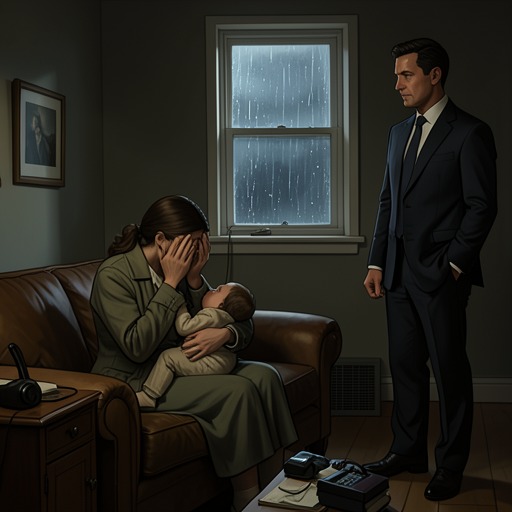
Norma Jeane’s pregnancy
BlondeNorma Jeane Baker’s pregnancy briefly offers her a future she insists is her own: a child she wants, a family she has imagined for years, and a reason to interrupt the demands of her career. The movement from elation to abortion is not presented as a simple change of heart. It is threaded through her complicated attachments, her mother’s institutionalization, her public identity as Marilyn Monroe, and the physical aftermath of what she calls an operation.
Confirmation and refusal
Under the name Gladys Pirig, Norma Jeane consults an obstetrician-gynecologist at a distant Los Angeles office. When the doctor confirms that she is pregnant, she cries and explains that she had suspected it. Her response is happiness, not fear. But the doctor attends to the tears rather than their meaning and reaches for her hand, assuring her that an abortion would be straightforward. Norma Jeane pulls away, offended by the assumption, and insists that she wants the child and that she and her husband have been trying for years.
That exchange establishes the pregnancy’s central conflict: the gap between what Norma Jeane says she wants and what other people presume she must want. The doctor treats her tears as a problem to be managed and the pregnancy as a condition with an uncomplicated medical solution. She instead asserts a personal desire and a claim to motherhood. Her refusal is immediate and explicit; at this point, the evidence gives no indication that she has already decided otherwise.
A future imagined with others
After leaving the appointment, Norma Jeane hurries to call Cass Chaplin and Eddy G. Robinson Jr. She spends much of the day trying to reach them, so absorbed by the news that she forgets a producer’s lunch, a New York journalist’s interview, and several appointments at The Studio. She considers postponing her next film, a musical, and supporting herself for a while through magazine photographs. Her thoughts move quickly from the present confirmation to the visible changes ahead: she wonders how many months will pass before her pregnancy shows and imagines letting her hair grow without further dyeing.
A late-summer night drive in the pale-green Cadillac becomes an intimate scene of shared anticipation. Cass, Eddy, and Norma Jeane are described as inwardly absorbed by the prospect of a child, though the secret will remain private until she decides to disclose it. The distinction matters: the pregnancy binds the three together, but the timing and terms of its revelation remain Norma Jeane’s choice. Cass repeats that this is real life, not cinema, while Eddy, who has joined Alcoholics Anonymous, considers whether Cass might also stop drinking. Their conversations about change accompany their hopes for the coming child without resolving what their future as a group will be.
The doctor estimates that Norma Jeane is five weeks pregnant and expects a birth around mid-April. He considers her in good health, noting that her heavy menstrual flow and associated pain will cease during the pregnancy. For Norma Jeane, this medical estimate turns an overwhelming possibility into a near-term expectation. The child is no longer only a private confirmation: the pregnancy has a projected course, and the three imagine a birth approaching.
Work, public identity, and motherhood
The pregnancy interrupts an already demanding working life. Norma Jeane earns money both as a model for the Preene Agency and as a novice actress at The Studio, but she begins to consider putting film work aside. When someone presses her about a musical, she declines for the present, despite having taken singing and dancing lessons and being considered promising at The Studio. Music can bring her an almost childlike energy, yet she now has something she regards as more important. Her refusal marks a moment when professional opportunity does not automatically take precedence over a private future.
The contrast between the pregnancy and her screen identity sharpens this choice. Norma Jeane imagines that the role of Rose might help people in Hollywood recognize her as an actress distinct from the woman represented on a billboard. She insists that the pictured woman is not herself, even while acknowledging that the image is the product of her labor. She claims a right to happiness and to her child. In that moment, motherhood appears not as an extension of Marilyn Monroe’s public image but as something Norma Jeane hopes to possess beyond it.
The turn and its aftermath
The later narrative gives no single explanation for the change from her insistence that she wants the child to the pregnancy’s end. It places a decisive realization on the day after the visit to I Cipressi and after the visit to Lakewood, following a night of turbulent dreams. The sequence links the decision to an unsettled emotional period, but does not establish one simple cause. At Lakewood, Gladys Mortensen has returned to the clinic after being found asleep in a church; Norma Jeane weeps and embraces her. Their meeting reactivates a mother-daughter bond marked by long separation. Years earlier, Norma Jeane had visited Gladys at Norwalk State Hospital after not seeing her for a decade; her mother’s psychiatric treatment and prolonged institutional care form part of the history against which Norma Jeane’s own hopes for motherhood unfold.
After the abortion, Norma Jeane experiences urination as hot and painful. In a women’s restroom, she flushes twice to cover the sound and wonders whether Jewell has recognized her, and whether recognizing Marilyn Monroe would mean recognizing the person inside that role. She refers to the procedure as the Operation, a distancing name that makes the physical aftermath legible without explaining the decision that preceded it. The scene returns the reader to the division between public persona and private self: the pregnancy had seemed to promise a life beyond the billboard, while its ending leaves Norma Jeane managing pain, exposure, and the possibility of being recognized. The child she had called hers as a right remains central to the loss, even as the narrative withholds a complete account of how she arrived at the operation.