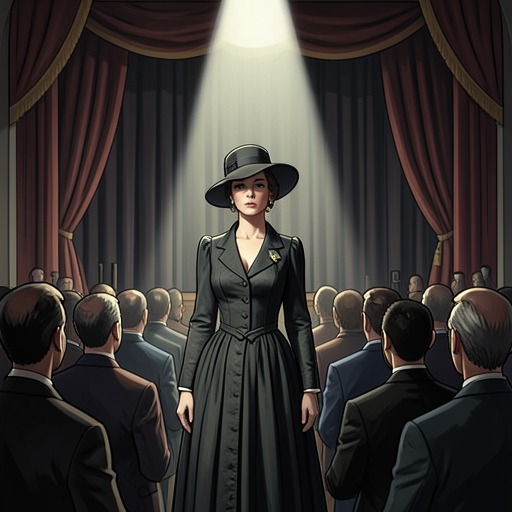
Norma Jeane's insomnia
BlondeNorma Jeane Baker’s insomnia makes sleep feel at once like a refuge, a threat, and something she cannot reach by ordinary exhaustion. As sleeplessness intensifies, familiar voices crowd her thoughts, work becomes physically punishing, and Cass Chaplin offers pills and alcohol as a way to rest. Her initial refusal gives way after a disastrous day on set; the deep sleep that follows brings relief, but also leaves her wondering whether a memory of Clive Pearce has surfaced through a medicated dream.
The Shape of the Sleeplessness
The insomnia worsens until Norma Jeane Baker lies awake with a roar in her head and mocking, indistinct voices she recognizes without being able to identify. She wonders whether they are her judges or spirits of the damned waiting for her. The uncertainty matters: sleeplessness is not simply an empty night but an experience in which inner accusation and supernatural dread become difficult to separate. Against that noise she has only Angela, the work of interpreting her, and what Norma Jeane regards as her art.
The condition persists whether Norma Jeane is alone or sharing a bed with Cass Chaplin. Alone in her tiny Salvation Army bed, she cannot sleep; with Cass beside her, she remains awake while he sleeps beyond her reach. She suffers from his absence when he is away, yet resents the ease with which he disappears into sleep when he is present. Rest therefore becomes entangled with intimacy: the person nearest to her cannot share the state she most wants, and his sleep can feel like another form of escape from her.
Motherhood, Memory, and the Hope of Sleep
Harriet’s account offers Norma Jeane a possible explanation for the kind of sleep she longs for. Harriet had suffered insomnia as a girl, but slept deeply during pregnancy; after her daughter Irina was born and her husband disappeared, sleep remained peaceful and dreamless. Irina had become, in a sense, Norma Jeane’s child too, so Harriet’s story joins the prospect of motherhood to the possibility of relief. Norma Jeane imagines that having a child might let her sleep in the same way, but immediately confronts the uncertainty of whether she will become pregnant and when.
That hope sits within Norma Jeane’s painful history of separation from Gladys Mortensen. Gladys had been hospitalized for years, and her medical records described paranoid schizophrenia and probable neurological damage associated with alcohol and medication abuse. Norma Jeane had not seen her for a decade before visiting Norwalk; the reunion left Norma Jeane crying while Gladys accepted, but did not return, her embrace. The novel does not establish that Norma Jeane’s insomnia is the same condition as her mother’s illness. Instead, it places Norma Jeane’s fear of mental disturbance and her longing for sleep beside a family history in which voices, diagnosis, treatment, and separation are already present.
The association between sleep and Gladys recurs in a later episode: when Norma Jeane reaches Lakewood, Gladys has been found asleep on a bench in a Catholic church and returned to the clinic by police. Norma Jeane breaks down and holds her mother. The episode does not cure the daughter’s sleeplessness; it sharpens the contrast between sleep as an involuntary state for Gladys and the elusive rest Norma Jeane pursues. Motherhood, too, remains an imagined route to belonging and repose rather than a certainty.
Cass Chaplin’s Offer
Cass Chaplin approaches sleep as something that can be chemically summoned. He offers Norma Jeane two white capsules, presenting them as a means for both of them to sleep. This is not his first offer: he has previously offered barbiturates as well as whiskey, gin, and rum. He himself rarely falls asleep without drinking, taking pills, or combining the two, and insists that physical tiredness alone cannot quiet him. His dependence gives the offer a double meaning: it is a gesture of intimacy, but it also invites Norma Jeane into a habit she already fears.
Cass frames sleep as a state close to death, in which a person is both dead and alive, and describes it as the best possible condition. Norma Jeane feels love for him, but also fear; in that moment she sees his invitation as temptation. The Orphanage-taught Christian Science doctrine and the influence of Mary Baker Eddy inform her objection to an artificially induced sleep. She knows Edith Mittelstadt would disapprove as well. Norma Jeane turns away from the capsules, even though she wants the rest they promise.
The Cost of Refusal—and the Relief of Surrender
After refusing the pills, Norma Jeane stays awake and anxious while Cass sleeps. She goes to work tense and nervous, struggles to remember lines she has learned by heart, and performs in a shrill voice. John Huston watches her and wonders whether casting her was a serious mistake. The consequence is immediate: insomnia crosses from private distress into professional risk, threatening the role through which she has been trying to resist the voices in her head.
The next evening she accepts the capsules. Cass places them solemnly on her tongue, in a gesture likened to communion. The contrast with the previous night is stark: the same offer she had treated as forbidden now becomes acceptable after sleeplessness has impaired her work. She sleeps more deeply than she ever remembers sleeping and wonders whether the resulting rest can be artificial and beneficial at once. Her relief is real, but the scene does not turn the pills into a lasting solution; it shows how exhaustion narrows the space in which she can maintain her refusal.
The following day, while rehearsing with Louis Calhern, Norma Jeane suddenly remembers Clive Pearce. She suspects that the revelation may have come from Cass’s sleeping potion, perhaps through a dream that was not entirely dreamless. Insomnia’s temporary interruption thus brings not blankness but a possible return of memory. The narrative leaves the source uncertain, preserving the tension at the heart of Norma Jeane’s search for rest: sleep offers relief from conscious distress, yet may also open onto material she cannot fully control.