Padlock on Milo's boathouse
BloodhoundsThe Padlock on Milo's boathouse is the crucial piece of hardware behind the apparent locked-room mystery aboard Milo Motion's narrowboat. Its importance lies not in an extraordinary mechanism but in a simple distinction: the lock Milo believes he is using is not necessarily the lock actually securing the door. Peter Diamond's reconstruction turns the padlock from a guarantee of security into a means of deception, explaining how someone could enter the cabin and leave it apparently sealed without possessing Milo's key.
Identity and Initial Significance
The padlock first matters because Milo's account makes the cabin seem inaccessible. He had one key, and the lock on the door when the police opened it was understood to be his. At the incident-room demonstration, John Wigfull recalls that the key Milo had recovered from his old bunch of keys found in the canal fitted the lock. That recovery had appeared to settle the practical question of access: if Milo alone possessed the key, then nobody else could open the locked door by ordinary means.
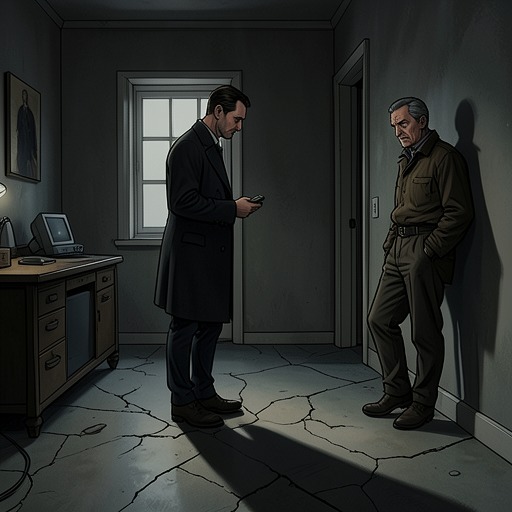
The padlock also draws attention because Sid Towers enjoyed locked-room puzzles and had training in security. Peter Diamond suggests to Polly Wycherley that Sid may have driven to Limpley Stoke boatyard out of curiosity, hoping to inspect the narrowboat and work out what had happened. Polly agrees that this is possible. The physical lock therefore links the puzzle's apparent impossibility to Sid's particular interest in solving such problems, although the suggestion about his reason for going to the boatyard remains a possibility rather than a confirmed fact.
The Evidence and the Apparent Dead End
Diamond's breakthrough begins with a second padlock among the bagged and labelled contents of a dead man's pockets. He asks Wigfull to compare it with the lock from the narrowboat. Wigfull recognizes the same make but objects that this is not enough: the lock taken from the pockets could not have secured Milo's door if Milo's own padlock had been on it when the police entered. The locksmith had also said that two keys could not be identical, while Milo had only one key to his lock. The apparent resemblance thus seems to offer a clue without solving the access problem.
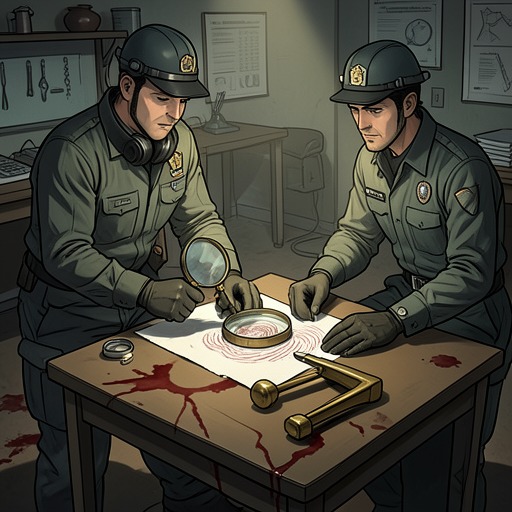
Diamond tests the keys instead of relying on appearance. The ring associated with Rupert Darby holds four keys: a Yale-type key resembling a front-door key, a plastic-topped key probably for a car, and two small, narrow keys identical in shape to each other. Diamond tries each of the narrow keys in Milo's padlock; neither turns it. Wigfull takes this as confirmation that the keys do not fit. When Diamond places one beside Milo's key, their cuts are visibly different. The failed test establishes an important limit: similar-looking hardware does not make the keys interchangeable, and the second lock cannot simply be treated as a duplicate that opens Milo's door.
That distinction preserves the puzzle rather than dissolving it. The recovered keys do not directly unlock Milo's padlock, and the second lock alone proves nothing about how entry occurred. Diamond's solution depends instead on the way an ordinary padlock can be attached and closed, and on what Milo assumes about the lock hanging outside his door.
Diamond's Reconstruction
Diamond asks his colleagues to imagine Milo arriving at the locked boat and using his own key to open the padlock. Once aboard, Milo has no reason to lock the outside of the door while he remains inside; for privacy, he can use the fingerbolts on the inside. The padlock hangs from the exterior staple with its arched shackle unfastened, so it can be lifted off. In this state, the door's apparent security depends less on the lock than on the assumption that the familiar lock is still the one hanging there.
The culprit can then replace Milo's unfastened padlock with a similar one that takes a different key. The substitution is quick, and Diamond's scenario has Milo unaware that it has happened. The distinction between the two locks is the heart of the deception: the substitute looks sufficiently like Milo's for him to mistake it for his own, but the culprit retains the key that opens it.
When Milo later leaves, he closes the door, lifts the substitute from the staple, and puts it back in place. He does not need to use his own key. A padlock of this kind locks automatically when its shackle is pressed home, so the door appears secured even though Milo has not keyed it. He believes the lock is his; in fact, he has fastened the culprit's lock to the door. What looks like routine locking is the point at which the apparent barrier is created.
The culprit can use the key to enter the cabin, commit the crime, and leave. Before departing, the culprit replaces the substitute with Milo's padlock and presses it closed. Milo later returns, unlocks the familiar lock as usual, and cannot understand how anyone entered. The door's locked appearance is not false in the simple sense that no lock was present: a padlock is there, but its identity changes at the decisive moments. The method makes the cabin seem inaccessible by exploiting the owner's trust in a familiar object.
Function in the Mystery
The padlock's changing role explains why the first line of reasoning stalls. The recovered lock and the recovered keys invite a direct comparison: if the keys do not fit Milo's lock, the second lock seems irrelevant. Diamond shifts attention from whether the keys match to when each lock is on the staple and whether the shackle is fastened. That change of question turns the hardware's ordinary operation into the missing mechanism of the crime.
The demonstration also depends on the difference between possession of a key and control of access. Milo's possession of the one key to his own padlock initially appears conclusive, but it only proves that he can open that particular lock. It does not prevent another person from exchanging the lock while it hangs unfastened, or from using a separate key after the substitute has been installed. The object's apparent continuity conceals a break in the chain of control.
In the incident room, Diamond's explanation is tested publicly rather than merely asserted. Wigfull handles the comparison cautiously, the assembled detectives and staff watch the experiment, and the unsuccessful key test initially seems to support Wigfull's objection. Diamond nevertheless proceeds from the padlock's operation to the substitution sequence. The colleagues' cautious murmurs give way to understanding, and Julie Hargreaves observes that nobody else had solved the problem before that moment. The padlock consequently serves both as evidence and as the physical model through which the locked-room puzzle is resolved: its routine, automatic closure creates the illusion of an impossible lock, while the possibility of substitution makes that illusion workable.