Sid's brown paper bag
BloodhoundsSid's brown paper bag is an unassuming object whose importance depends on its passage through several hands. At a Bloodhounds meeting, Sid Towers produces it to help Jessica Shaw respond to Miss Chilmark's attack of breathlessness; afterward, Jessica keeps it, forgets it in her handbag, and Peter Diamond recovers it. When Diamond opens the bag in front of investigators, its three rows of rhyming words make an ordinary piece of wrapping part of the case's evidence.
At the Bloodhounds Meeting
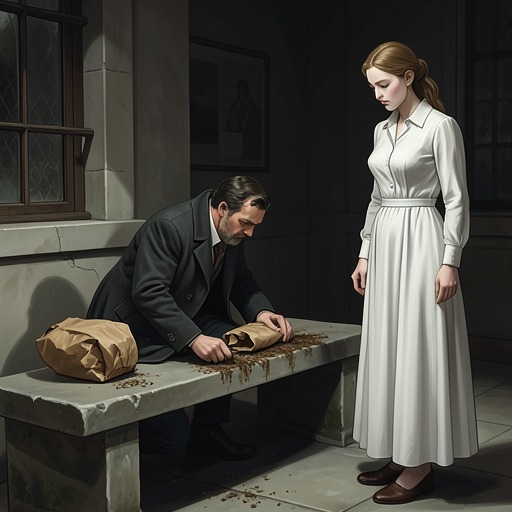
The bag first enters the account as a practical item, still wrapped around a book Sid had brought to the meeting. After Rupert's dog jumps beside Miss Chilmark, she becomes distressed and suffers an attack of breathlessness. Jessica calls for a paper bag, and Sid supplies one from his carrier bag. Jessica holds it against Miss Chilmark's face, and the attack subsides. The bag's immediate value is therefore direct and bodily: it gives Jessica a means of helping Miss Chilmark, rather than serving merely as packaging.
The action also depends on a small chain of cooperation. Jessica recognizes what is needed and asks for it; Sid has the bag to hand and provides it; Miss Chilmark responds to Jessica's intervention. Rupert removes the dog, while Miss Chilmark feels well enough to remain at the meeting. In this first episode, the bag passes from Sid to Jessica as part of an improvised response, and its use appears complete once the distress has eased.
Kept, Then Overlooked
Jessica does not immediately discard the bag. She says she kept it beside her in case Miss Chilmark's attack recurred, since Miss Chilmark intended to stay for the rest of the meeting. That decision gives the object a brief continuing purpose: it remains available as a precaution even after it has already been used. The bag's later disappearance from view is not a dramatic loss but a consequence of the gathering's confusion. At the end of the meeting, Jessica puts it in her handbag and forgets about it.
The investigation reconstructs this unremarkable route by asking what happened to the bag after the incident. Jessica initially treats the question as possibly beside the point, while Diamond insists on tracing it. He later recovers the bag from her that afternoon. The recovery connects the object to a particular meeting and a specific sequence of custody: Sid supplied it, Jessica kept it, and it remained in her handbag until Diamond retrieved it. Its evidentiary importance depends on that mundane continuity, not on any conspicuous feature of the paper itself.
The Writing Inside
When Diamond presents the bag to the other investigators, he smooths it on John Wigfull's desk and passes it to Arnold Musgrave. The bag is no longer being examined for its usefulness as wrapping or as a remedy. Its interior carries three rows of words written in untidy black ballpoint. Wigfull recognizes that the words rhyme; Diamond encourages the group to take time over them. The physical object that had been easy to overlook now bears writing that invites interpretation.
A book had been wrapped in the bag when Sid brought it to the meeting. During the later examination of recovered objects, Diamond asks where the brown paper bag connected with the book is, and the book is identified tentatively as The Three Coffins. The bag's association with that book places it within the meeting's sequence of books and discussion, but the account establishes the writing on the bag itself as the feature requiring attention. The distinction matters: the paper's significance does not rest solely on what it once enclosed, but on what was written on it.
From Useful Object to Clue
The bag's changing role gives it a compact but consequential trajectory. At first it is ordinary packaging carried by Sid; in the crisis it becomes a makeshift aid; afterward it is kept as a precaution and then forgotten; finally, its handwritten rows bring it before the investigators as an object to be read. No single participant initially treats it as important for all these purposes. Its meaning accumulates through use, retention, accidental preservation, and inspection.
That progression also explains why Diamond follows the bag's whereabouts so closely. Jessica's account of keeping it and later putting it in her handbag identifies how it survived the meeting and came within his reach. The written rhymes turn this preserved trace of an ordinary encounter into material evidence. The bag therefore joins the human recollection of the meeting to a physical inscription: what might have vanished as disposable wrapping instead remains available for the investigation to examine.