The Penny Black riddles
BloodhoundsThe Penny Black riddles are rhyming clues woven into a carefully planned stamp theft and its later reappearance. They address both the police and the Bloodhounds, turning a criminal scheme into a puzzle about prediction, interpretation, and recognition. Their central irony is that a clue may seem clear once its answer is known while offering no practical way to anticipate the event it describes.
Design and sequence
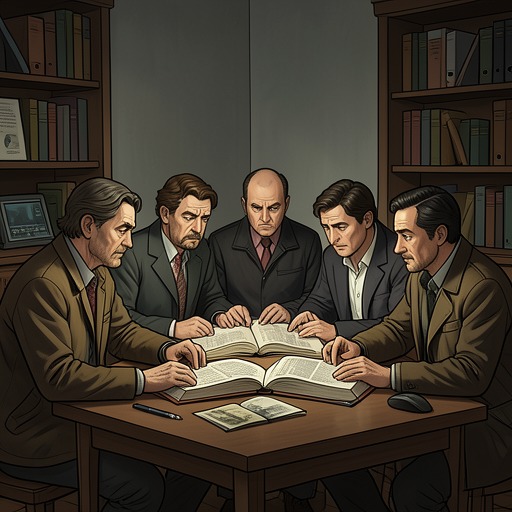
The riddles form part of a plan that began before the police understood the connection between them. John Wigfull reconstructs a sequence from the previous week: an erroneous tip-off from Bristol on Thursday, the first rhyming riddle on Friday, and the theft of the Penny Black at the Postal Museum that same Friday morning. In his account, these are not separate coincidences but interlocking stages, followed by the stamp’s deliberate planting in Milo Motion’s book. The thief intended to return the stamp after making fools of both the police and the Bloodhounds.
The planting depended on a particular future occasion. The stamp appeared in chapter seventeen of a book written sixty years earlier, when Milo brought it to a Bloodhounds meeting and opened it there. Diamond stresses the gap between a clue’s apparent intelligibility afterward and its usefulness beforehand: the police could not have known that the stamp would surface in that precise chapter. The riddle therefore functions less as a straightforward advance disclosure than as a message whose apparent solution is completed by the staged event itself.
That arrangement also implicates Milo without making him the thief. Diamond concludes that the stamp’s appearance was planned and that Milo had been selected as the fall guy. Julie Hargreaves identifies the practical implication: whoever stole it must have known Milo would take the book to the meeting and open it at chapter seventeen. The clue narrows the circle of suspects, but only after the elaborate placement has exposed the thief’s knowledge of Milo’s plans.
Hindsight, authorship, and competing explanations
The first rhyme invokes Victoria, and Julie recalls its opening as “Whither Victoria and with whom-The Grand Old Queen?” Wigfull insists that the final two lines contain the puzzle. Diamond, however, is unconvinced that solving the verse would have enabled the police to prevent the theft or predict the stamp’s appearance. He compares it to the earlier rhyme: easy enough to work out after the event, but not a meaningful warning in advance. The contrast makes interpretation itself part of the trap. The detectives can recognize a pattern without having been given a usable forecast.
The riddles also invite questions about who composed them and why. Diamond proposes a different possibility when considering Sid Towers: perhaps Sid stole the stamp to make a point to the opinionated Bloodhounds, who thought they knew everything about detective stories. Because Sid’s speech was underdeveloped, Diamond imagines that he might have made his claim through writing, using riddles and rhymes to communicate that he was cleverer than the others supposed. The stamp’s appearance in Milo’s book would then stage a previously unknown locked-room mystery, one that even Dr. Fell had not encountered. Diamond explicitly treats this as a hypothesis, not an established solution; the riddles permit an attractive theory without, in this scene, proving Sid was the thief.
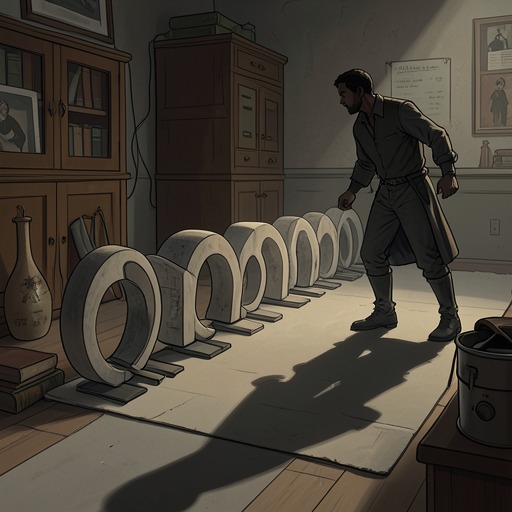
The physical clues have the same demand for interpretation. In a later inquiry, three rows of words written in an untidy hand in black ballpoint are recognized as rhyming words. Their arrangement presents language as material to be sorted and decoded, but the surviving evidence here does not specify a complete solution to those lists. The episode underscores the difference between recognizing a formal device and establishing what it means: rhyme is a method, not by itself a revelation of authorship or motive.
The third riddle and the demand for recognition
By chapter twenty-seven, another message reaches the police. The Assistant Chief Constable reads the verse aloud: “To end the suspense, as yours truly did, / Discover the way to Sydney from Sid.” It is reported to have reached all the local media first, extending the riddles’ audience beyond the investigators and the Bloodhounds. Its wording is more direct than the earlier clues, and its appeal to end the suspense sounds like an invitation to resolve the case rather than merely admire the puzzle.
Wigfull interprets this change in tone as a possible sign that the writer wants to be exposed. He reasons that a person who has committed a masterly crime and produced clever rhymes may become frustrated when no one recognizes the achievement; the desire for glory, he suggests, could eventually overcome the wish to remain hidden. This is presented as an optimistic reading, not a confirmed motive. Diamond hopes it may be right because the investigation needs a breakthrough, but does not endorse it as fact.
The line about finding the way from Sid to Sydney links the new verse to the murder investigation through its wording, while “To end the suspense” addresses the case’s continuing uncertainty directly. The riddles thus change in apparent purpose: what first seemed to conceal a plan can later seem to solicit its solution. Yet even a more explicit invitation does not establish who is writing, or whether the writer truly wants to be unmasked.
Narrative function
The riddles make the theft legible as a designed sequence while keeping the crucial distinction between a pattern and proof in view. The erroneous Bristol tip-off, the rhyme, the theft, and the planted stamp can be assembled into a coherent plan; the delayed appearance in Milo’s book shows how that plan turns the act of solving into part of the spectacle. Investigators may reconstruct the sequence only after the intended embarrassment has occurred.
Their connection to the Bloodhounds sharpens the contest between detective-fiction ingenuity and actual police work. A theft is made to resemble a literary puzzle, and the stamp’s placement in a book provides a staged locked-room effect. But clever construction does not automatically supply a fair or timely clue. Diamond’s objection is precisely that hindsight gives the riddles a clarity they did not offer in advance. The final message may promise release from suspense, but its call to discover the route from Sid to Sydney sustains the uncertainty until someone can turn its wordplay into evidence.