Abalone
BluebackAbalone are reef-dwelling shellfish whose harvesting sustains work and household life at Longboat Bay, while their vulnerability to heavy extraction makes them central to the story’s movement from dependence on the sea toward its protection. The novel presents them in practical detail: attached to rock, gathered by hand and tool, used for food and income, and finally flourishing within a protected bay. Their changing fortunes register both human use of the coast and the consequences of safeguarding it.
Habitat and harvesting
On a dive with his mother, Abel Jackson finds abalone in seams along smooth granite. The shellfish are round and silver, clamped tightly to the rock; a substantial screwdriver is needed to prise them free. Once detached, the abalone twitch inside their shells, and their meat is white with a green edge. The account makes harvesting a physical task shaped by the reef itself: divers descend on a breath, search the rock, and work along the bottom before returning to the surface.
Abel and his mother collect abalone in repeated dives, filling their bags as they move from clump to clump. Their practice is selective. They take a couple from each cluster and leave the others to breed and grow. This limit does not make the work separate from the reef’s ecology: disturbed sediment and scraps of meat draw small fish from weed and crevices. The scene places human gathering within a living community, where what divers remove and leave behind has consequences for other animals as well as for future harvests.
Food, income, and inherited use
Abalone belong to the household economy at Longboat Bay. After the first encounter with Blueback, Abel helps his mother shell the catch and trim the meat for freezing. She heats seawater in a drum over a gas flame to clean the empty shells, which people in town buy as souvenirs. The shells bring in a few dollars, while the meat is prepared for storage. Harvesting therefore supplies both food and modest income through distinct uses of the animal.
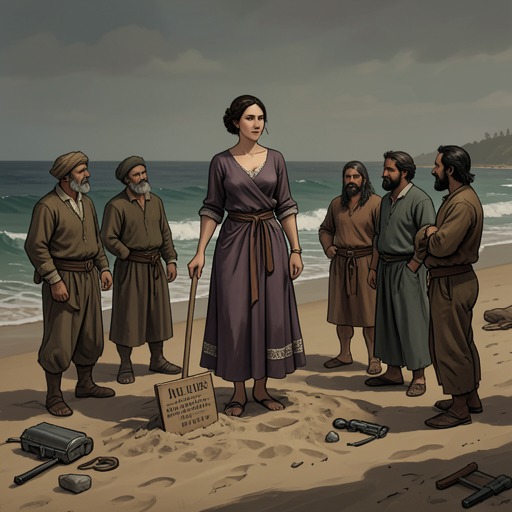
The work sits within a much older pattern of living from the surrounding land and sea. Abel and his mother fish, grow fruit and vegetables, and keep animals; their family has lived in this way at Longboat Bay for more than a century. The narrative also places earlier generations’ exploitation of marine life in the area’s history: the Jackson family came as whalers, and the coastal economy drew on marine resources. Abalone gathering is not presented as identical to whaling, but it belongs to the broader inheritance of making a living from the sea. The later discovery of buried whale bones makes that inheritance visible and helps change its meaning: Dora Jackson comes to see protection, rather than continued extraction, as the work now owed to the bay.
Commercial pressure on the reef
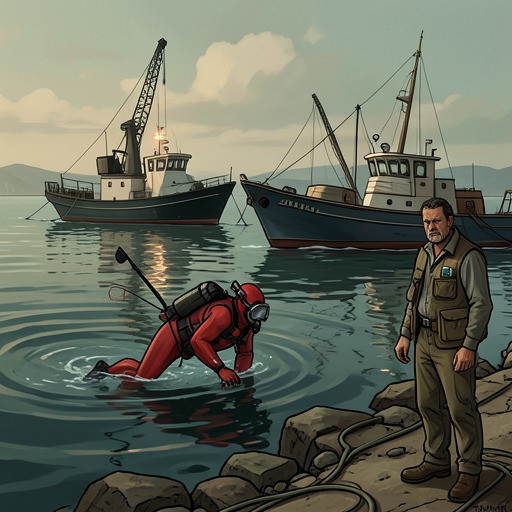
The novel contrasts the family’s limited harvesting with more intensive commercial activity. Mad Macka’s boat works across the bay with an air compressor and a hose supplying air to a diver underwater. His method also involves taking a few abalone from each seam and leaving others for the following year. Later, Costello’s anchored boat presents a different scale of extraction. Its deck is crowded with fish, including many undersized specimens, while crates hold writhing abalone. The scene’s range of catch and its excess make the cost of commercial exploitation visible rather than abstract.
Abel responds by returning abalone from the crates to the water. He then watches divers working on the reef and sees shellfish falling back toward the bottom behind them; some are dead, and small fish pick at them. The episode distinguishes returning animals from restoring the conditions of the reef: not all the abalone survive, and the divers continue their work without turning back. Abel’s attempt to intervene is followed by a threat that he would be hurt if he boarded the commercial boat, while his mother goes into the water herself. The consequence is a period of uncertainty, then a Fisheries patrol arrives, boards Costello’s boat, and tows it away. Fines cost Costello his licence and put him out of business. The account thus links commercial pressure to enforcement, while also showing that individual acts of rescue cannot by themselves stop extraction.
Protection and ecological recovery
Dora Jackson’s campaign leads to Longboat Bay being declared a marine sanctuary, with its living resources protected by law. When officials later mark the boundaries, the reserve extends out to Robbers Head. The change gives the bay a formal limit against damaging use and provides a setting in which abalone and other marine life can recover. Abel and Stella later write papers on abalone breeding habits, joining their scientific work to the protection of the place where Abel learned to dive and gather shellfish.
The account describes the results in a wider ecological frame. Fish enter the sanctuary and breed there, increasing the stocks beyond it; seagrass, coral, and sponges thrive, and abalone grow abundantly. Dolphins and sharks return to the bay, while sea lions come back to Robbers Head after a century away. These details do not reduce recovery to a single species: the abalone’s renewed abundance is one part of a richer marine community. The sanctuary is presented both as shelter within its boundaries and as a source of life for surrounding coastal waters.
Narrative significance
Abalone trace a change in what it means for Abel’s family to belong to the coast. At first, the shellfish are encountered through skilled labor: locating them in granite, judging how many to take, and using the catch at home. Later, commercial pressure reveals how quickly the reef can be treated as a stock to strip, while Dora’s campaign recasts the family’s inherited relationship with the sea as a responsibility to protect it. The abalone’s progression from catch to threatened resource to abundant life within the sanctuary gives that change a concrete measure.
The story does not suggest that people can fully know or command the sea. Instead, harvesting practices, research, and legal protection all meet the limits of a living system that must be allowed to continue on its own terms. Abalone connect everyday sustenance to long environmental history: their shells and meat have value to people, their breeding depends on what remains on the reef, and their later abundance signals the benefits of restraint. Their place in the narrative makes conservation not a rejection of coastal life, but a shift from taking from the bay to helping it endure.