Tiger shark
BluebackThe Tiger shark is both a remembered danger and a living victim in the history of Longboat Bay. One killed Abel Jackson’s father before Abel could remember him; years later, another enters the bay with a hook and buoy dragging from its jaws. Abel watches it suffer, finds the name Costello on the buoy after its death, and carries it out to sea. The two encounters make the shark more than a sign of danger: they connect the sea’s unknowable power with the consequences of human violence toward it.
Identity and Earlier History
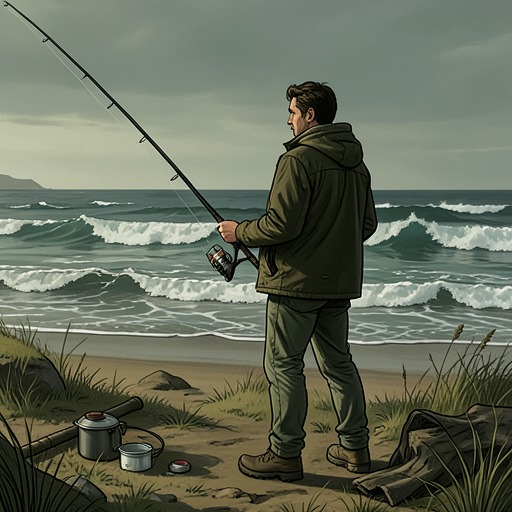
Abel’s father was a pearl diver who travelled north each year for the pearling season. Though he returned with the season’s earnings and said he would not go back because the work was boring, he kept returning. One year a Tiger shark took him. The crew of his lugger hauled in his air hose and found no one at its end; they later found his fins on the murky bottom of Roebuck Bay, but never recovered his body. His death was therefore known through what was missing as much as through what the crew found.
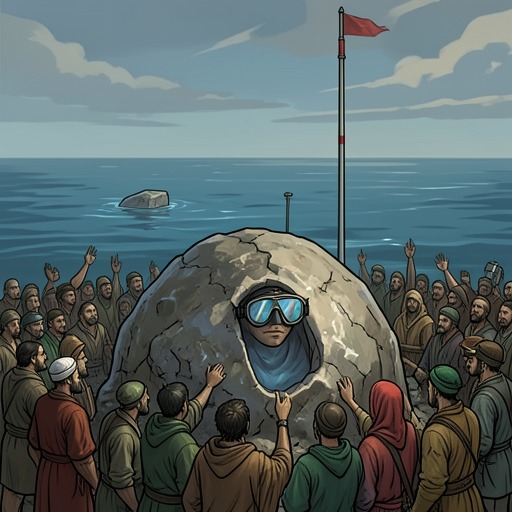
For Abel, who was two when his father died, the attack is inherited knowledge rather than a remembered scene. His mother keeps a photograph of his father on the mantelpiece and preserves a small memorial near the orchard, where a candle, pearl shells, and a driftwood dolphin mark her continuing grief. Abel experiences the bay, garden, and house as connected to his father, but the shark itself remains part of the mystery of what happened beneath the water. The novel places this personal loss within the Jackson family’s longer history at Longboat Bay: the family came there as whalers, and its old livelihood was bound to taking life from the sea.
The Shark in Longboat Bay
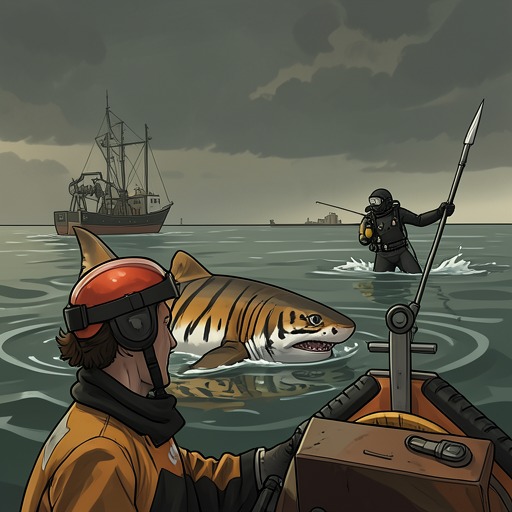
A couple of weeks after the Costello affair, a huge Tiger shark swims into the bay. Abel takes his boat out to look at it, while his mother stays ashore. She cannot bear to see a Tiger shark again, a response shaped by the death of Abel’s father. Abel understands her reluctance but goes because curiosity overcomes his own fear.
The shark appears wrong for its size and kind. Instead of looking thick and powerful, it is wrinkled and flabby. A large red buoy trails behind it on a chain, and a stainless-steel meat hook is lodged in its jaws. The buoy prevents it from diving: whenever it tries to descend, the line drags it back to the surface. The shark must have fought the restraint for hours when it was first hooked, but by the time Abel sees it, its strength is spent. Each movement of its head and tail brings pain; it is starving and exhausted, unable to escape or recover.
Abel watches from his boat through the afternoon, then comes ashore and continues watching from the jetty. That night, from the verandah, he sees moonlight catch the buoy as it moves across the still water, leaving a bleak, glittering wake. The small flash of light does not soften what the buoy means: the shark remains trapped in a condition Abel can witness but cannot undo.
Death and Abel’s Response
Abel imagines that, if he had a gun, he would pull alongside and shoot the shark to end its suffering. He also recognizes that he cannot save it, even by cutting it free. The scene gives his helplessness a concrete limit: compassion does not provide the means to rescue an animal already weakened by its injury and restraint.
In the morning, the Tiger shark is dead. The tide has left its body stiff and leathery on the beach. Abel turns the red buoy over and sees the name Costello stencilled on it. The discovery connects the animal’s suffering to the human figure whose fines have cost him his licence and business. It does not restore the shark or turn its death into a rescue; instead, it makes the responsibility behind the harm legible.
Abel tows the body out to sea, replaces the buoy with lead weights, and cuts it free. The shark sinks into the black depths like a torpedoed ship. His action gives the dead animal a final passage away from the shore, but it cannot reverse the suffering that came before. The contrast is stark: the buoy had forced the living shark back to the surface, while Abel’s weights let its body descend.
Ecological and Narrative Significance
The shark’s appearance changes Abel’s understanding of cruelty. After returning to school in the new year, he feels older and different; that summer has taught him that nature is not as cruel and savage as a greedy human being. The judgment arises from what he has watched: the Tiger shark is dangerous, but in this encounter it is also the creature made to endure prolonged pain by human equipment. The danger it once represented in Abel’s family history does not excuse the cruelty inflicted on it.
The shark thus binds two generations of Abel’s story without making their experiences identical. His father disappears in a fatal encounter with a Tiger shark, leaving the family with no body to bury. Abel, by contrast, sees a shark’s body and the mechanism of its torment, then takes responsibility for returning it to the sea. Later, sharks come into the flourishing waters of the protected Longboat Bay alongside dolphins and other marine life. That return concerns the renewed life of the bay, not the individual shark Abel found dead. Across these episodes, the Tiger shark remains a reminder that the sea exceeds human knowledge, while human choices can still determine whether its creatures are left to live, suffer, or recover.