Pilchards
BluebackPilchards are both a practical resource and an early warning in the story of Longboat Bay. Abel Jackson and his mother, Dora Jackson, catch them to enrich their gardens; years later, a sudden mass die-off leaves the beach black with dead fish and signals that the sea may be changing. The shift from harvest to unexplained mortality gives these small fish a distinct place in the novel’s account of family livelihood, coastal history, and environmental uncertainty.
A resource in household life
Each year, Abel and Dora net Pilchards and salmon and use the catch as fertilizer. The fish are chopped into a rich compost with tree bark, vegetable scraps, and seagrass, then dug into the orchard’s sandy ground. Abel carries washed kelp uphill from the jetty and spreads it around the fruit trees, including figs and apricots. This work makes the orchard’s productivity part of a broader dependence on the bay: the sea supplies materials that are returned to the land.
The arrangement belongs to a self-sufficient household rather than an occasional fishing excursion. The Jacksons live from the sea and the land at Longboat Bay, raising fruit and vegetables and keeping animals for food. The routine harvest of Pilchards connects marine life to daily labor and to the soil where the family grows its food. At this point, the fish enter the narrative as part of a working cycle: caught in the bay, mixed with other organic matter, and spread through the family’s gardens.
The sudden die-off
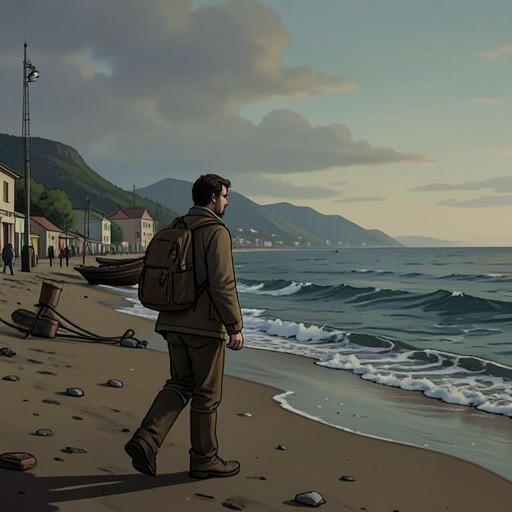
That cycle is interrupted when Abel, home during the holidays after graduating from high school, finds the beach covered with dead Pilchards. The scene offers no clear cause. There has been no storm, warning, or oil spill, and no explanation is available. The beach is black with fish; flies fill the air, while gulls hover uncertainly above the stinking mass. Abel walks the shore trying to understand what has happened.
The response is practical as well as bewildered. Abel helps Dora load the mushy fish into a truck, and for hours they spread them over the orchard and gardens. The dead catch is still put to use, but its meaning has changed. What had previously been harvested deliberately and made into compost is now a mass of unexplained deaths that the family must clear away. The work continues, yet it can no longer be understood simply as a familiar part of living from the bay.
Dora identifies the event as abnormal, saying that something is wrong with the sea and that this is not normal. Her judgment comes from close experience of the place and its patterns, but it does not supply a cause. The episode leaves the contrast intact: the fish are visible and their death is undeniable, while the process behind it remains unknown.
From local event to coastal mystery
Later that month, tuna skippers tell the Jacksons that dead Pilchards are floating along the coast. The reports widen the scale of the event beyond the beach at Longboat Bay, without making its cause any clearer. No one has an explanation. The recurrence in a broader stretch of water makes the first discovery harder to dismiss as an isolated local incident, but the evidence still offers no diagnosis.
For Abel, that uncertainty becomes a question he wants to pursue. Dora says the ocean is sick; Abel, thinking about the dead fish and the sea’s wider puzzles, wants to figure out what is happening. He eventually goes to university to study the sea. The die-off does not, by itself, prove what has caused the disturbance, and the narrative does not assign it a specific source. Its consequence is instead to sharpen Abel’s attention: familiar waters may look ordinary on one dive and still belong to a larger, unsettled system.
Meaning in the bay’s changing history
The Pilchards’ role changes from dependable input to disturbing evidence. Their annual use as fertilizer reflects a household economy built around the exchange between sea and land; their unexplained deaths expose the limits of that practical knowledge. Abel and Dora can recognize an abnormal event and respond to it, but neither can immediately explain why it has occurred. The gap between observation and understanding is central to the episode.
The fish also belong to a coastal history in which the bay has sustained human life and borne the consequences of human use. The Jackson family’s older history includes whaling, while Dora later works to secure legal protection for Longboat Bay. These histories are not presented as causes of the Pilchard die-off. Rather, they frame the change in how the sea is regarded: as a source of livelihood, as a place whose condition can become uncertain, and finally as an ecosystem requiring protection. The Pilchards make that shift concrete. Once familiar enough to be gathered and spread on garden soil, they become an unsettling sign that the sea’s health cannot be taken for granted.