Belonging to place
BluebackBelonging to place in the story is more than affection for a familiar landscape: it is a relationship built through work, memory, family inheritance, and dependence on a living environment. For Abel Jackson and Dora Jackson, Longboat Bay is not interchangeable property. It is the ground of their daily life and the storehouse of their family history; when Abel leaves, his sense of self remains oriented toward it, and when he returns, that attachment becomes a choice to help care for the place and its future.
Home as inheritance and daily practice
Abel’s attachment begins in a life shaped by the close exchange between land and sea. His family has lived at Longboat Bay for more than a hundred years, and its land has been theirs since whaling times. The surrounding country is national park, while the family’s own work joins the coast to the orchard and household: Abel and Dora Jackson fish, grow fruit and vegetables, keep animals, and use marine plants and fish to enrich the soil. Abel carries washed kelp uphill to the fruit trees; fish caught in the bay are chopped into compost. The place is not merely scenery around his life but part of the labor that sustains it.
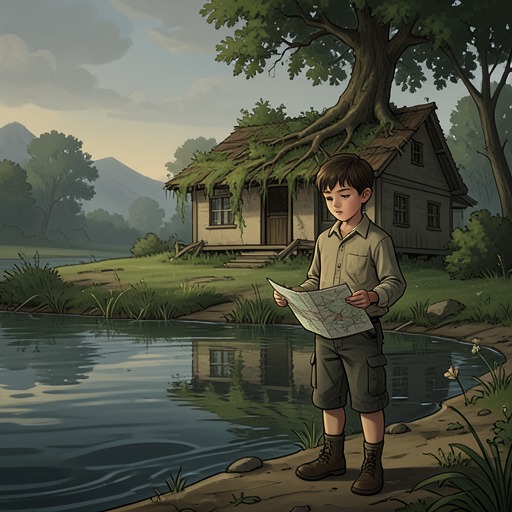
That life is demanding and materially limited. There is no mains electricity, the household relies on rainwater, and there is no television. Yet Abel has never known another home. He swims in the sea every day, roams the surrounding forest, and works beside his mother. His knowledge of land and water comes from her, as does his practical understanding of living there. The familiarity is bodily and learned: it grows through repeated work, movement, and attention rather than through an abstract idea of home.
Family memory gives the landscape another depth. Behind the orchard, a small cemetery holds the crosses and headstones of generations of Jacksons. Abel’s father has a cross there, although his body was never buried beneath it. A peppermint tree serves Dora Jackson as a private shrine to Abel’s father; as a boy, Abel leaves a piece of white coral in its fork and presses his cheek to its bark. The gesture links the coast’s materials to family remembrance, making a particular tree and a fragment of coral part of the way he understands where he comes from.
Separation and the pressure of distance
Abel’s departure for school makes the force of that attachment visible by contrast. Before leaving, he looks down on the house, orchard, poultry, washing, and chimney smoke and sees his whole life gathered there. The prospect of going inland troubles him because the departure is not simply a move between addresses: he understands Longboat Bay as the place where he belongs. As the truck carries him away, he fears he will wither without it.
The inland town offers a sharp reversal. Instead of the open coast and forest, Abel encounters flat wheat country where trees have been cleared, and a crowded routine of school, hostel, slamming doors, clacking shoes, voices, coughs, and pipes. He works hard and makes friends, but the density of town life leaves him feeling hemmed in and surrounded. Time seems slower than it did at home, and longing for the bay throbs in him like a headache. His distress is not presented as a dislike of every new experience; it comes from the mismatch between the life around him and the place that has formed his sense of freedom and continuity.
Sleep allows him to revisit the sea, but it also shows that return cannot undo loss. In one dream, Blueback leads him through a deep crevice among drowned people, including Mad Macka and Abel’s father. Abel sees his father as a young man who will always be thirty-two, reaches toward him, and is kept from touching him as Blueback carries him upward. The dream gives the sea a double role: it is the medium through which Abel remembers home and his father, but its depths also hold what cannot be recovered. Letters from Dora Jackson, along with shells and other marine objects she sends, keep the coast present in his inland life without making distance disappear.
The bay as memory, conflict, and responsibility
The family’s history at Longboat Bay is not innocent of change. Dora Jackson tells Abel that his ancestors came as whalers, watching for whales from a ridge before rowing out in longboats to harpoon them. When right whales later surround Abel and his mother at sea, their stillness as observers contrasts with that earlier pursuit. Dora reflects that the Jacksons once hunted whales and that the sea has also taken its share of the family. The encounter makes belonging carry a historical obligation: the family is tied to the coast not only by affection and sustenance but also by what earlier generations took from it.
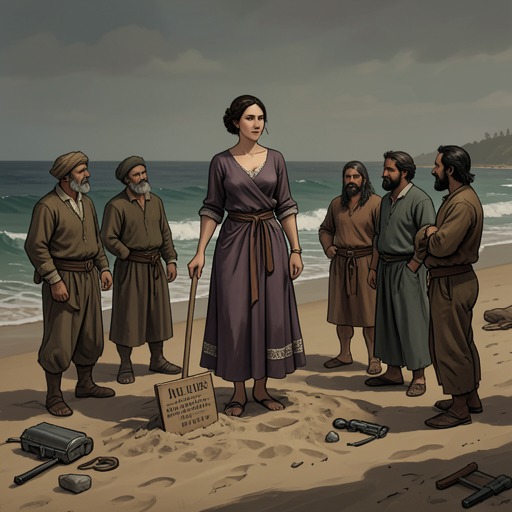
That history becomes physically unmistakable after a storm exposes thousands of whale bones along the bay. Dora walks among them as if through a graveyard, realizing that she and Abel had lived above this buried past without knowing it. The bones reveal how whaling and sealing helped bring the Jacksons to the coast and paid for the land over time. Dora understands the inheritance as a responsibility that must change direction: after generations of living from the sea, it is time to help the sea live. Her work to have the bay protected grows out of this recognition, joining family memory to an active form of stewardship.
The meaning of home is also tested by commercial pressure. Businessmen try to persuade Dora Jackson to sell, beginning with flowers, chocolates, champagne, and practical gifts before escalating to experts, tax officials, lawyers, and agents. When she refuses, the gifts stop and a pattern of harassment follows: neglected road maintenance, disrupted mail, fuel contaminated with water, and mysterious winter fires. Abel reads about these pressures while away and understands that the men see land as property, not as the life and companionship it represents to his mother. Dora’s refusal is therefore a defense of a lived relationship, not merely a rejection of a financial offer. She outlasts the businessmen after five years, preserving the possibility that the place can remain a home rather than become a development.
Return and the choice to stay
When Abel returns for the summer holidays, seeing the green sea and reaching Jackson land brings immediate joy. He and Dora laugh on the way home; that night he stands on the jetty and breathes the salt air. His return does not erase the experiences that took him away. He travels for scientific work with Stella, sees damaged and unfamiliar marine environments, and watches from overseas as an oil tanker breaks apart off the coast. The oil never reaches Longboat Bay, but the near-disaster shows him how vulnerable the coast is even when he is far away.
As Dora grows older, Abel’s attachment faces a harder question: whether loving the place means remaining there, and whether she can continue to live there alone. After she breaks her hip, Abel recognizes that she is afraid of having to leave more than she is afraid of the injury itself. He repairs the neglected family property while she is in hospital, fixing the house and gardens and attending to the rotting jetty and failing sheds. The work is practical care, but it also restores the place that has sustained them. At the peppermint tree he returns to the childhood gesture of pressing his cheek against the bark, now feeling close to his father’s memory there.
Abel’s own decision to stay is made with Stella. He worries that Dora would die in a town and knows she cannot manage alone. Stella agrees that Dora should remain at Longboat Bay and tells Abel that they are staying; she has already told the Foundation they are leaving their work. Abel acknowledges that life there is hard, but also admits that it is what he has always wanted. The choice resolves the long movement between departure and return: home is not only the place he longs for from inland or dreams of while away, but the place whose care he accepts as his responsibility.
Continuity beyond nostalgia
Abel’s decision to stay does not make Longboat Bay a private refuge sealed off from change. Dora lives there after her return from hospital, and the bay is formally declared a marine reserve, with marker buoys showing the sanctuary’s boundaries all the way to Robbers Head. The former businessmen who had sought to build hotels are present among the officials, a reversal that makes the protection of the coast a concrete outcome of Dora’s persistence. Abel and Stella bring Dora home to a repaired house and care for her as she recovers; belonging here includes looking after the people who have made the place home.
After Dora dies, Abel makes a new cross for the little cemetery behind the orchard. He does not leave Longboat Bay. Its marine life grows richer: fish use the sanctuary, breeding there and increasing stocks beyond it; seagrass, coral, and sponges thrive; abalone multiply; dolphins and sharks return, and sea lions come back to Robbers Head after a century away. The ecological recovery confirms that attachment to place can mean protecting conditions for life beyond the human family. Abel and Stella continue their scientific work and welcome visitors, yet they do not claim to have discovered every secret of the sea. Abel lets the sea be itself. In the end, belonging is expressed not as possession or complete knowledge, but as sustained attention, inherited memory, and the decision to remain answerable to a place that exceeds any one generation.