Environmental stewardship and conservation
BluebackEnvironmental stewardship and conservation in Longboat Bay begin as a practical way of living with the sea and become a campaign to secure its future. Abel Jackson and Dora Jackson depend on the coast for food and livelihood, yet their habits distinguish use from depletion: they take only some abalone from each clump, leave the rest to grow, and eventually work to establish the bay as a legally protected refuge. The arc moves from intimate, place-based care to public rules, while insisting that even protection does not make the sea fully knowable or subject to human control.
Living with the bay
The Jacksons’ conservation ethic grows out of daily dependence rather than separation from nature. Abel Jackson and Dora Jackson fish and gather from Longboat Bay, grow fruit and vegetables, and raise animals for food. Their family has lived there for more than a hundred years, and the land carries visible traces of generations: behind the orchard stands a small cemetery, including a cross for Abel Jackson’s father, whose body was never recovered. The sea is livelihood, home, and family history at once, so its condition is inseparable from the family’s own.
Their harvesting practices show that dependence need not mean taking everything available. When Abel Jackson and Dora Jackson collect abalone, they remove only a couple from each clump, leaving the others to breed and grow. The scene makes restraint concrete: their work is still extractive, but it attends to renewal and to the small reef life sustained around the harvest. Fish pick through the sediment and scraps they disturb, placing human labor within an ecosystem that continues beyond its usefulness to people. The novel therefore presents stewardship not as untouched wilderness, but as a way of using a place while recognizing that its life must continue after the immediate use is over.
That ethic also sits uneasily beside the Jackson family’s past. The family came to the coast as whalers; its land was acquired in the era when whale products and other marine resources paid for property. Watching Right whales pass, Dora Jackson recalls how the Jacksons’ ancestors watched from a ridge, rowed out in longboats, and harpooned them. She feels unease about that history even though it preceded her, while also recognizing that the sea has taken lives from the family. The crosses behind the orchard make that exchange personal, but the account does not treat loss as a simple repayment for past exploitation. Instead, inherited livelihood and inherited harm meet in the same landscape, forcing a new generation to decide what responsibility to carry forward.
Protection through everyday choices
Abel Jackson’s bond with Blueback turns stewardship into a specific act of protection. As boats visit Longboat Bay, Dora Jackson tells skippers about the large fish near Robbers Head and asks them to leave him alone. The warnings work partly because local fishing people respect her. Mad Macka also says Blueback is safe with him, but the growing stories about the boy and the fish bring new attention. Abel Jackson eventually takes visitors out to see Blueback, reasoning that an open secret may be safer than one that could be discovered by someone intent on killing the fish for fame. He knows fishing for food, but sees a difference between that and killing a large fish for a photograph.
The limits of personal protection become clear when Dora Jackson worries not only about Blueback but about the whole bay. Abel Jackson asks whether Costello can be kept out, but Dora Jackson explains that the family’s ownership of the land does not give them control of the water: Costello has a licence to take abalone, and only the Fisheries Department can intervene. The distinction matters. Local knowledge and care may alert people to danger, but they cannot by themselves regulate a shared marine area or stop licensed commercial activity. The novel sets personal responsibility against the limits of private authority and points toward collective rules as necessary to protect a place.
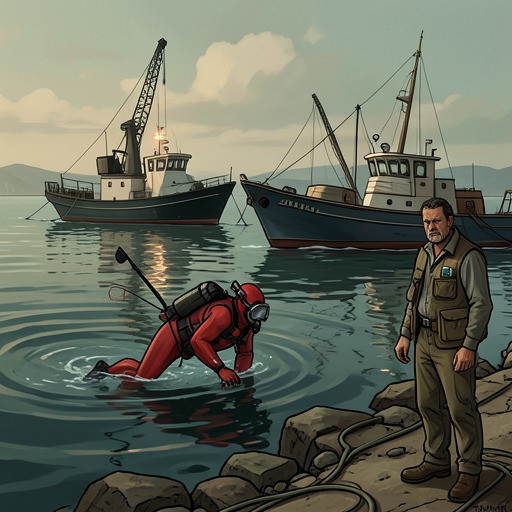
When Abel Jackson and Dora Jackson find Costello’s boat at Robbers Head, its deck holds large piles of dead or dying fish, including many undersized ones, alongside crates of live abalone and illegal crayfish. Abel Jackson begins emptying the abalone crates back into the water, hoping some may survive. He then sees divers working among the reef with spearguns, and Blueback approaches them. A spear misses the fish and strikes rock; Blueback retreats with a sore head. The episode shows the inadequacy of relying on goodwill alone: a warning has not prevented damage, and the reef itself bears the pressure of commercial activity.
The intervention that follows combines immediate action with enforcement. Abel Jackson and Dora Jackson wait ashore, and the Fisheries patrol boat eventually arrives, boards Costello’s boat, and tows it away. Costello’s fines cost him his licence. The episode does not make the outcome complete or effortless: some abalone have been returned, but some are dead, and Blueback keeps away from Dora Jackson for the rest of the summer. Still, the patrol’s arrival demonstrates how public authority can turn environmental concern into enforceable limits where the family could not act alone.
Damage, memory, and the case for change
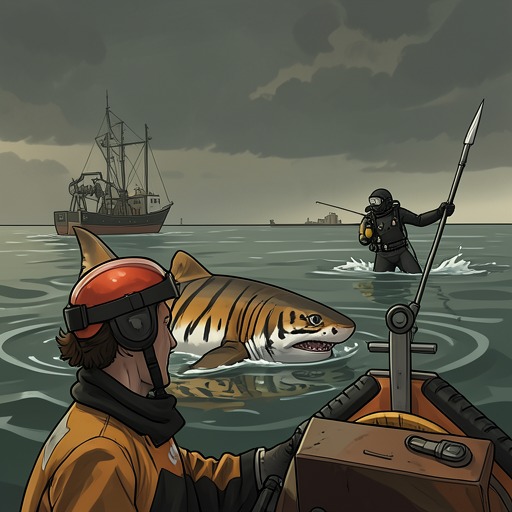
The Costello episode also connects the condition of the reef to consequences beyond the immediate catch. After the business at Robbers Head, a tiger shark enters the bay towing a red buoy attached by a chain to a meat hook in its jaws. The shark is weak and starving; the buoy prevents it from diving, and Abel Jackson cannot save it. After it dies, he finds the name COSTELLO stencilled on the buoy. He takes the shark’s body out to sea, replaces the buoy with lead weights, and cuts it free. The scene links a named commercial operator to an animal suffering from fishing gear, and changes Abel Jackson’s understanding: he recognizes the cruelty that human greed can produce. Conservation here is not only about preserving a marketable stock or a celebrated fish; it also concerns the lives damaged by methods of extraction.
The novel widens its account of risk beyond single acts. In later years, Dora Jackson sees seasons marked by unsettling changes: a leopard seal arrives from Antarctica, salmon fail to appear one year, and five dead dolphins are found snagged in the cliffs at Robbers Head. Weather grows more fierce and erratic. A tanker breaks in two off the coast while Abel Jackson is overseas; its oil slick burns and disperses in foul weather before any oil reaches shore. The disaster is narrowly averted, not harmless: Abel Jackson understands how close the coast came to catastrophe, and Dora Jackson calls it a warning. The story places visible incidents beside gradual strain, showing why waiting for a catastrophe to reach land would be an inadequate measure of the bay’s vulnerability.
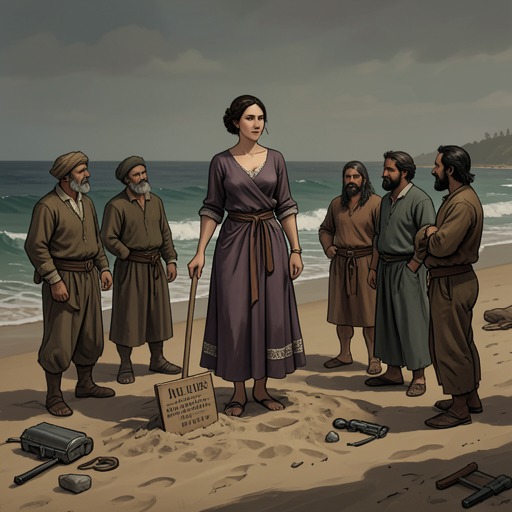
A storm eventually exposes the history beneath the beach. After it tears at the coast, Dora Jackson finds thousands of whale bones uncovered along Longboat Bay, where they had lain under the sand for a century or more. She has walked over them for decades without knowing they were there. Their sudden appearance makes environmental history material: the landscape holds evidence of exploitation that ordinary familiarity had concealed. Sitting among the bones, Dora Jackson understands the family’s inheritance differently. Generations had lived from the sea; with only her and Abel Jackson left, she concludes that their responsibility must now include helping the sea live.
From local knowledge to legal protection
Dora Jackson turns that recognition into persistent public work. From the wreckage of her house, she writes hundreds of letters to politicians, businesspeople, and scientists. Many ignore her, so she continues writing month after month. She also sends newspaper editors photographs of Blueback, using the fish’s recognizable face to draw attention to what is at stake in the bay. Her campaign transforms a local attachment into an argument that has to travel beyond Longboat Bay and reach people with the power to change its legal status.
The case for protection is also shaped by pressures on the bay’s access and use. Boats bring divers who want to swim with Blueback, sometimes in large numbers, and some visitors spear fish in groups. Abel Jackson and Stella travel for work and cannot return often, while Dora Jackson struggles to manage the property alone. The sanctuary campaign is therefore not simply a response to one diver or one incident. It addresses a shared area under repeated pressure, where the protection of a particular fish cannot be separated from the protection of the reef and the wider bay.
The decisive change comes when Longboat Bay is declared a sanctuary, with the life growing and swimming there protected by law. Dora Jackson lives to see officials mark the reserve’s boundaries with buoys; it extends out to Robbers Head. She points out the officials who had once been businesspeople seeking to build hotels in the area. The result makes a difference between private concern and public protection: the bay’s limits are now marked and backed by law, rather than depending solely on Dora Jackson’s warnings or Abel Jackson’s actions. Dora Jackson hopes for other havens along the coast, but regards this protection as a meaningful beginning.
Recovery and the limits of mastery
After the sanctuary is established, the novel describes recovery at several connected scales. Fish enter the protected bay, breed there, and contribute to stocks beyond its boundaries. Seagrass, coral, and sponges thrive; abalone multiply; dolphins and sharks return, and sea lions come back to Robbers Head after a hundred-year absence. These details present the sanctuary as more than a line on a map: protection gives marine life room to reproduce, and the benefit extends beyond the refuge itself. Abel Jackson and Stella later write papers on abalone breeding and take visitors to see Blueback, joining continued observation and research to the practical work of overseeing the bay.
Yet conservation does not conclude with the claim that people have solved the sea. Abel Jackson and Stella continue to watch, listen, and read, but never discover its secret. Abel Jackson believes his mother and father knew much, and imagines that Mad Macka may have understood something too, while accepting that knowledge remains incomplete. His final practice is restraint: he lets the sea remain itself. In this way the novel joins legal protection to humility. Rules can limit destructive use, and a refuge can support recovery, but stewardship also requires accepting that the ocean has its own life and exceeds any person’s ability to possess or fully explain it.