Place-based knowledge
BluebackPlace-based knowledge in the novel is not simply information about a landscape; it is a way of knowing formed by living within its rhythms and dependencies. At Longboat Bay, Dora Jackson learns by working, watching, and listening, while her son Abel Jackson first experiences the same knowledge bodily, underwater. His later scientific training gives him new methods, but the story’s decisive conservation insight comes from his recognition that his mother’s long familiarity with the bay lets her understand and defend it in ways that distance cannot replace.
Learning the Bay Through the Body
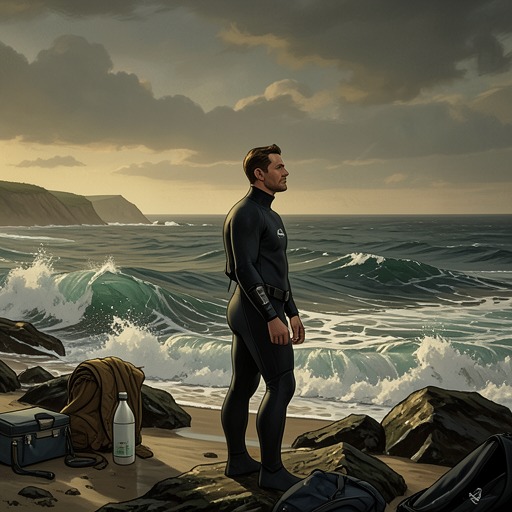
Abel’s early knowledge begins with repeated immersion. At ten, he cannot remember a time when he could not dive, and his mother says he was a diver even before birth, floating in the ocean within her. Everything he knows on land or under the sea, he has learned from her. In the opening dive, the sea is not a blank setting: Abel passes boulders, dark cracks, trembling seaweed, starfish, and coral while following Dora down toward the abalone beds. The details he notices belong to a familiar working environment, not a distant spectacle.
The work itself teaches limits and relations. Abel and Dora pry abalone from granite with screwdrivers, but they do not strip each clump: they take a couple and leave the rest to breed and grow. As they move along the bottom and surface for air, reef fish feed on meat fragments and stirred sediment. Knowledge here is practical and ecological at once. It includes how to gather food, how long a breath lasts, and how extraction affects the living community around it. The repeated descent and return to the surface makes bodily constraint part of what can be known: the sea is encountered through finite breath, pressure, movement, and attention.
Attachment, Memory, and Distance
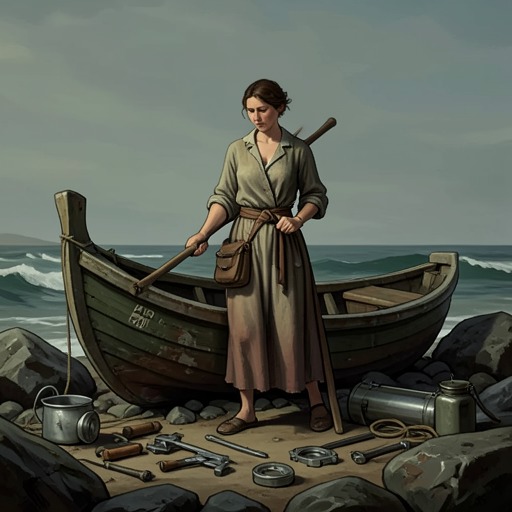
For Dora, knowing the bay is inseparable from belonging to it. When Abel worries that she might be lonely, she explains that the place is a kind of friend; Longboat Bay holds her memories, including those of Abel’s father. She returns to the peppermint tree she uses as a shrine, where Abel too leaves a piece of coral among other objects. The gesture connects intimate memory to the local landscape: the coast is at once home, livelihood, and the setting in which family history remains present.
Abel’s departure makes that connection visible by contrast. On his last morning, rough seas keep him from swimming with Blueback; after chopping wood, he looks down from the ridge at the bay and sees the house and its surroundings as his whole life. At the peppermint tree he leaves coral for his father, then leaves with his mother. Inland, the flat wheat country, removed trees, crowded school, and noisy hostel make him feel hemmed in. He works and makes friends, but home continues to throb in him. In sleep, he returns to Blueback and descends into a crevice where he sees drowned people, including Mad Macka and Abel’s father. The dream cannot restore his father to him: Blueback leads him upward and keeps the boy from reaching the body. The coast remains a place of attachment and loss, not merely a landscape that can be carried elsewhere.
Reading Change Without Claiming Certainty
Dora’s familiarity with Longboat Bay gives her a basis for recognizing when its conditions seem wrong. After the pilchards die en masse without storm, warning, oil spill, or explanation, she identifies the event as abnormal. Abel helps spread the dead fish over the orchard and gardens; later, he dives along the point and out to Robbers Head. The abalone have recovered, fish move in healthy schools, and kelp and coral appear alive. This apparently ordinary underwater visit does not resolve the mystery. Instead, the difference between what Abel sees in the bay and what has happened along the coast sharpens his sense that the sea may be changing beyond the reach of a single observation.
He wonders whether Blueback, old enough perhaps to have known Dora as a girl, might have witnessed his parents swimming together or seen his father dive at Robbers Head. These are questions and possibilities, not recovered facts. The fish becomes a figure for knowledge accumulated over a lifespan longer than Abel’s, while the sea’s history remains only partly available to human understanding. When tuna skippers later report dead pilchards along the coast, Dora again recognizes a wider disturbance. Abel, confronted with the mystery, decides he wants to figure out the sea.
The near-disaster of an oil tanker cracking in two offshore further shows how local knowledge is formed through exposure to risk as well as routine. Abel watches the slick spread on television from far away, then sees the ship catch fire and the slick burn and break apart in foul weather. No oil reaches the shore, but he understands how close the coast came to disaster. Dora calls it a warning. Her response does not supply a technical explanation; it registers the event as a threat to a place whose vulnerability she knows through long residence.
Local Knowledge and Scientific Work
Abel leaves Longboat Bay to study the sea at university. He uses computer modelling, books, specimens, photographs, and films, and joins field trips to unfamiliar islands, boats, and beaches. He travels with Stella to coral atolls, polluted estuaries, and other oceans. These experiences extend his knowledge, but they do not erase the difference between studying marine environments and belonging to one particular coast. On the plane home after learning that Longboat Bay has been declared a sanctuary, he tells Stella that he has studied, lectured, and become a prominent scientist, yet Dora is the one who understands the bay. She has learned by staying, watching, listening, and feeling its conditions; she is part of the place.
The comparison does not make formal science useless. Abel’s education and work are real parts of his life, and he and Stella continue as scientists after returning. Rather, the novel places scientific methods beside an intimate, accumulated knowledge that cannot be obtained solely through travel, models, or credentials. Abel’s childhood wish to understand what Blueback thinks and to learn the language of the sea marks the boundary of his ambition: knowledge is not simply a collection of facts, and the sea may not yield its meaning in human words. Dora’s way of knowing is attentive without claiming complete mastery.
Stewardship, Return, and Inheritance
Dora’s defense of Longboat Bay turns local attachment into action. When businessmen try to buy her property, she refuses despite their gifts and offers of money. Their later pressure takes material forms: neglected road maintenance, delayed or damaged mail, contaminated fuel, and mysterious winter bushfires. Abel, away at school, understands that they fail to see the bay as more than property. To Dora it is a life and a friend, bound to the sea, the bush, her home, and her husband’s memory. She outlasts the businessmen, and years later her sustained campaign helps secure the bay’s protection by law.
Abel’s eventual choice to stay gives this knowledge an intergenerational future. When Dora’s broken hip makes clear that she can no longer remain alone indefinitely, he repairs the family place and brings her home. He leaves his foundation work with Stella, acknowledging that the difficult coastal life is the life he wants. After Dora’s death, he remains at Longboat Bay. Fish gather in the protected waters; seagrass, coral, and sponges thrive, abalone multiply, and sea lions return to Robbers Head after a century away. These changes give visible consequence to the sanctuary, while also showing the bay’s life as more than a human possession.
Abel and Stella continue to study and observe, but they never discover the sea’s secret. Abel comes to think that Dora knew much of what could be known through her life there, as his father had before her, and that Mad Macka may have understood something too. The conclusion preserves a limit rather than turning local experience into omniscience: attentive knowledge can guide care, but it cannot exhaust the ocean. Abel’s decision to let the sea be itself is therefore the final expression of place-based knowledge—not withdrawal from responsibility, but a form of stewardship grounded in listening, staying, and accepting what remains unknown.