Intergenerational memory and inheritance
BluebackIntergenerational memory and inheritance in the novel are not confined to what one generation tells the next. They are held in Longboat Bay’s land and water, in family objects and rituals, and in the work through which Abel Jackson and Dora Jackson make a life there. The family’s past includes loss and the exploitation of marine life; its inheritance becomes a choice about what obligations the living owe to the sea and to those who will follow them.
Family Memory Held in Place
For generations, Abel Jackson’s family has lived from the sea and the land at Longboat Bay. Their property dates from the era of whaling, and the surrounding land is national park. The family cemetery lies where orchard gives way to bush and forest. Its white crosses and headstones mark generations who lived and died there, but one cross commemorates Abel’s father without a body beneath it. The landscape is both home and a record of absences.
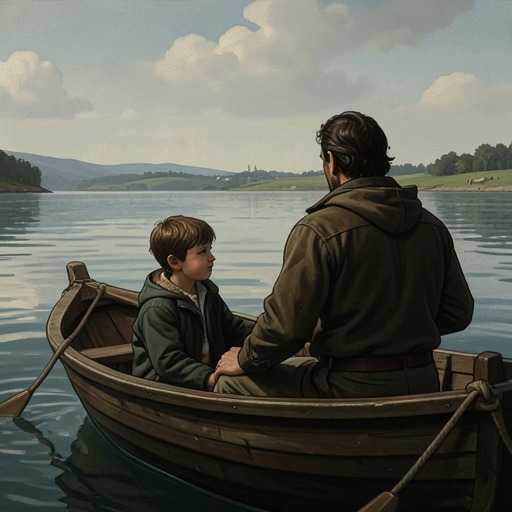
Abel grows up in this continuity without knowing every part of its history. His father died when Abel was two, so he has little direct memory of him. Instead, the bay, garden, and house seem to carry his father’s presence. Abel recognizes him in Dora’s practical way with boats and motors and in her working hands. For Abel, inheritance begins as resemblance and atmosphere: a past he cannot remember personally, but encounters in the place and person closest to him.
Dora’s mourning gives that inheritance tangible forms. Near the orchard, she keeps a candle, pearl shells, and a driftwood dolphin carved by Abel at an old peppermint tree. She sometimes remains there for hours, remembering and crying. The objects do not resolve her loss; they give memory a place and a repeated practice. The tree becomes a private memorial that Abel can visit too, as he later leaves a piece of white coral in its fork before departing for school inland.
Loss, Stories, and What Cannot Be Recovered
Abel learns that his father was a pearl diver who went north each year for the pearling season. Though he said he would not return to the work, he went back; one year a tiger shark took him. The crew pulled in his air hose and found no one at its end. His fins were recovered from the murky bottom of Roebuck Bay, but his body was never found. The family can preserve what happened and mark the loss, but cannot complete it with a burial or a recovered body.
That gap returns in Abel’s dreams while he is away from home. In one, Blueback leads him into a deep crevice among drowned sailors and other dead people, then to Mad Macka beside the body of Abel’s father. Abel sees his father as a young man who will always be thirty-two, and tries to reach him; Blueback draws him upward, away from the body. The dream gives shape to Abel’s longing, but not access to the father he wants to bring back. Memory can approach the dead without undoing death.
The living sea also becomes a possible keeper of family knowledge. Abel wonders whether Blueback, old enough to have known Dora as a girl, might have seen Dora and Abel’s father together when they were young. He imagines that the fish could tell him about his parents and about his father’s connection to the water. When Dora tells Abel that he resembles his father, he initially rejects the idea, then recognizes the likeness in the photograph on the mantelpiece. Family inheritance thus passes through accounts, images, and resemblance, while important parts of the past remain beyond anyone’s certainty.
The Coast’s Material History
The whales Dora and Abel encounter offshore connect the family’s memories to a history larger than their household. Dora tells Abel that the Jacksons came to the area as whalers: lookouts watched from the ridge, and crews rowed out in longboats to harpoon passing pods. The two stop fishing to watch the right whales. Dora acknowledges that she has felt troubled by the family’s role, although the hunting took place before her time; she also sees the history of the sea as bound up with the losses suffered by her family. Abel, thinking of the crosses behind the orchard, links the visible whales to the family dead.
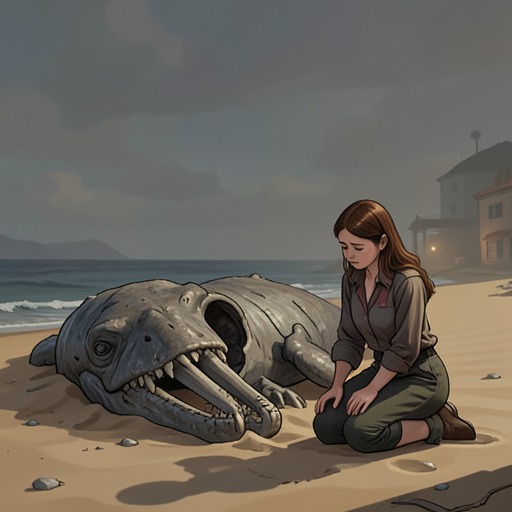
That past becomes materially present after a fierce storm exposes thousands of whale bones along Longboat Bay. Dora recognizes that they have lain beneath the sand for a century or more, though she has walked over them for forty years without knowing they were there. The bones make the family’s history impossible to keep at a distance: they are remains of the whaling that brought the family to the coast and helped pay for its land. Dora understands that the family’s inheritance is not only a home and a livelihood. It also includes the consequences of how earlier generations used the sea.
The discovery changes the direction of that inheritance. With generations of the family gone and only Dora and Abel remaining, she decides that it is time to help the sea live and to protect the bay. She writes hundreds of letters to politicians, business leaders, and scientists, and sends photographs of Blueback to newspaper editors. Her campaign eventually helps secure Longboat Bay’s status as a legally protected marine sanctuary. The bay that supported the family across generations becomes a place the family works to protect for those beyond it.
Leaving, Returning, and Choosing a Home
Abel’s time away tests whether belonging can survive separation. Before leaving for school inland, he looks down on the bay and recognizes the house, orchard, and surrounding land as his whole life. The town feels crowded and enclosed to him, unlike Longboat Bay. In sleep, he returns to the sea and to Blueback; letters and shells from Dora, and a turban shell he listens to beside his bed, help him keep the ocean present in a place far from it.
As an adult, Abel tells Dora that he does not care about money and loves fishing and growing things; the house, land, and water are the life he wants. Dora admits that she, too, cannot bear being inland because Longboat Bay holds her memories and her connection to Abel’s father. Their attachment is not identical: Dora misses Abel when he is away, while Abel is still imagining the future he will choose. But both understand the place as more than property or scenery. It is the setting of their work, their relationships, and the memories that make their lives continuous.
Abel does leave, travelling with Stella for work, and sees an oil tanker break apart off the coast of Longboat Bay from far away. The slick burns and breaks up in bad weather before oil reaches shore, but the near-disaster warns him how vulnerable the coast is. When Dora is injured and can no longer manage the old place alone, Abel returns to care for her and repair the house, jetty, sheds, fences, and orchard. He eventually leaves his work with Stella and chooses to stay. Returning does not restore the past unchanged: Dora grows frail, and the family’s practical responsibilities have shifted. Instead, Abel takes up the work of caring for the place and for his mother.
Memory Passed Forward
The inheritance continues through ordinary shared work and deliberate storytelling. After Dora comes home from hospital, Abel and Stella nurse her on the shady verandah. Later the three mend nets, bottle fruit, and smoke fish, while Abel and Stella keep watch over the bay and write about abalone breeding. Their life joins observation and care to the older routines of fishing and growing food. Dora’s memories, in turn, become stories for the child born at Longboat Bay, named Little Dora after her grandmother.
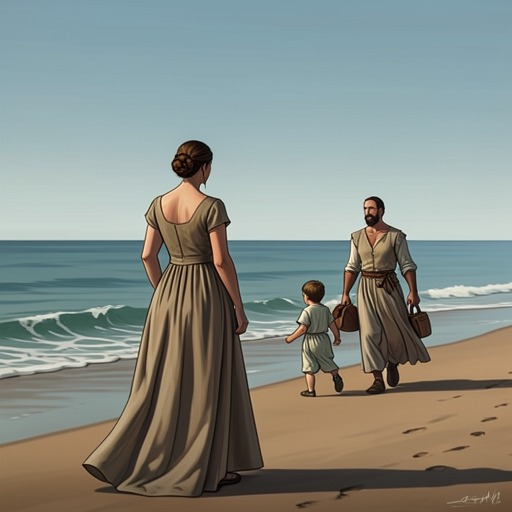
When the older Dora tells Little Dora about Abel’s birth, she describes how Abel’s father wanted their child to meet the sea straight away. They lowered the baby gently into the warm shallows; he stiffened briefly, then kicked as if ready to swim away, and cried when they carried him back to the house. The story makes Abel’s lifelong relation to the water part of family memory, linking his father’s wish to the child Abel became and, through the telling, to his own daughter.
The day before Dora dies, Abel carries her to the shore and holds her floating in the clear, still water. Her words connect human life and belonging to water; a large blue shadow swims around them. The next afternoon she dies in her sleep, and Abel makes a new cross for the family cemetery. The scene joins a final shared experience of the sea to the family’s established way of marking the dead, while leaving the water beyond any family’s possession.
Abel stays at Longboat Bay and sees the sanctuary’s life flourish. Fish breed there and contribute to stocks beyond the bay; seagrass, coral, and sponges thrive, abalone multiply, and sea lions return to Robbers Head after a century away. Abel and Stella continue their work as scientists, but they never discover the sea’s full secret. Instead, Abel accepts that knowledge passes across generations without becoming complete. The inheritance he gives Little Dora is therefore both intimate and practical: family stories, a home by the water, and a protected bay where the next generation can meet the living sea.