Postwar period
BluebeardThe Postwar period in Rabo Karabekian’s recollections is both an age of promised miracles and the setting for their failure. After serving in a wartime camouflage unit and losing his left eye in Luxembourg, he returns to civilian life expecting neither a heroic homecoming nor an easy artistic future. The period’s confidence in technological progress becomes painfully personal when the acrylic wall paint Sateen Dura-Luxe destroys his paintings; the same historical moment that advertises a brighter future leaves him with blank canvases and a changed life.
Demobilization and the return to civilian life
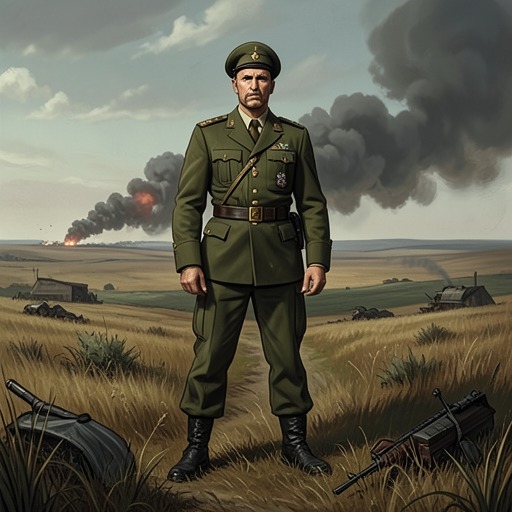
During World War II, Karabekian commands a platoon of Army Engineers who are artists in civilian life and specialists in camouflage. Near the war’s end, the unit is sent into combat as ordinary infantry. In Luxembourg, Karabekian is captured and loses his left eye. His wound heals quickly, and he is sent to a prisoner-of-war camp; after the war, the United States pays for cosmetic surgery at Fort Benjamin Harrison outside Indianapolis. The military experience gives way to a civilian world that offers compensation for his injury but cannot restore the wartime community or give him a clear purpose.
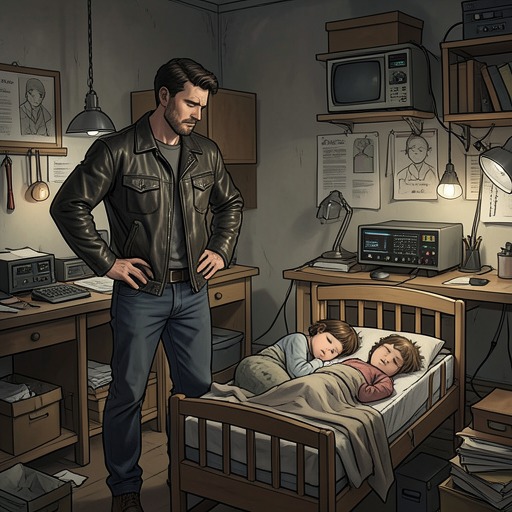
The contrast between wartime service and postwar life is especially sharp in Karabekian’s account of coming home. He describes himself as blank rather than bitter, and says that neither he nor his close friend Fred Jones had anything to return to. He marries Dorothy, his nurse, and they have two sons, Henri and Terry. His later recollections connect the difficulties of postwar adjustment to the intimate losses of family life: Dorothy and the boys leave him, and the sons eventually take their stepfather Roy Steel’s surname. Karabekian identifies his failure as a husband and the resulting estrangement from his sons as a lasting source of shame.
An age of promised miracles
Karabekian presents the postwar years as a period saturated with claims that new inventions will overcome old limits. Instant coffee, DDT, nuclear energy, antibiotics, improved fibers, new breakfast foods, and the prospect of a helicopter for every family all belong to this catalogue of promised transformation. In his retrospective account, such confidence follows a war imagined as a final struggle between good and evil: miracles seem like the fitting reward, and technological advances are advertised as remedies for scarcity, disease, and even future war.
The language of universal progress reaches its most pointed form in the advertising for Sateen Dura-Luxe, whose colors were said to outlive the Mona Lisa’s smile. Karabekian’s irony depends on the gap between that boast and what follows: the Mona Lisa continues to smile, but the paint becomes obsolete, and dealers laugh when asked for it. The failed product is not simply an unfortunate material. It embodies the instability beneath the era’s assurances that innovation can make its benefits permanent.
The destruction of Karabekian’s paintings
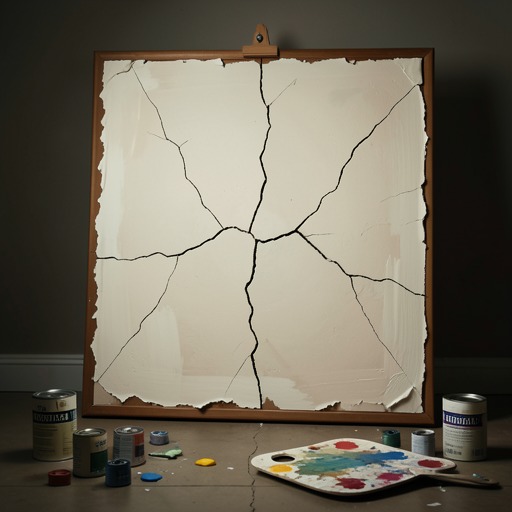
In the early 1960s, unforeseen chemical reactions between the sizing of Karabekian’s canvases and the acrylic wall paint and colored tapes he had applied cause his paintings to destroy themselves. Works for which buyers had paid fifteen, twenty, or even thirty thousand dollars leave blank canvases behind, with the colored tape curled on the floor and debris that resembles moldy cereal. The loss overturns the promise built into the paint’s advertising: a material sold as enduring instead removes the work it was meant to preserve.
Karabekian calls this a postwar miracle that wrecked him, and uses the wartime acronym FUBAR—short for a condition of extreme disorder—to describe a planet overwhelmed by its own postwar miracles. The collision between technological optimism and material failure turns his career into a concentrated example of the period’s broader contradiction. The paintings’ destruction is also a personal reversal: after he had given up art and later returned to it, the new medium on which he relied undoes the work itself.
Memory, work, and the aftermath
Karabekian arranges his past as a series of imaginary galleries. One contains the European pictures he bought during the war for a few dollars or for chocolate bars and nylon stockings; another holds his Abstract Expressionist paintings, imagined as resurrected for Judgment Day. Elsewhere in the sequence are the advertisements he illustrated before joining the Army, the magazine illustrations of Dan Gregory, and the works of his boyhood. This gallery-like structure places postwar artistic failure among several earlier versions of his life rather than isolating it as a single accident.
After the war, Karabekian sells his wartime possessions and uses the proceeds to invest in the stock market. He abandons his boyhood ambition to become an artist, studies accounting, economics, business law, and marketing at New York University, and imagines becoming a businessman. He reasons that a camera can reproduce the likenesses he and Dan Gregory could make, while modern art movements have sought pictures that cameras cannot duplicate. His conclusion that he is too ordinary to make serious art brings relief at the time, but the destruction of his later paintings gives that decision a different weight in retrospect.
The period’s legacy persists well beyond the failed paint. After Edith dies, Karabekian says he is lonely; he recalls years of loneliness as a boy, in New York City during the Great Depression, and after Dorothy and their sons left in 1956. He spends eight years as a hermit after giving up on himself as a painter. In the novel’s backward-looking account, postwar history is therefore not just a sequence of inventions or a date range: it connects military injury, a retreat from art, technological failure, and the family and social isolation that continue to shape Karabekian’s later life.